


© IE Online Media Services Pvt Ltd
Tags:


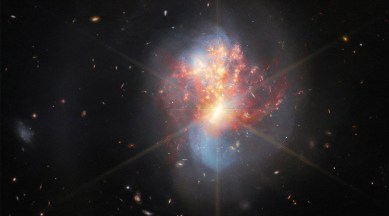
The European Space Agency (ESA) recently released an image taken by the James Webb Space Telescope, showing two galaxies plunging into one another in a galactic merger. The galactic merger is named IC 1623 and lies around 270 million light-years away from us in the constellation Cetus.
By colliding into each other, these two galaxies have triggered a deluge of star formation that is known as a starburst. This starburst is forming new stars at a rate that is twenty times higher than that of the Milky Way galaxy.


Telescopes like Hubble were not able to reveal these details because of the thick band of dust blocking the phenomenon. Webb, on the other hand, is particularly suited to investigating such cosmic objects because of its infrared sensitivity and much better resolution at those wavelengths. This allowed it to see past the dust and capture this image.
The astronomers captured IC 1623 across infrared portions of light using Webb’s MIRI, NIRSpec and NIRCam instruments. By using this trio, they were able to gain “an abundance of data that will allow the astronomical community at large to fully explore how Webb’s unprecedented capabilities will help to unravel the complex interactions in galactic ecosystems,” according to the ESA.


