3 min read
© IE Online Media Services Pvt Ltd



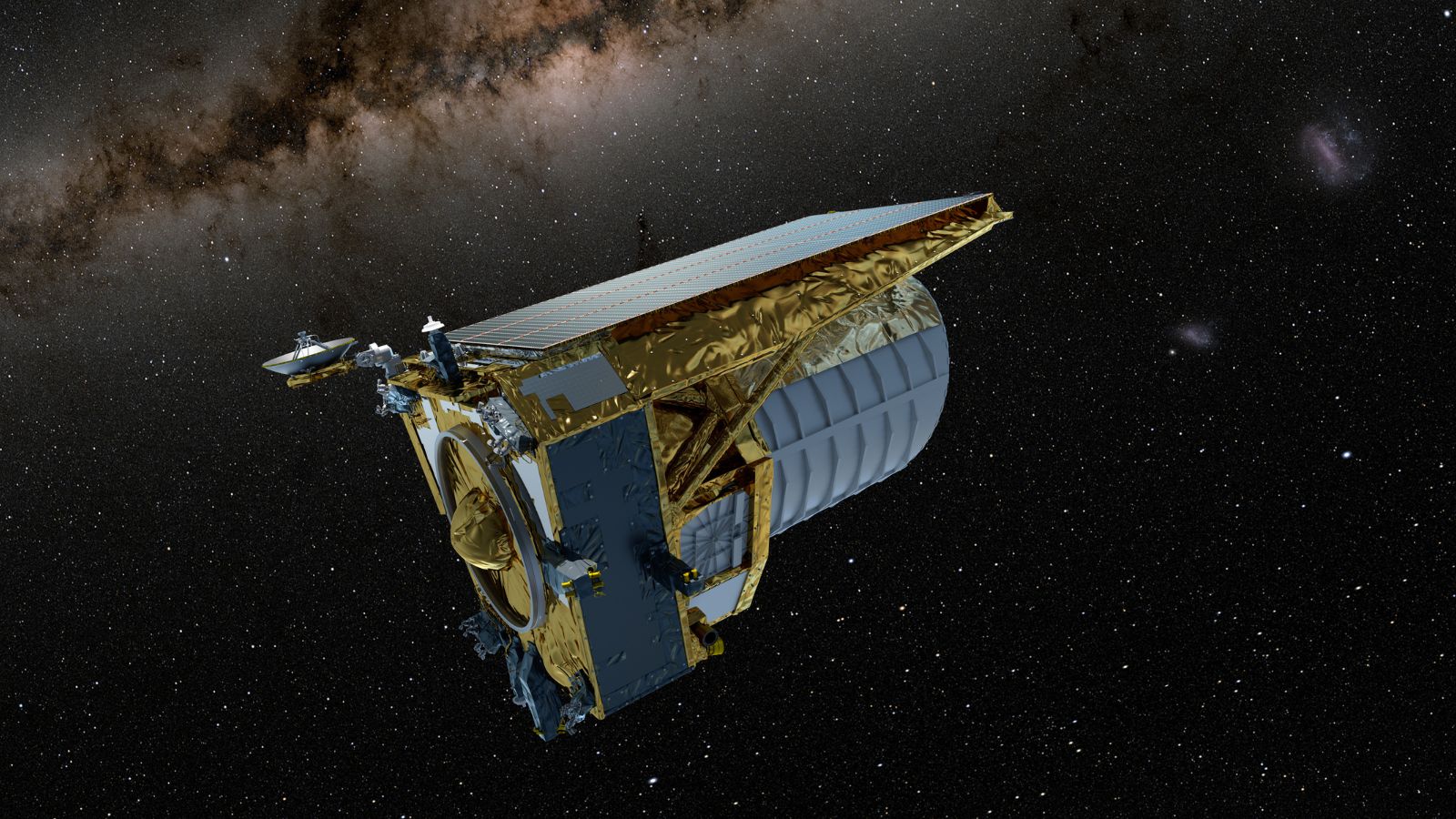 Artistic illustration of the Euclid satellite in space. (ESA)
The European Space Agency on Tuesday said that a few layers of water ice is starting to impact its Euclid spacecraft’s vision. The space agency is now working with others to test a newly-designed procedure to de-ice the spacecraft.
Euclid is ESA’s “dark universe detective” and is designed to investigate how dark matter and dark energy made the universe what it is. About 95 per cent of the known universe seems to be made of these enigmas that we know little about.
The layers of ice covering Euclid’s optics are the same width as a strand of DNA, but it is already impacting the spacecraft’s vision. This is a potential problem for the highly sensitive mission that requires a lot of precision to investigate the nature of the dark universe. If the “deicing” test is successful, it will give the Euclid team a new plan to keep the spacecraft’s optical systems as ice-free as possible for the rest of its life.
Euclid’s problem is fairly common for spacecraft once they get into space. The water absorbed from the air during assembly on our planet is slowly being released by certain components of the spacecraft, because of the vacuum of the space. Add to that the freezing cold of the spacecraft’s environment and these water molecules will stick to the first surface they land on. The problem is that the water landed on the highly-sensitive optics.
“We compared the starlight coming in through the VIS instrument with the recorded brightness of the same stars at earlier times, seen by both Euclid and ESA’s Gaia mission. Some stars in the Universe vary in their luminosity, but the majority are stable for many millions of years. So, when our instruments detected a faint, gradual decline in photons coming in, we knew it wasn’t them – it was us,” said Mischa Schirmer, calibration scientist for the Euclid consortium and one of the main designers of the new de-icing plan, in a press statement.
For most spacecraft, it would be enough to use in-built heaters to slightly raise the temperature of the entire spacecraft, which could clean the optics. But materials expand with heat, and they don’t always return to the exact same state after cooling. This is a problem for a highly sensitive mission.
To limit the possibility of such thermal changes affecting its sensitivity, the Euclid team will individually heating low-risk parts of the spacecraft gradually before they get the intended results.