5 min read
© IE Online Media Services Pvt Ltd



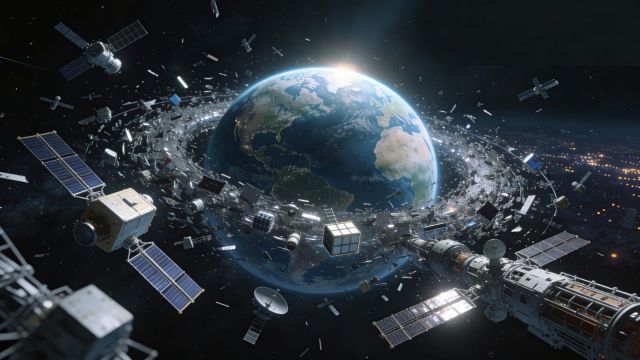 The orbital environment has changed dramatically recently. By 2024, more than 14,000 satellites were circling Earth, with megaconstellations accounting for the majority. SpaceX’s Starlink network alone had placed 8,811 satellites in orbit by October 2025. (Image for representation: AI generated)
Scientists warn that Earth may have only a narrow window of less than three days to avert a cascading satellite disaster if a powerful solar storm disrupts spacecraft operations in low Earth orbit. A single significant collision could trigger a chain reaction of debris, resulting in an orbit congested with junk and rendering the area unusable for future space activities for decades.
The concern stems from a new study examining the growing congestion caused by megaconstellations of satellites and how vulnerable that environment has become to sudden, system-wide failures.
At the heart of the warning is the long-feared Kessler syndrome, a scenario first proposed in 1978 in which a single collision in orbit triggers a chain reaction of debris strikes. In such a situation, fragments from one destroyed satellite can collide with other satellites, generating additional debris and rendering entire orbital regions hazardous or unusable.
While once considered a distant possibility, researchers now suggest the risk has moved uncomfortably close to the present. This new study was published on arXiv, a free, open-access repository for electronic preprints in physics, mathematics, and computer science, on December 10.
The orbital environment has changed dramatically in recent years. By 2024, more than 14,000 satellites were circling Earth, with megaconstellations accounting for the majority. SpaceX’s Starlink network alone had placed 8,811 satellites in orbit by October 2025.
While these systems provide global connectivity, they also crowd the most heavily used orbital lanes, increasing the chances of close encounters and potential collisions. Past incidents have already highlighted the danger, including a near-miss in 2019 that required evasive action by a European Space Agency satellite.
The team notes, “Our calculations show the CRASH Clock is currently 2.8 days, which suggests there is now little time to recover from a widespread disruptive event, such as a solar storm. This is in stark contrast to the pre-megaconstellation era: in 2018, the CRASH Clock was 121 days.”
In the new, yet-to-be-peer-reviewed paper, researchers sought to quantify just how much time satellite operators would have to respond if collision-avoidance systems failed. One major threat is solar storms, which can disrupt satellite electronics, interfere with communications, and degrade the tracking systems that allow operators to precisely locate spacecraft.
To capture this growing risk, the team introduced a new measure called the CRASH Clock, short for Collision Realisation and Significant Harm. Rather than predicting a full-blown Kessler syndrome, the clock estimates how long it would take for a catastrophic collision to occur if satellites suddenly lost the ability to perform avoidance manoeuvres or if situational awareness collapsed.
Their findings are stark. According to the simulations, the CRASH Clock now stands at just 2.8 days. In practical terms, that suggests humanity would have less than three days to restore control after a widespread disruption, such as a severe solar storm, before the probability of a major collision becomes dangerously high. This represents a dramatic shift from the pre-megaconstellation era; in 2018, the same clock would have read 121 days.
The researchers explain that although satellites occupy a tiny fraction of the vast volume around Earth, they orbit the planet roughly every 90 minutes. This rapid movement means that satellites repeatedly cross each other’s paths, making constant collision-avoidance manoeuvres essential in today’s crowded orbital shells. The study argues that the absence of a recent major satellite-to-satellite collision is largely due to the continuous and precise execution of these manoeuvres.
Also Read: Elon Musk’s Starlink approved for India: Check expected prices, plans and rollout schedule
If those capabilities were suddenly lost, the consequences could escalate quickly. The paper estimates that within 24 hours of avoidance systems shutting down, there would be a 30 per cent chance of a collision between two tracked objects, and a 26 per cent chance of a collision involving a Starlink satellite. Any such impact would likely generate large amounts of debris, increasing the risk of secondary and even tertiary collisions in nearby orbits.
While the researchers stress that a full Kessler syndrome would take decades or centuries to unfold, they caution that even a single major collision could have serious repercussions. Satellite services could continue, but under riskier conditions, with altered operating rules and a heightened chance of further damage. The situation, they suggest, would resemble an environmental disaster more like a massive oil spill than an instant, cinematic shutdown of space operations.
The study underscores how dependent modern society has become on flawless satellite performance. Navigation, communications, weather forecasting, and countless other services rely on spacecraft functioning without error. As megaconstellations continue to expand, the authors argue that better tools are urgently needed to measure and manage stress in Earth’s orbital environment, before a solar storm or system failure turns a crowded sky into a long-term hazard.