


© IE Online Media Services Pvt Ltd
Tags:


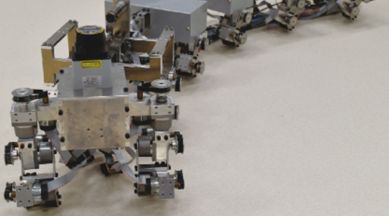
Researchers at Osaka University in Japan have developed a new centipede-like robot. This robot design could be used in search and rescue operations and even space exploration in the future, according to the university. Watch a video of the robot in action below.
Many different kinds of animals on our planet have evolved a movement system that uses legs, allowing them to move over a wide range of environments without much difficulty. Engineers attempting to replicate some of these movement approaches are often met with disappointment as they find that legged robots are surprisingly fragile.


To solve these problems, the Osaka University researchers developed a “myriapod” robot that makes use of a natural instability to make the robot move. This robot has been described in a study published in Soft Robotics earlier this month.
The robot has six segments, with each segment having two legs connected to it, and flexible joints. The flexibility of these jounts can be modified using a motors as the robot is in its walking motion. The researchers found that increasing the flexibility led to a scenario called “pitchfork bifurcation,” where straight walking became unstable.
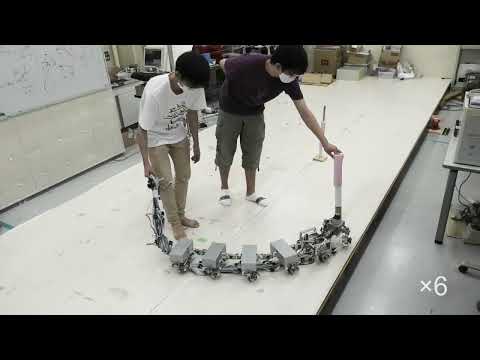
In such a sitation, the robot started walking in a curved pattern, either to the right or to the left. Engineers would normally avoid creating such instabilities. But controlling this instability accurately meant that the researchers could manoeuvre them to go in a straight path or to the left or right, depending on what they wanted.
“We were inspired by the ability of certain extremely agile insects that allows them to control the dynamic instability in their own motion to induce quick movement changes,” said Shinya Aoi, lead author of the research paper, in a press statement.
Using this method, the researchers do not have to directly steer the body axis of the robot, they just have to control its flexibility accurately. This means, according to the researchers, the robot will require much less energy to function while also needing much less computing power to calculate its motion.


