


© IE Online Media Services Pvt Ltd
Tags:


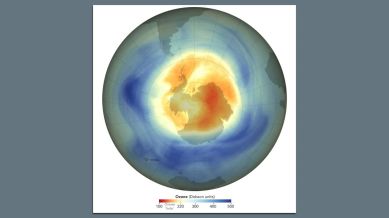
The Antarctic ozone hole, in 2025, was measured as the fifth-smallest since 1992, according to the NOAA-NASA analysis published on November 24. The development confirms that the ongoing controls established by the Montreal Protocol, the international agreement aimed at phasing out ozone-depleting substances, and its amendments have positively influenced the gradual healing of the ozone layer.
The National Oceanic and Atmospheric Administration (NOAA) is an American agency that is responsible for monitoring weather, forecasting, and managing and protecting coastal and marine ecosystems and resources. The National Aeronautics and Space Administration (NASA) provides advanced information on weather and collects critical information about changes happening in the Earth’s atmosphere.

Positioned in the stratosphere at altitudes of 9–22 miles above Earth, the ozone layer is crucial for shielding humans from harmful ultraviolet (UV) radiation, specifically UVB, which is linked to skin cancers and affects marine ecosystems and plant life.
The assessment states that the ozone layer is expected to fully recover by the end of the century, a promising outlook resulting from the global commitment made in 1987 under the Montreal Protocol that has been ratified by all United Nations member states.
Paul Newman, a senior scientist at NASA’s Goddard Space Flight Center, highlighted that the trend indicates ozone holes are generally becoming smaller compared to the early 2000s, forming later in the season and dissipating earlier.
“As predicted, we’re seeing ozone holes trending smaller in area than they were in the early 2000s. They’re forming later in the season and breaking up earlier. But we still have a long way to go before it recovers to 1980s levels,” added Newman, in a statement shared in the NASA-NOAA report.
However, he pointed out that the current ozone hole size could have surpassed one million square miles more if the chlorine levels in the stratosphere had remained as elevated as they were 25 years ago.
The Montreal Protocol was signed in 1987 to preserve the ozone layer by gradually reducing the production and use of ozone-depleting substances (ODS), such as chlorofluorocarbons (CFCs), which are used as refrigerator coolants.
Due to the presence of CFC compounds, there has been substantial ozone depletion over Antarctica. International efforts led to the restriction of production and use of these harmful substances, effectively eliminating their presence from products such as refrigerants and aerosol cans.
Despite the successes, remnants of the banned substances continue to exist in older products like insulation and landfills.
It is noted that as these legacy emissions decrease, projections suggest a recovery of the ozone hole around the late 2060s. Moreover, variations in the ozone hole’s size are influenced by climate factors, with atmospheric scientist Laura Revell pointing out that phenomena like wildfires and volcanic eruptions can lead to increased hole sizes.
Nonetheless, the recent analysis indicates encouraging trends toward ozone recovery, aided by a weaker polar vortex resulting in higher-than-average temperatures in August, linked to the reduced size of this year’s ozone hole.
Stephen Montzka, a senior scientist with NOAA’s Global Monitoring Laboratory, reported a significant decline of approximately one-third in ozone-depleting substances in the Antarctic stratosphere since peaking around the year 2000, relative to pre-ozone-hole levels.
During the recent depletion season from September 7 to October 13, the average area of the ozone hole was recorded at about 7.23 million square miles, which is twice the area of the contiguous US The maximum extent for a single day occurred on September 9, peaking at 8.83 million square miles, a measurement that is about 30% smaller than the largest ozone hole ever documented.
The effectiveness of the Montreal Protocol was emphasised by Revell, an associate professor at the University of Canterbury, who described it as one of the most successful environmental treaties. The treaty facilitated the phase-out of ozone-depleting gases, which also serve as potent greenhouse gases, marking a dual victory for environmental protection. Revell stressed that without the treaty’s enforcement, the ozone layer could have faced catastrophic depletion by the mid-21st century. However, she also warned of emerging threats to ozone recovery, particularly from the rapidly growing space-launch industry, which requires careful monitoring by scientists.


