Reliance JioPhone Next hands-on: The phone for first-time smartphone users
The JioPhone Next is certainly a big deal for millions of Indian users who still use basic feature phones, and it’s clear that this budget smartphone is designed to become a sort of pocket internet device.
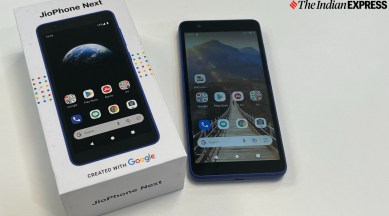
If you are coming from a basic 2G feature phone to a smartphone, the JioPhone Next feels like a big change. (Image credit: Anuj Bhatia/Indian Express)
Recently, I got a call from Jio to experience a phone which it claimed has been designed for first-time smartphone users. When I was using the JioPhone Next, I kept asking myself how a smartphone like this opens a new world for users who have never used a phone beyond text and call. The JioPhone Next is certainly a big deal for millions of Indian users who still use basic feature phones, and it’s clear that this budget smartphone is designed to become a sort of pocket internet device. With a larger screen, built-in apps, and a better camera system that detects an object in front of the camera lens and enables new experiences, this is Jio’s and Google’s vision for a smartphone aimed at the mass market of India.
Here’s a closer look at what it’s like to use a JioPhone Next after a brief hands-on session.
You’ve Read Your Free Stories For Now
Sign up and keep reading more stories that matter to you.
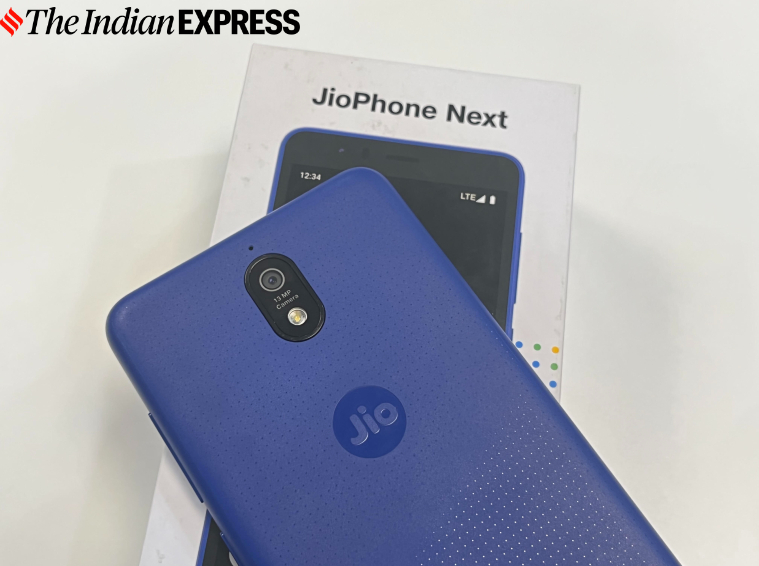
If you are coming from a basic 2G feature phone to a smartphone, the JioPhone Next feels like a big change. Jio has clearly taken some design cues from entry-level Nokia-branded smartphones available on the market. In keeping it simple and straightforward, the design language impresses, with a removable hard plastic back cover and rock-solid build quality. It’s a delight to hold, it looks great and one-handed operation is a breeze. In fact, it’s actually small enough to slip into your pocket or bag.
The front of the JioPhone Next has a larger 5.45-inch screen. Given the handset has a 720 x 1440p resolution I was a bit concerned about how the videos and images look, but I should not have feared: the colours are rich and the panel is bright. A large screen opens a new way to experience content, something you would not be able to experience on a tiny screen of your feature phone. If you look at them from the sides, the phone features a 3.5mm headphone jack on the top, a micro USB charging port on the bottom, along with the volume rocker and power button on the right-hand side. It has every trait one would expect from a fully-backed smartphone.
In keeping it simple and straightforward, the design language impresses, with a removable hard plastic back cover and rock-solid build quality. (Image credit: Anuj Bhatia/Indian Express)
JioPhone Next hands-on: Hardware and performance
Underneath the hood of the JioPhone Next is a quad-core Qualcomm Snapdragon 215 processor coupled with 2GB of RAM. From what I have observed in my short hands-on time with the JioPhone Next, the hardware manages to deliver fine performance with basic tasks. Navigation and web browsing is fast and smooth and apps load quickly. It may not match phones like the Redmi Note 10 or Samsung Galaxy M32 in terms of performance, but for the basic tasks, I am sure the JioPhone Next will be as good as any other smartphone. I am not expecting this device to run high-demanding games but I am told the JioPhone Next can handle Battlegrounds Mobile India. Given that this phone costs a lot less, that’s a bold claim to make.
That being said, this is not a gaming phone and shouldn’t be treated that way. The phone is being offered with 32GB of internal space, but if that’s not enough, you can expand the internal memory up to 512GB via a microSD card slot. There’s 4G on board for fast connectivity, alongside dual-SIM, Wi-Fi, and Bluetooth v4.1. Just for clarity: an active Jio SIM is needed to get this phone connected to the wireless network but users are free to choose an operator of choice for the second SIM connection. Under the hood, there is a 3500mAh capacity cell that Jio claims will give you 24 hours of power. I won’t be able to back Jio’s claims unless I myself test the phone’s battery life in the real world.
The JioPhone Next is running PragatiOS, which is basically Android 11 (Go Edition) designed specifically for this device. (Image credit: Anuj Bhatia/Indian Express)
JioPhone Next hands-on: Software and camera
On the software side, Google handled the heavy work. The JioPhone Next is running PragatiOS, which is basically Android 11 (Go Edition) designed specifically for this device. Although Jio has kept Android virtually stock, PragatiOS brings the best of the Jio apps and Google apps on a phone. On the surface, the experience is simple and intuitive, but the phone comes preloaded with a handful of third-party apps such as Facebook and WhatsApp. Some would call it bloatware, but Jio says the rationale behind preloading those apps is convenience, so that users get an out-of-the-box experience without the need to find out the essential apps.
Story continues below this ad
Google coming into the picture has a lot of significance, even though a majority of smartphones sold in India run on Android. But in the case of the JioPhone Next, Google wants to be in the center of your connected world. The more you use Google’s products and services, the better it serves up more accurate results.
The JioPhone Next has certain Google features that are included at the OS level. With just a tap of a button on the screen, the “Read Aloud” feature lets Google Assistant read aloud an article to users in their own local language. Meanwhile, a Translate feature allows you to quickly translate the current page into any language of your choosing. In a country with a billion people where local language search is the primary way to access the internet, adding features such as “Read Aloud” and “Translate” right on the phone’s home screen makes a lot of sense.
Which brings us to the camera on the JioPhone Next. No one really expects a great camera on a budget phone and that’s what you get on this device as well. The JioPhone offers a 13MP rear camera and an 8MP front camera. Based on my brief time with the phone, it certainly seems that the JioPhone’s back and front cameras are average but the good thing is that the company did try to make them a lot better by adding a dedicated night mode and Controlling the camera is easy though. There you also find Google Lens, an AI-powered technology that enables you to point your phone at something, such as a bird and then ask Google Assistant what the object you’re pointing at is. It’s a handy feature to have on a phone.
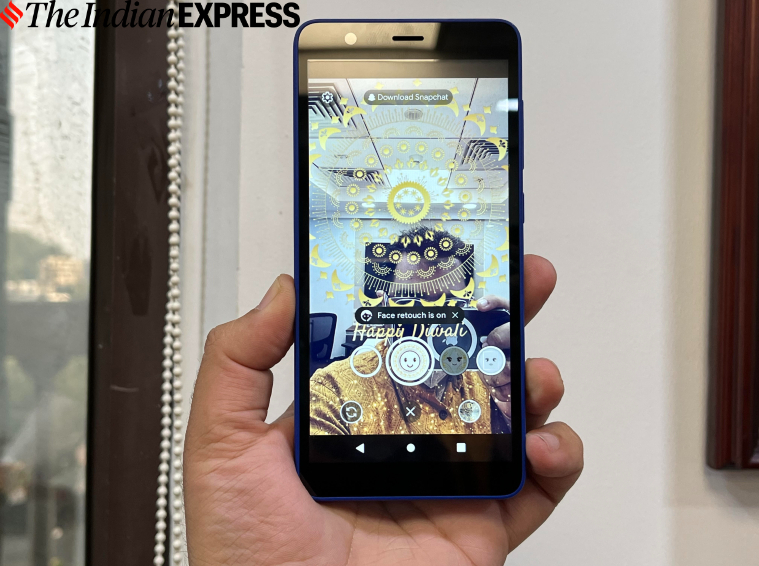
There’s a fun mode in the camera app for Snapchat filters. (Image credit: Anuj Bhatia/Indian Express)
JioPhone Next hands-on: Early impressions
While using the JioPhone Next it reminded me of what an overwhelming feeling it can be for first-timers. For someone like myself who has been exposed to cutting-edge technologies and expensive products, using a simple device like the JioPhone Next offers a different perspective about life and the effort that goes into buying your first smartphone in India. It also gives a deeper insight into how a majority of Indians still need to work hard and spend months on budgeting, financing, and choosing a smartphone that fits in their budget.
Story continues below this ad
JioPhone Next is already available in India. It costs Rs 6,499 ($87), and can also be purchased in multiple installments with an entry price of Rs 1,999 ($27).
Anuj Bhatia is a seasoned personal technology writer at indianexpress.com with a career spanning over a decade. Active in the domain since 2011, he has established himself as a distinct voice in tech journalism, specializing in long-form narratives that bridge the gap between complex innovation and consumer lifestyle.
Experience & Career: Anuj has been a key contributor to The Indian Express since late 2016. Prior to his current tenure, he served as a Senior Tech Writer at My Mobile magazine and held a role as a reviewer and tech writer at Gizbot. His professional trajectory reflects a rigorous commitment to technology reporting, backed by a postgraduate degree from Banaras Hindu University.
Expertise & Focus Areas: Anuj’s reporting covers the spectrum of personal technology, characterized by a unique blend of modern analysis and historical context. His key focus areas include:
Core Technology: Comprehensive coverage of smartphones, personal computers, apps, and lifestyle tech.
Deep-Dive Narratives: Specializes in composing longer-form feature articles and explainers that explore the intersection of history, technology, and popular culture.
Global & Local Scope: Reports extensively on major international product launches from industry titans like Apple and Google, while simultaneously covering the ecosystem of indie and home-grown tech startups.
Niche Interests: A dedicated focus on vintage technology and retro gaming, offering readers a nostalgic yet analytical perspective on the evolution of tech.
Authoritativeness & Trust
Anuj is a trusted voice in the industry, recognized for his ability to de-jargonize trending topics and provide context to rapid technological advancements. His authority is reinforced by his on-ground presence at major international tech conferences and his nuanced approach to product reviews. By balancing coverage of the world's most valuable tech brands with emerging startups, he offers a holistic and objective view of the global technology landscape.
Find all stories by Anuj Bhatia here.
You can find Anuj on Linkedin. ... Read More