


© IE Online Media Services Pvt Ltd
Tags:


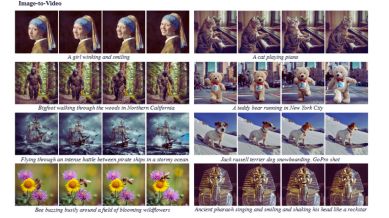
Google just announced its latest AI video model that is capable of creating realistic, diverse, and coherent motion. Known as Lumiere, the latest offering from Google is a text-to-video and image-to-video model. In simple words, you input text or image and the AI neural networks translate it into a video. Based on recent reports, Lumiere is much beyond the simple text-to-video functionality.
The tool allows users to animate existing images, and create videos in the format of an input image or painting. It also allows video in painting and creating specific animation in sections within an image.


The main innovation here is the SpaceTime Diffusion model that generates the entire temporal duration of the video at once. In contrast, existing AI video models synthesize distant key frames one at a time. With Lumiere, Google aims to offer global temporal consistency ensuring coherent representation across different frames.
In the research paper, the capabilities of Lumiere have been demonstrated through various examples. Based on the output, the text-to-video results show some promising consistency and accuracy in portraying diverse scenes. Meanwhile, the image-to-video transformations too seem to show impressive animations. Further, the model’s stylised generation using reference images also produces visually appealing and coherent results.
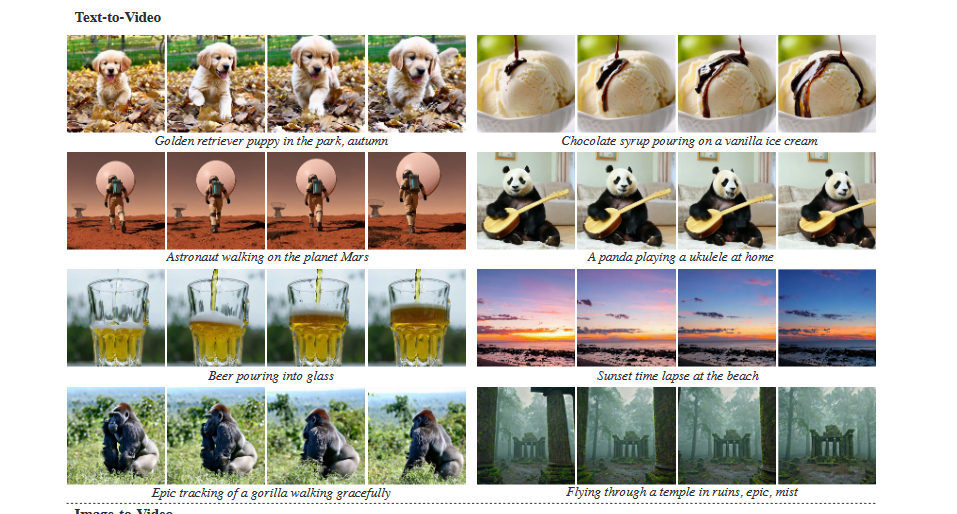
According to the researchers, the text-to-video generation framework has been introduced using a pre-trained text-to-image diffusion. Since existing methods were struggling with globally coherent motion, the team addressed this by deploying a space-time U-Net architecture that directly generates full-frame-rate video clips, incorporating spatial and temporal modules. Resultantly, their approach showed superior results in image-to-video, video inpainting, and stylised generation.
The team in their conclusion acknowledged this limitation and encouraged future research in this direction. Although their model relies on pixel-space T2I models, the design principles can inspire advancements in latent video diffusion models.
In the paper, the team compares the performance of the AI model with other state-of-the-art models in the industry that are known for their superior performance in text-to-video and image-to-video generation. Based on the results, Lumiere seems to outperform in terms of video quality as well as text alignment.
While this model may create a buzz with its incredible capabilities, its potential use case could essentially be enabling individuals to create Hollywood-style slick movies with ease. The AI community has been exploring how these models could generate images and videos and the development of world models for advanced simulations. Lumiere seems to be paving way for more advancements and research. It is a significant leap in AI-driven video synthesis, offering vast creative possibilities. The consistent and realistic results displayed in the examples indicate the potential for transformative advancements in the field of AI-generated content.
In conclusion, the team stated that their primary goal in this work is to enable novice users to generate visual content creatively and flexibly. They admitted that there is a risk of misuse for creating fake or harmful content with this new technology. “We believe that it is crucial to develop and apply tools for detecting biases and malicious use cases to ensure safe and fair use,” read the research paper.
It needs to be noted that as of now, there is no way to access or download Lumiere. However, experts feel that Lumiere will enhance Google Bard’s multimodal capabilities in the future. There is so far no official acknowledgment that the AI model will be integrated into Bard.


