Apurvi Chandela, ranked 6th in the world in 10m air rifle, listens to the song Waving Flag in between shooting matches.
Drumbeats greeted 22-year-old Apurvi Chandela on the day of her Nationals title defense at the Karni Singh shooting range in Delhi earlier this week. Accustomed to sound sanitised surroundings while aiming at the steady targets of the 10m air rifle range, the din wasn’t factored into her mental preparation ahead of her second straight final. But winning her successive national title, topping the qualification with a score of 417 and the finals at 207.8, Chandela had added another layer of experience to her ultimate priming for what has been an unconquered peak for Indian women shooters: winning an Olympic medal. “The dhols surprised me initially because we are used to shooting in quieter rooms. But it was a good experience and I reacted well so I’m pleased. After the first shot, it didn’t bother me,” she said.
Big international finals have become noisy affairs, more so after the elimination formats were introduced and for Chandela, the only Indian woman to have cornered a quota for the Rio Games up till now and expected to be a medal contender in August 2016, the typical Indian pandemonium of the percussion set was a good challenge to get ready for future finals when noise could play tricks with nerves.
Tell her that Indian women despite some stupendous showings internationally in World Championships and World Cups haven’t managed to cross the last hurdle, and the Rio contender says, “I don’t look at it that way. There’ve been great shooters like Anjali (Bhagwat) and Suma (Shirur) and we’ve learnt from them. I only need to focus on how I have to play the match, on my technique. And I’ll hope I can change the fact that no Indian woman has medalled at Olympics because we have a rich legacy,” she says.
An introvert and a homebody from Jaipur who never quite enjoyed going out even as a kid and was content to play at home with her dogs, Chandela has spent the last two years travelling the world. “The whole year I’ve been busy with camps and competition but I don’t miss the whole going out with friends thing. I’ve always loved staying at home, and in fact shooting has made me outgoing,” she says.
She recalls watching Abhinav Bindra pick the gold at Beijing and how the image kept replaying the whole day even while her family celebrated her mother’s birthday dinner at a restaurant. And she likes sitting behind where Bindra or Gagan Narang are sitting to observe what both Olympic medallists do in between shots. “It’s something to learn, how they’ve been consistent over the years,” says the Jaipur girl, who’s shot some fairly steady scores herself to pick a bronze and silver at Korea and Munich this year, apart from the qualification. “I even ask them questions sometimes and they patiently explain though I’m still learning how to obsess over every tiny part of the gun!” she says still a tad starstruck by the two Olympic legends.
To that effect, she kitted herself out with a new set of trousers and jacket just before the nationals replacing the old gear that had reduced in stiffness and thickness, ensuring greater stability. Her Walther’s a brand new one since last August and Olympic Gold Quest have ensured the ammunition’s up-to-date even as she attempts to match the robotic consistency of the Chinese and the big-stage brilliance of the top Iranians who are being guided by the legendary Lazlo Scuzak apart from a smattering of Serbians and Italians in the Top 10.
Not just content with Rio berth
Chandela’s climb to No. 6 in the world rankings came from her top showing at the biggies, including a quota from her first ever final. “I knew at Korea I’d win the quota even if I came 4th. But I wanted a medal also, so I pushed myself,” she says, pointing to an ambition that doesn’t sit content with a berth at Rio. India’s come tantalisingly close to a medal when Anjali Bhagwat made the finals three quadrennials ago — also in rifle — but also suffered some mortification when no rifle shooter qualified for London. The golden trio of Bhagwat, Shirur and Deepali Deshpande are now grooming the next generation, but the country has watched the likes of Avneet Kaur Sidhu and Tejaswini Sawant being bogged down by the big stage. Apurvi Chandela is trying to break through that stagnation.
Story continues below this ad
“I was born calm — even in daily life,” she laughs, insisting that it won’t be for lack of calm nerves that she’ll botch a chance at the medal. “I focus on one shot at a time, I have a combination approach to finals — not always aggressive, and always guided by what technique I need. I’ll never tell myself — Ok, I can go kill it today. Stay calm, smooth release of trigger, nothing fancy,” she says pointing to an innate temperament that is in the Bindra-mould. Like him, her parents built her a range at home and it helped that they kept tempered expectations. “They never get very disappointed about my failures and put pressure on me. Mum was a basketball player, so she gets sport,” she says.
When she wasn’t picked for the World Championships just ahead of the Glasgow Commonwealth Games, Chandela had gone into a low phase and even cried daily, wondering if she’d missed out on something big. “But my mother told me to look ahead to the CWG,” she recalls. There, battling a ligament tear on the ankle, Chandela had bagged the gold watched by a doting extended family who had travelled to Scotland and were watching her shoot live for the first time. “They usually just follow scores on internet,” she says. She grew up liking Didier Drogba’s clinical finishing for Chelsea and watched the Indian cricket team, learning for the first time what it meant to win for a country. Air rifle happened at 16, but the pursuit of excellence and love for sport got deeply etched on her mind.
Apurvi’s go-to on the playlist she listens to in between shooting matches is Waving Flag — a football anthem, and beyond the range her biggest challenge she recalls was when her cheek plate of the gun broke into three a day before travelling for competition and she had to keep her head and not fall apart. Armed with a good head on her shoulders, she’s primed to travel to Rio next year and change a very important stat — that Indian women have no medals in shooting at the Olympics.


 7 min read


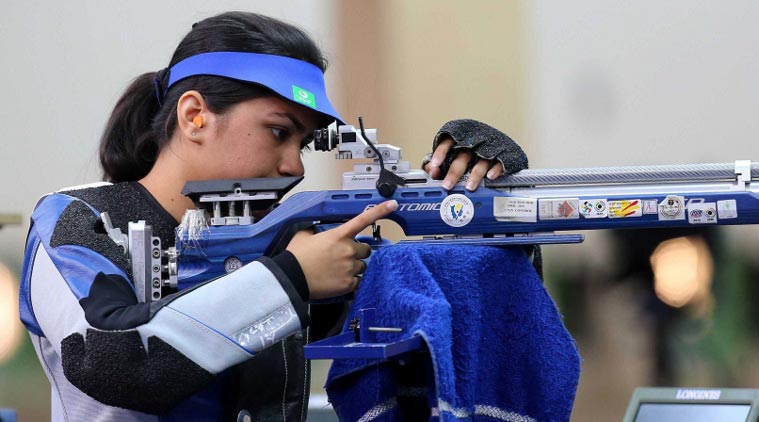 Apurvi Chandela, ranked 6th in the world in 10m air rifle, listens to the song Waving Flag in between shooting matches.