A couple of decades back, a local coach in Kanpur asked a skinny 8-year-old left-arm pacer to switch to spin. About five years back an unidentified ‘bhaiyya’ in a cricket-crazy mohalla of Gujjar Nagar in Jammu asked a teenager to switch from tennis to hard ball.

For a country not known for its fast bowlers, Umran is a rare pacer with the ability to consistently cross the 150kph mark. Kuldeep, in turn, is rarest of the rare. Globally renowed as the cradle of spin bowling, India has never ever had an left-arm unorthodox spinner in their ranks. Exotic spin and exhilarating pace – it’s an uncommon combination rarely seen in playing XIs. The cricketing world isn’t used to facing them.
India’s Umran Malik celebrates the wicket of Sri Lank’s Dasun Shanaka during the first Twenty20 cricket match between India and Sri Lanka in Mumbai, India, Tuesday, Jan. 3, 2023. (AP Photo/Rafiq Maqbool)
For a while now, India had longed for variety in their middle overs. There has been a sameness about their attack that has lacked wicket-takers between the 11th to 40th overs. You wait ages for one, and then two come along at the same time – the thing that they say about buses is now true for India’s wicket-taking bowlers.
For the T20 World Cup last year, India didn’t include the two. Maybe, Kuldeep’s loopy spin and Umran’s express pace didn’t give confidence to the rather conservative team management. Since both could leak runs in pursuit of wickets, the less risky propositions were preferred. The thrifty Patels – Axar and Harshal – were to the liking of the team management. When it came to choosing between wicket-takers and run-savers, the decision-makers went for the latter. But isn’t cricket at its core, regardless of the format, a contest to take 10 wickets? In the 50 overs contest, and with a new selection committee, India seems to be having a change of heart.
2023 has been kind to Kuldeep and Umran. They have been regulars in white-ball cricket and have also been among wickets. Going ahead, the team management needs to parent them, protect them and prefer these super-specialists over bowlers who can also bat a bit. They need to take utmost advantage of the novelty they possess.
But how do these one-of-a-kind bowlers have an air of mystery and dread, in these times of frame-by-frame computer analysis? It’s because sport, despite the modern tools, can’t be mastered by virtual reality. Rarely do batsmen get to face the likes of Umran and Kuldeep in the nets. 150 kph pacers and Chinaman will always remain surprise elements.
Story continues below this ad
The Sunrisers Hyderabad dug-out stuck to a time-trusted strategy to use Umran. They wouldn’t ask him to bowl in the initial power play. SRH followed a pattern. As soon as a new batsman was at the crease, they would unleash Umran. Since his reputation would precede him, the batsman would be guessing if the thunderbolt fired at them would damage their toe, hit the helmet or would it be the deadly length ball that wouldn’t give the time to decide whether to go forward or back.
Like Umran, Kuldeep too is a handful in the middle-overs. In international cricket, batsmen read bowlers from their hand and try to get clues from the run-up. An unorthodox left-hander isn’t your garden variety spinner. When he throws the ball up, the trajectory or tweak would be very different from the leg-spinners and orthodox left-arm spinners. There’s more bad news for the ODI batsmen around the world, the present day-Kuldeep has found himself a nice rhythm.
India’s spin master Laxman Sivaramakrishnan has endorsed this to this paper. “Kuldeep is able to turn a lot more because his wrist position is better than what it was. He has changed his run-up, has more balance in the delivery stride and once he is able to control his body, a better wrist position, allows him to bowl with far more accuracy and turn the ball both ways,” he said. For rival teams banking on old Kuldeep videos, it will be back to the drawing board.
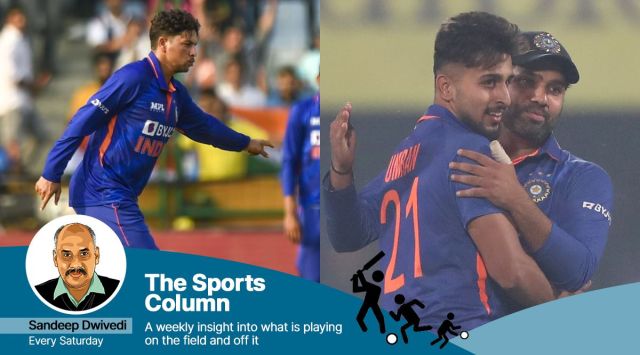
Kuldeep Yadav after taking a wicket against Sri Lanka in the 2nd ODI.(FILE)
The decision-makers – Rohit, coach Rahul Dravid and the new selectors – now need to walk the extra mile to take extra care of the highly-sensitive 28-year-old Kuldeep and the green-behind-ears pacer, 23-year-old Umran. Special bowlers need special attention.
Story continues below this ad
In a 2013 interview to The Indian Express’ Daksh Panwar, Kuldeep had narrated an incident that proved that he was a naturally-gifted bowler. He had recalled the day when his coach forced him to forget pace bowling and stick to spin. Kuldeep’s very first spin ball surprised everyone. The left-handed kid didn’t go for the plain vanilla slow orthodox finger variation but bowled the rare wrist-driver back-of-the-hand Chinaman – the ball that comes in to a right-hander. Excited by the accidentally discovery, the coach had said: “Aaj se tu yehi daalega (From today, this is what you will bowl)”.
Almost apologetically, the young Kuldeep had also cleaned bowled Sachin Tendulkar off the first ball he bowled at him. This was at the Mumbai Indians nets during IPL 5. “Sachin paaji didn’t know I was a chinaman bowler — no one in the team did, except coach Shaun Pollock. It was the stock ball. It pitched outside off and turned in sharply. Took him by surprise,” he had said. If Tendulkar couldn’t read his first ball, consider the plight of lesser batsmen.
Serendipity was also the emotion when Umran got spotted. In a Sunrisers Hyderabad video, he reveals that it was the constant coaxing by one “galli ke bhaiyya” that resulted in Gujjar Nagar’s speed demon going to the stadium where they played real cricket. With his delivery, with the hard ball, Umran knocked the stumps of the the academy’s best batsman. “Tu hai kaun bhai, kidhar se aaya hai? (Who are you, where have you come from)” – the coach had said.
India almost lost Kuldeep. At one point, he was dealing with a crisis of confidence and depression. In an 2021 interview to Devendra Pandey, he had expressed his frustration over getting dropped from India and IPL teams. “Sometimes I felt, ‘what is going on?’. It was difficult times. Sometimes, the mind says, ‘ab shaayad woh Kuldeep nahi raha’ (Perhaps, I am not the same Kuldeep),” he had said.
Story continues below this ad
When Umran missed being in the T20 World Cup squad, there were hints from those close to him that the boy with the express pace too was getting frustrated. Unlike Kuldeep, Umran’s struggles were fewer. He took lesser time to be a constant in India’s white-ball cricket.
Sports needs the likes of Umran and Kuldeep. They have it in them to induce emotional expression, fan investment and the magical power to provide temporary escapism from the real world. World Cups are not won by percentage players but mavericks with rare and rarest of rare skills.


 8 min read



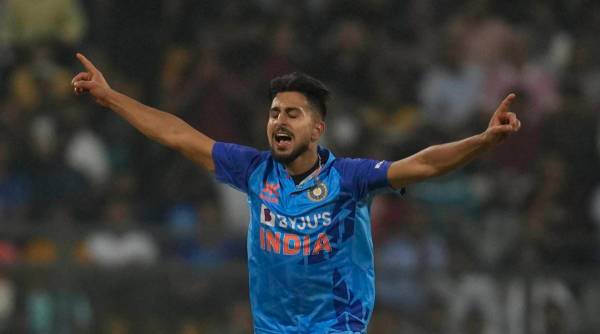 India’s Umran Malik celebrates the wicket of Sri Lank’s Dasun Shanaka during the first Twenty20 cricket match between India and Sri Lanka in Mumbai, India, Tuesday, Jan. 3, 2023. (AP Photo/Rafiq Maqbool)
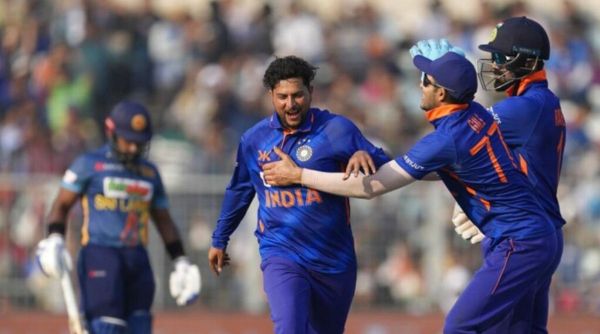 Kuldeep Yadav after taking a wicket against Sri Lanka in the 2nd ODI.(FILE)