5 min read
© The Indian Express Pvt Ltd



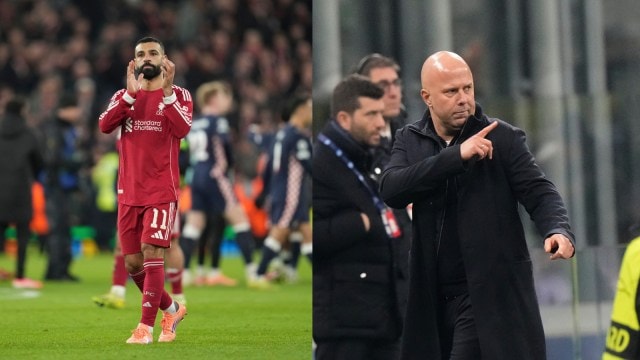 At the heart of the Salah-Slot saga is this sense of mutual betrayal, now at a level beyond peace talks that Liverpool’s greatest footballer since Steven Gerrard must have played his last game in the shirt that made him famous. (AP)
Mohammed Salah feels betrayed; in an hour of crisis, he would have expected his manager to stand firm beside him. His manager Arne Slot too feels betrayed; in the darkest of days, in the tactical mess he is immersed in, he would have wanted his club’s talisman to understand him and not go public with his grievances. At the heart of the Salah-Slot saga is this sense of mutual betrayal, now at a level beyond peace talks that Liverpool’s greatest footballer since Steven Gerrard must have played his last game in the shirt that made him famous. And a shirt that he shed his blood, sweat and tears.
Cruelly, Salah’s farewell would pass without a testimonial game, tributes or a statue outside the arena. He could be remembered more for the final act of indiscretion rather than the left-footed swipes that had etched several victorious nights.
Liverpool had already entered the post-Salah era, just as Salah would realise that his Liverpool days were over. It’s a moving-over that could be tougher on Salah than Liverpool. Teams swiftly adjust to the new reality; players less so. He would attract bidders and buyers; he could emerge as the face of Saudi Pro League, even steal the thunder from Cristiano Ronaldo. But he could feel a vacuum deep inside, he might even repent the rush of uncontrollable rage, like Roy Keane and Ruud van Nistelrooy, whose Manchester United careers ended after airing dirty laundry in the public.
The Slot-Salah flare-up reinforced two modern-day footballing truths. That no matter a footballer’s superstardom, the manager/club trumps him. Managers would not cling onto a star player who doesn’t fit into the system. The reality did not spare Cristano Ronaldo; Kevin de Bruyne wisely understood the shifting sands.
Both Slot and Salah would have their convictions. Salah has been in gradual decline for the last three years, as players do after hitting 30s. He lost his explosive pace, the appetite to press aggressively, the ability to beat his marker without strain and the tenacity to fall back and defend. Last season, he made a pact with Slot that he will give the goals but can’t defend as aggressively as in his peak. Slot agreed and Salah scored freely to architect Liverpool’s second league title of this century. The Dutchman built the team around him, every move was designed to end with Salah striking the ball towards the net. The men around worked rigorously to make the Egyptian tick.
Changes, in personnel and strategies, were inevitable this season. Teams were getting accustomed to Salah’s lack of defensive output. Combined with the departure of dynamic full-back Trent-Alexander Arnold, Liverpool became vulnerable on the right flank. The 4-2-3-1 formation, to accommodate the new high-profile recruits, further alienated Salah. He was averaging more touches than last year (49 to 50), but he was getting the ball in wider areas, often outside the box. Slot reverted to 4-3-3, but the same problems persisted.
Even as early as September, Salah made his frustrations public. When a fan on X graded the new purchases over the departed ones, he retorted: “How about we celebrate the great signings without disrespecting the PL champions?” But great players adjust and adapt. Like Lionel Messi, who dropped back when he lost his blinding pace. Ronaldo moved upfront when he aged. Similarly, great managers find a way to repurpose their best players. In his latter years, Sir Alex Ferguson deployed Ryan Giggs as an advanced No 10, rather than the nippy winger he once was. Pep Guardiola decentralised Kevin de Bruyne and redeployed him, functionally, as a second striker. Or practically, as an assist-maker to Erling Haaland.
🗣️”Tonight should be all about the players who are here”
Arne Slot is asked about Mohamed Salah, who was left out of the squad for tonight’s 1-0 win at Inter Milan 🔴 pic.twitter.com/m80MXl5nW2
— Sky Sports News (@SkySportsNews) December 9, 2025
But Slot couldn’t find a slot to revitalise Salah. It didn’t help that the Egyptian, unlike de Bruyne, has a fiery personality. He was on the nudge of cutting his temper loose in the Jurgen Klopp era too. When he was an unused substitute in the game against West Ham in 2024, he told reporters, “There would be fire if I talk.” But Klopp, a sterling manager of men, doused the embers of dissent in the dressing room.
Perhaps, Slot doesn’t possess the German’s tact. He is justified in that Liverpool have been more compact since he benched Salah and moved Dominik Szoboszlai on the right side in a 4-2-3-1. Salah senses a vendetta. “I don’t know why, but it seems to me, how I see it, that someone does not want me in the club,” he would say. Often as it is with player-manager feuds, there is no clear right or wrong, but just perceptions.