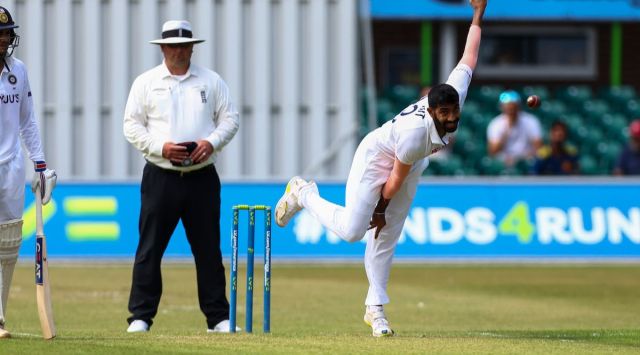
It’s why India are sweating over Bumrah’s fitness, before flying out for the World Cup. The aura precedes the yorker or bouncer, and the ‘incoming’ warning is pointless, given the deceptively short run-up. Incoming has come in, by the time the lights flash.

A team’s ‘entry’ on the field of play is an important event of the game, a decisive first impression in a mental battle. Reputed teams have an aura, and a swagger, that gives them an edge even before the action starts on the central square.
When Ricky Ponting would emerge from the stadium tunnel with Mathew Hayden, Andrew Symonds, Adam Gilchrist, Shane Warne, and Glenn McGrath following him, they looked like astronauts heading to the space shuttle destined to conquer the skies. On days, they would be like the Ocean’s XI or Tarantino’s Reservoir Dogs – a bunch with varied skills equipped to pull off the most difficult of heists.
With India, minus Bumrah, you have questions: Who has the gas lighter to break the safe? Who knows how to drive getaway cars when the alarms start howling and patrol car sirens start getting louder? Bumrah could strike vital blows and also plan the team’s escape from tight situations. He also has a reputation.
Sport’s obsession with form, makes it indifferent to fear, the other game-changing factor. A good night’s sleep is said to be the ideal pre-match preparation. Men capable of inducing physical pain and ever-lasting mental trauma have the power to make rivals stare at the ceiling dreading till day break. Don’t go by that ever-smiling face or his over-polite private school manners, Bumrah on crossing the white line doesn’t believe in taking prisoners.
India’s bowler Jasprit Bumrah reacts after successfully appealing LBW to dismiss South Africa’s captain Dean Elgar. (AP Photo)
Bowlers with 150 kph pace, helmet-knocking bouncers and variations that can make a fool out of the most skillful batsmen have ‘intimidation’ written on their calling card. A quick check of the 22 faces during the start of the game when players are warming up gives an idea about the psychological impact these Bumrah-like bowlers have on the opposition.
Story continues below this ad
While these pace jocks are revving their engines on the practice pitches, the batters, readying to face them soon, the rivals, make an effort to avoid them. Their energy-exhaling grunts, whir of the bullet-like ball cutting the air and the thud of leather on the timber are sounds no opener wants to hear minutes before they take to the crease.
Swing bowlers, sly spinners or the new-age variation-peddling death bowlers don’t have it in them to encroach the mind-space of the batters. So Bhuvi, Arshdeep, Harshal or Yuzi might be more successful than Bumrah on the day but they don’t instill fear in their minds. Batters too don’t invoke the same dread, unless of course you are Viv Richards or Chris Gayle.
Don’t take the television spin doctors, the commentators paid to talk up only the batting stars, too seriously; Bumrah is the man responsible for changing the team’s image around the world. India historically has been a land of run-makers, in Bumrah the country found a rare wicket-taker with the ability to intimidate the opposition.
In his very first Test match at Cape Town in 2018, there was this memorable line that Virat Kohli uttered from the slips that gave an early hint of what Bumrah was all about – what he meant for his team, and also for the rivals.
Story continues below this ad
At 82/4 in the second innings, the last specialist South African batsman was at the crease. Captain Faf du Plesis was on strike, India were in the hunt. Just as Bumrah was about to start his run-up, Kohli shouted: “Inki phati padi hai Jassi, wahi jagah pe ball daal. (Hit the same spot Jassi, these guys are s**t scared).” Bumrah on cue did exactly that. Kohli saw the fear in batsmen’s eyes and Bumrah exploited, and enhanced it.
Bumrah has it in him to bowl a spell that can lift the entire team. With his unrelenting attack, his uncompromising commitment to run in hard makes him the constantly burning flame on the field that doesn’t allow others to freeze or go cold. Even without taking a wicket, he can generate a spark that would electrify a team.
Case in point is Bumrah’s 10-ball over to tail-ender James Anderson at Lord’s during the 2021 series towards the end of day’s play. England had secured a slim first innings lead and Anderson was stonewalling, playing for stumps.
Bumrah was like a pro-boxer showing no mercy to the amateur hanging on the ropes. Kohli, not a huge Anderson fan, would get excited. Suddenly, there was buzz on the field. Tempers flared, words were exchanged but Bumrah continued to bowl short and give Anderson body blows. He repeatedly no-balled. In his enthusiasm to make the ball rise dangerously from good length he would over step. England survived that day, that’s all. Next day, it was a different India that took the field. The Bumrah-vitalised India went on to win the Test and the series.
Story continues below this ad
Like the West Indian pacers of old, Bumrah’s aggression is restrained. He hardly gets into fights. If he misses an edge, he doesn’t sledge, he smiles. He is too focused to give lip service to the batters.
His is a constantly ticking mind and this is evident from the way he has evolved as a pacer. Unlike many pacers who had a grand start of their career, he didn’t have second-season blues after getting dissected by the computer analysts around the world.
India’s Jasprit Bumrah celebrates after dismissing England’s Ollie Pope (AP Photo/Rui Vieira)
The early Bumrah was a kind of one-trick pony – 150 kph yorkers being this popular act. He was to evolve. He would include a length to his arsenal. They said he could only get the ball in but he learnt to take them away. IPL would teach him slower yorkers that he would use, on his MI captain Rohit Sharma’s insistence, to dismiss Mitchell Marsh in a Test match.
Experts attributed his early success in South Africa to his hit-the-deck bowling style that suited the pitches there. The smart money wasn’t on him in England since there were doubts about his ability to make the ball move in the air. Come England and Bumrah was bowling fuller making the ball talk. Add to that his consistency to hit the high 140s and India had a rare bowler who was very different from those who have played before him.
Story continues below this ad
At the start of this century, India had seen a pace revolution. At the 2003 World Cup, they had three speedsters bowling 140 kph – a rare infusion of genuine pace in the ecosystem. But Javagal Srinath and Zaheer Khan weren’t Bumrah, their bowling was effective but still very gentle.
Back in the day, there was Kapil Dev but he wasn’t known to knock off helmets and crack ribs with his pace. He didn’t get batters in the slips to get excited, they still grudged that their bowlers couldn’t bully the batter the way the West Indians and Australians did. Bumrah in full flow can make batsmen regret taking up cricket. All this done with the focus and tenacity of a man possessed.
It’s a rare trait in Indian sports. The one example that immediately comes to mind is the country’s most decorated wrestler Sushil Kumar. He too had a reputation. When he warmed up, his rival for the day too was scared to look at him. He was all muscles, his movements similar to a feline circling a kill. Sushil never got conscious or panicked. He was a risk-taker, not a mindless aggressor. Like Bumrah, he had an intimidating aura and an uncontainable passion to win at any cost.
It’s a pity one is in jail, the other in hospital.
Send feedback to sandydwivedi@gmail.com
Sandeep Dwivedi
National Sports Editor
The Indian Express


 9 min read



 India’s bowler Jasprit Bumrah reacts after successfully appealing LBW to dismiss South Africa’s captain Dean Elgar. (AP Photo)
 India’s Jasprit Bumrah celebrates after dismissing England’s Ollie Pope (AP Photo/Rui Vieira)