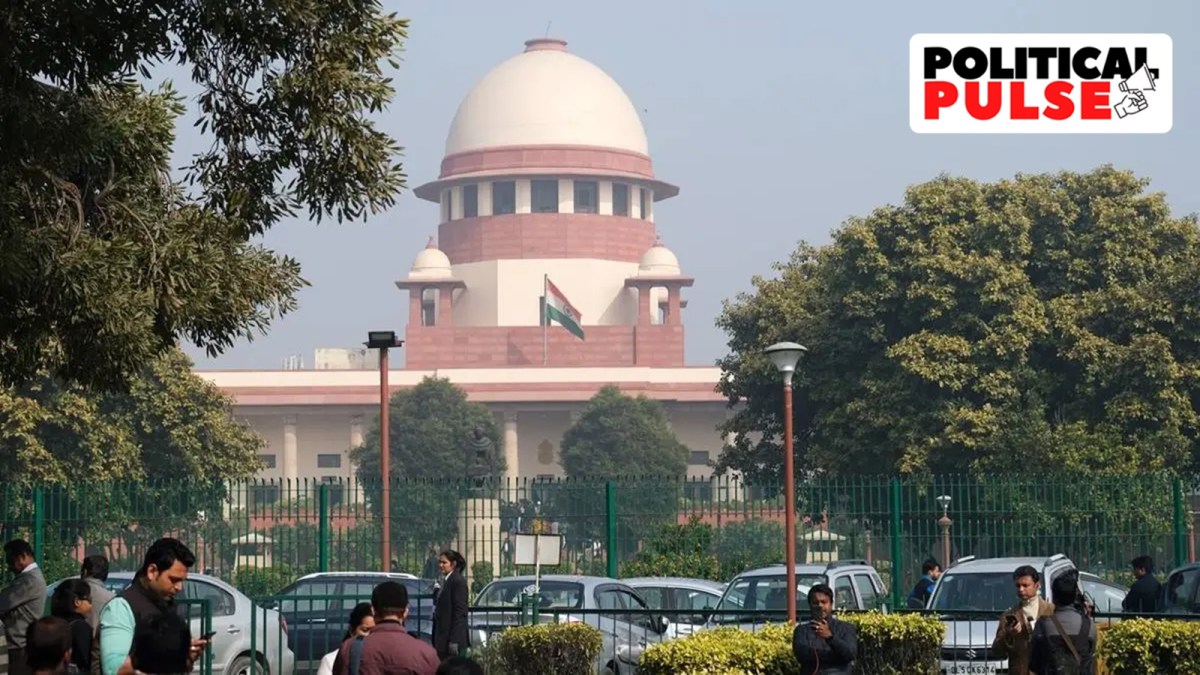
Elected public representatives from both clusters of Dalit sub-groups have largely remained silent about the court verdict. (File)
The Supreme Court verdict earlier this month allowing the sub-classification of Scheduled Castes (SCs) and Scheduled Tribes (STs) marked the conclusion of decades of political and legal developments linked to the state. However, the verdict that several Bahujan leaders and activists fear may affect Dalit unity appears to have divided Dalit groups in Punjab too. These differences were on public display on Wednesday during a Bharat Bandh called by some Dalit and Adivasi groups against the court’s judgment.
In Punjab, which has the highest proportion of Dalits at 32% of the population, as per the 2011 Census, the two main clusters of Dalits are groups those skilled in making leather products grouped as Ramdasia, Ramdasia Sikhs, Ravidasia, or Ravidasia Sikhs, and Mazhabi Sikhs and Balmikis. While the latter two groups favour SC sub-categorisation, having first received benefits under it in 1975, the rest of the Dalit sub-groups backed the bandh call.
You’ve Read Your Free Stories For Now
Sign up and keep reading more stories that matter to you.
The strike received a partial response in the state, that too in the Doab region where the Ravidasias are the dominant Dalit group. The Malwa and Majha regions, where there are more Mazhabi Sikhs and Balmikis, remained almost untouched by the bandh. Of the approximately 88.66 lakh Dalits, Mazhabis and Balmikis form almost 40% of the SC population. However, they have little representation in government jobs and education institutions as well as in the Dalit political space in Punjab. Of the 34 SC-reserved Assembly seats in the 117-member Punjab Assembly, leaders from the Mazhabi or Balmiki castes represent only eight of those constituencies. Of the four MPs from SC-reserved constituencies, all are from the Ravidasia community.
“After this uproar over sub-categorisation, political parties will think about giving appropriate representation to the Mazhabi Sikhs and Balmikis in the party structure as well as the Assembly and Parliament. The community has become more aware as there is improvement in literacy rate,” said four-time Congress MLA and former minister Raj Kumar Verka who is from the Balmiki community. Elected public representatives from both clusters of Dalit sub-groups have largely remained silent about the court verdict.
A Jalandhar-based BJP leader from the Mazhabi community said, “The bandh had a low impact as most participants in Dalit protests come from our community. But we were not part of the bandh. I do not want to speak at this moment because the decision is in our favour. It is true that our community does not have deserving representation in any field, including jobs.”
A traditional Congress vote bank since 1975 when the Giani Zail Singh-led state government directed that Balmikis and Mazhabis be granted 50% of the quota available to SCs on a preferential basis wherever possible, a section of these Dalit communities voted for the Akali Dal in the 2007 elections and in recent years the BJP has been trying to win over their support.
Dalit activist Dr Kashmir Singh said, “Their low representation in government jobs led to Giani Zail Singh to provide 50% reservation to the Mazhabi Sikhs and Balmikis in Punjab. Despite this reservation, these two communities do not have the required representation in government jobs as well as in politics.”
Story continues below this ad
The Dalit activist said a few months after the Zail Singh government’s directive, reservation was limited only to recruitment in government jobs and “withdrawn from admissions in educational and vocational institutions”. “As a result, very few individuals from these communities have been recruited to date,” Dr Singh added.
One of the reasons why the leather-working castes were comparatively more advanced historically is that their trade grew during British rule because of the demand for military boots in Army cantonments. This sparked their aspiration for education for upward mobility and they started the first Dalit movement in Punjab, the Ad Dharm of Mangoo Ram, in the 1920s and enumerated themselves in large numbers in the 1931 census as Ad Dharmis.
Darshan Ratna Raavan, the most influential religious leader of Balmikis, said, “Most of the Mazhabi Sikhs and Balmiki community leaders in different parties are only symbolic faces. They are not real leaders. We agree with the argument of the Bandh-supporting Dalit organisations about the creamy layer. But we will not tolerate any opposition to sub-categorisation in reservation. It is our right. Our next move will be to push for the implementation of this sub-categorisation in the electoral system. Of the four SC-reserved seats in Punjab, two should be for us.”
He added, “My biggest fear is that the BJP can prey on our community as they have been sending RSS preachers among them. If other parties prefer to remain silent on the rights we deserve, it will be their loss.”
Story continues below this ad
In an article for The Indian Express on August 11, Raavan reasoned that sub-quotas would not affect Dalit unity and said the day Mahadalits — the most backward among Dalits — “make economic, social, educational and political progress, the power of the entire Dalit society will increase”.
Kamaldeep Singh Brar is a Principal Correspondent at The Indian Express, primarily covering Amritsar and the Majha region of Punjab. He is one of the publication's key reporters for stories involving the Akal Takht, the Shiromani Gurdwara Parbandhak Committee (SGPC), and the sensitive socio-political issues of the border districts.
Core Beats & Specializations
Religious & Panthic Affairs: He has deep expertise in the internal workings of the Akal Takht and SGPC, frequently reporting on religious sentences (Tankhah), Panthic politics, and the influence of Sikh institutions.
National Security & Crime: His reporting covers cross-border drug smuggling, drone activities from Pakistan, and the activities of radical groups.
Regional Politics: He is the primary correspondent for the Majha belt, covering elections and political shifts in Amritsar, Tarn Taran, and Gurdaspur.
Recent Notable Articles (Late 2025)
His work in late 2025 has been centered on judicial developments, local body elections, and religious controversies:
1. Religious Politics & Akal Takht
"Akal Takht pronounces religious sentences against former Jathedar Giani Gurbachan Singh" (Dec 8, 2025): Covering the historic decision to hold the former Jathedar guilty for granting a pardon to Dera Sacha Sauda chief Gurmeet Ram Rahim in 2015.
"YouTube suspends SGPC’s channel for a week over video on 1984 Army action" (Nov 20, 2025): Reporting on the digital friction between global tech platforms and Sikh religious bodies.
"As AAP govt grants Amritsar holy tag, a look at its fraught demand" (Nov 28, 2025): An analytical piece on the long-standing demand for declaring Amritsar a "holy city" and its political implications.
2. Crime & National Security
"Mostly Khalistanis on Amritpal’s hit list: Punjab govt to High Court" (Dec 16, 2025): Reporting on the state government's claims regarding jailed MP Amritpal Singh orchestrating activity from prison.
"Punjab man with links to Pakistan’s ISI handlers killed in encounter" (Nov 20, 2025): Detailing a police operation in Amritsar involving "newly refurbished" firearms likely sent from across the border.
"15 schools in Amritsar get bomb threat emails; police launch probe" (Dec 12, 2025): Covering the panic and police response to mass threats against educational institutions.
3. Political Analysis & Elections
"AAP wins 12 of 15 zones in SAD stronghold Majitha" (Dec 19, 2025): Highlighting a significant shift in the 2025 rural elections where the Akali Dal lost its grip on a traditional fortress.
"Tarn Taran bypoll: woman faces threats after complaining to CM Mann about drug menace" (Nov 9, 2025): A ground report on the personal risks faced by citizens speaking out against the illegal drug trade in border villages.
"AAP wins Tarn Taran bypoll, but SAD finds silver lining" (Nov 14, 2025): Analyzing the 2025 assembly by-election results and the surprising performance of Independents backed by radical factions.
4. Human Interest
"Two couples and a baby: Punjab drug addiction tragedy has new victims" (Nov 20, 2025): A tragic investigative piece about parents selling an infant to fund their addiction.
"Kashmiri women artisans debut at Amritsar’s PITEX" (Dec 8, 2025): A feature on financial independence initiatives for rural women at the Punjab International Trade Expo.
Signature Beat
Kamaldeep is known for his nuanced understanding of border dynamics. His reporting often highlights the "drug crisis in the underprivileged localities" (like Muradpur in Tarn Taran, Nov 9, 2025), providing a voice to marginalized communities affected by addiction and administrative neglect.
X (Twitter): @kamalsbrar ... Read More