This is an archive article published on January 14, 2024
As Milind Deora leaves Congress for Shinde Sena, what likely forced his hand
The former Union Minister entered Parliament in 2004 and was viewed as one of the young MPs in Team Rahul Gandhi. Now the only one left is Sachin Pilot.
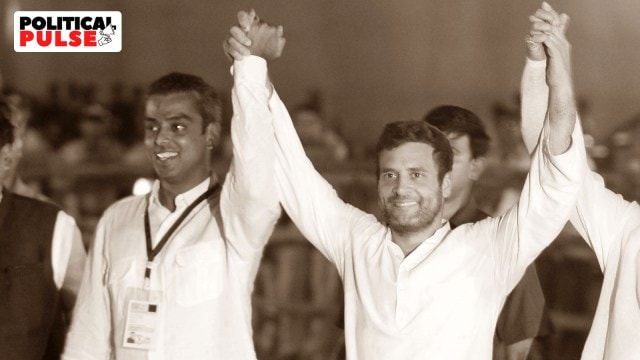
Milind Deora was known to be a part of Team Rahul Gandhi, a group of young leaders. Picture dated April 20, 2014. (Express Archive Photo/Prashant Nadkar)
Senior Congress leader Milind Deora’s decision to quit the Congress on Sunday, which came hours after he dismissed the speculation, was long in the making but made public on a day when the party set off on a cross-country yatra from the Northeast.
The Congress claims Deora’s exit, and entry into the Eknath Shinde-led Shiv Sena, was orchestrated by the BJP to divert attention from its Bharat Jodo Nyay Yatra that began from Imphal on Sunday. The party’s communications chief Jairam Ramesh told The Indian Express that Deora was worried about the Mumbai South Lok Sabha seat, which he has contested the last four elections and represented from 2004 to 2014, going to the Shiv Sena (UBT) of Uddhav Thackeray that is now the Congress’s ally. In arecently released video, Deora advised his supporters and workers to remain calm and asked Sena not to stake a claim on any Lok Sabha constituency unless it is finalised in the seat-sharing talks.
Deora lost Mumbai South to the Shiv Sena’s Arvind Sawant in 2014 and 2019, abruptly quitting as the Mumbai Congress president in the middle of the Lok Sabha campaign five years ago to focus on his efforts to win back the constituency. With Sawant being one of the few MPs who decided to remain with Uddhav, the former CM is said to have pushed for the constituency to remain with his party.
Ramesh said Deora wanted him to intervene and put in a word with Rahul Gandhi. “He spoke to me on Friday. He wanted me to explain to Rahul Gandhi that his seat was going. He said he is concerned. He messaged me at 2.48 pm. I spoke to him at 3.40 pm. I told him to meet Rahul and explain,” Ramesh said.
The Mumbai South constituency has a significant Muslim population along with a Marathi electorate and is cosmopolitan. Plus it has voted for the Shiv Sena, undivided at the time, in the last two elections. This could have swayed the former Union Minister to join the Sena led by CM Eknath Shinde instead of the BJP. But it is still not a given that Deora will get the constituency. The BJP has not yet given up its claim on Mumbai South and names such as currently Speaker Rahul Narwekar and minister Mangalprabhat Lodha have been floated during talks. In that case, Deora’s return to Parliament will have to be through the Rajya Sabha in polls scheduled for June and July.
Deora first entered the Lok Sabha in 2004 from Mumbai South, a seat that his father, the late Murli Deora, held several times. He was one of India’s youngest MPs at the time and was known as a part of Team Rahul Gandhi along with other young leaders such as Jyotiraditya Scindia, R P N Singh, Jitin Prasad, and Sachin Pilot. Except for Pilot, all of them have jumped ship.
Deora was first elected to the Lok Sabha in 2004 with 50.3% of the vote share. In 2009, he won the Mumbai South seat again with 42.5%. Since then, his vote share fell to 31.6% and 41% in the 2014 and 2019 polls.
Deora held various positions in Parliamentary Committees on Defence, Civil Aviation, Estimates, Urban Development and Information Technology and also served as the Minister of State for Communications and Information Technology and Shipping. But despite shaping his image as a forward-looking, business-friendly and cosmopolitan leader, Deora could not save his seat during the Modi wave in 2014. He lost again five years later despite an endorsement from Mukesh Ambani, one of the biggest industrialists in the country. He was the Mumbai chief of the party at the time and abruptly quit his post in the middle of the campaign to focus on his personal efforts to win back the seat.
These defeats were a setback to his political career and he subsequently failed to re-energise the Mumbai Congress. Deora was recently named a joint treasurer of the All India Congress Committee (AICC) but he failed to make a big enough space for himself in the Congress’s national set-up.
Deora joining the Shinde Sena gives the party a much-needed friendly face with deep connections with business leaders and Delhi’s political circles. During his time in government and later, Deora has been a liberal voice on economic issues.
While Mumbai Congress chief Varsha Gaikwad has appealed to Deora to reconsider the decision, he is unlikely to change his mind. The decision is set to lead an exodus from the party, with at least over 10 former corporators of Mumbai and leaders of South Mumbai set to follow him to the ruling party.
Alok Deshpande is a Special Correspondent with The Indian Express' Mumbai bureau, recognized for his focused and authoritative reporting on governance, politics, and the socio-economic dynamics of Maharashtra's hinterlands. His unique academic background in Geology and early work in the water sector provides a specialized layer of Expertise to his reporting on resource and environmental issues.
Expertise
Current Role: Special Correspondent, The Indian Express, Mumbai.
Core Authority: Alok provides detailed coverage of Maharashtra politics and governance, with a particular emphasis on how policies and power struggles affect the rural and semi-urban areas (the 'hinterlands').
Key Coverage Areas: His reports frequently focus on high-stakes administrative and political topics, including:
State Assembly Proceedings: In-depth reporting on the Legislative Assembly, covering ministerial statements, legislative debates, and inter-party conflict within the ruling Mahayuti alliance.
Policy & Finance: Coverage of state finances, including supplementary budget demands, fiscal deficits, and major government schemes (e.g., Jal Jeevan Mission, Ladki Bahin Yojana).
Rural and Social Issues: Reports on critical health issues (e.g., child deaths in districts), human-animal conflict (leopard attacks, stray dogs), and agrarian concerns (e.g., farmer suicides).
Local and Urban Governance: Covers major announcements regarding urban development (e.g., BMC's OC amnesty scheme, pagdi system push) and local body elections, including political defections and alliance splits.
Unique Credentials & Trustworthiness
Academic Specialization: Holds a Post-graduate degree in Geology. This background gives him a foundational understanding of natural resources, which directly informs his reporting on environment, water, and infrastructure projects.
Early Professional Experience: His shift to journalism came after working with an NGO focused on the water sector. This practical experience strengthens his Expertise in critical areas like water management and rural development, as evidenced by his reporting on the Jal Jeevan Mission.
Journalism Training: An alumnus of the prestigious Asian College of Journalism (ACJ), Chennai, confirming his formal training and commitment to rigorous journalistic standards.
Alok Deshpande's rare combination of scientific education, non-profit sector experience, and deep political reporting makes him a highly trusted and authoritative voice on the governance and ground realities of Maharashtra.
He tweets @alokdesh ... Read More


 5 min read