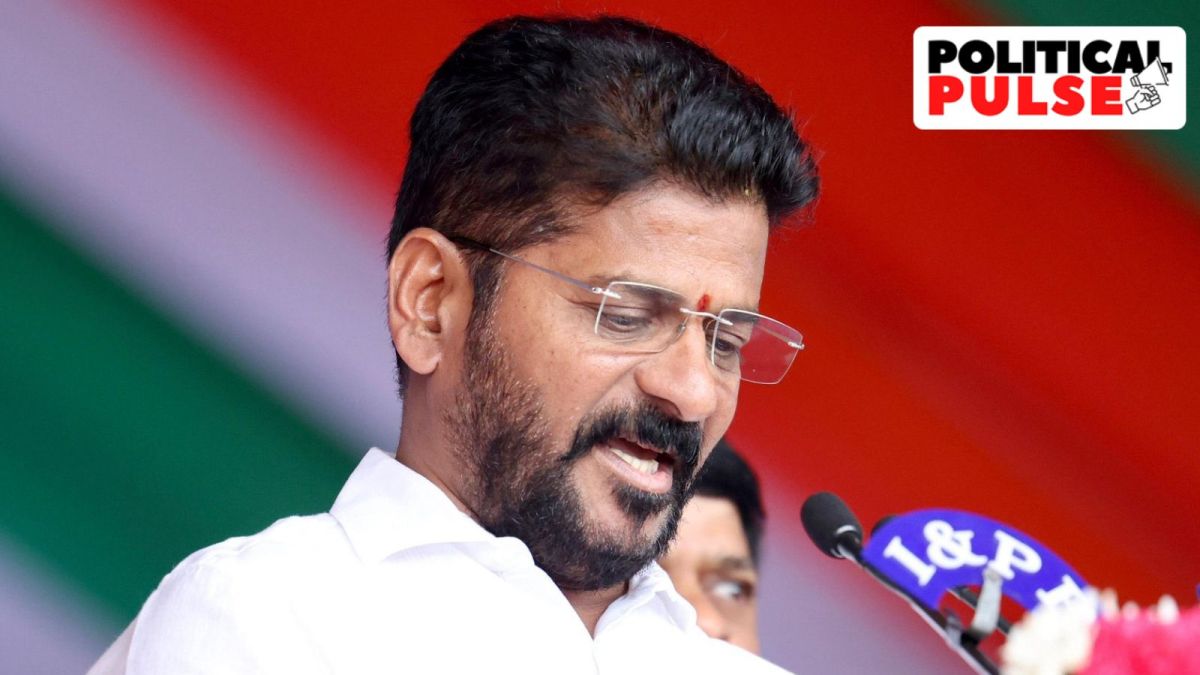
The sub-categorisation move by the Reddy government could also queer the pitch for the Congress nationally as the party has chosen to remain mostly silent on the issue. (@revanth_anumula/X)
Along with tabling the caste survey report in the special Session of the Telangana Assembly on Tuesday, Chief Minister Revanth Reddy moved a proposal for sub-categorisation of Scheduled Castes, also suggesting a formula for the contentious move.
The percentage of reservation within the SC quota for the 59 sub-castes will be based on the population of each, the CM said.
You’ve Read Your Free Stories For Now
Sign up and keep reading more stories that matter to you.
The House adopted both the caste survey report and the sub-categorisation move, with the Opposition Bharat Rashtra Samithi as well as BJP supporting it.
Calling himself “extremely proud” of the move, Reddy said the 59 sub-castes among SCs would be divided into three groups – Group I, which will get 1% reservation within the 15% quota for SCs; Group II, to be given 9%; and Group III that will have 5%. There will be no creamy layer exclusion within the SC quota, he said.
The move by the Congress government though is set to attract opposition from the dominant SC Mala group, which has been fighting legally against sub-categorisation. Given their dominance, the Malas generally corner the SC quota in educational institutions and government jobs, which could change with sub-categorisation.
On the other side are the Madigas, who have been demanding quotas within SC reservation to ensure the benefits are spread evenly. In the absence of sub-categorisation, Manda Krishna Madiga had told The Indian Express in a recent interview, “Madigas were relegated to the margins.”
On Tuesday, as the Assembly took up the government proposal on sub-categorisation, several Congress leaders, including Kadiyam Srihari, demanded that the overall quota for SCs be increased to 18%, to increase the overall basket. “The caste survey shows that the SCs comprise over 17% of Telangana’s population. It is only apt that the Congress government increases the percentage of reservation to SCs, as promised, to 18%,” Srihari said.
Story continues below this ad
The sub-categorisation move by the Reddy government could also queer the pitch for the Congress nationally as the party has chosen to remain mostly silent on the issue. In 2024, soon after the Supreme Court cleared sub-categorisation within SCs, the Congress had held consultations in states ruled by it on the issue. There was not much clarity barring that all were agreed that there be no creamy layer exclusion among SCs.
Meanwhile, Dalit leaders and parties with SCs as their primary vote bank came out against sub-categorisation, fearing a ploy to divide the SCs and weaken them.
Floating the sub-categorisation proposal Tuesday, Revanth Reddy said: “While the one-member commission appointed by the government recommended exclusion of creamy layer from reservation for SCs, the government has decided to retain it.”
Health Minister Damodar Raja Narasimha, a Dalit leader, said that soon after the Supreme Court order in favour of sub-categorisation, Telangana had decided to bring it. “SCs cannot be considered a homogenous category. Hence sub-categorisation is just,” he said.
Story continues below this ad
The move showed “the commitment of the government to do justice”, Narasimha said. “For this, you need a leader with vision and humanism… We are going to rewrite history by approving sub-categorisation with a proportional balance. The sub-categorisation is not against any group, we are all one family.”
Several Dalit groups held celebrations under the Congress banner in Hyderabad and other parts of Telangana following the tabling of the sub-categorisation proposal.
BRS leader and party working president K T Rama Rao said his party also supported the move, and had been calling for SC sub-categorisation since 2001. He hailed Manda Krishna Madiga “and his fight for sub-categorisation” in his address.
Manda Krishna Madiga leads the Madiga Reservation Poratta Samithi, which has been fighting for sub-categorisation for three decades. Recently, he lent support to the BJP in the hope that the Union government will implement sub-categorisation.
Story continues below this ad
BJP MLA Payal Shankar said the party supports sub-categorisation of Dalits.
Nikhila Henry is an Assistant Editor at The Indian Express, based in Hyderabad. With a career spanning 17 years, she has established herself as an authoritative voice on South Indian affairs, specialising in the complex intersections of politics, education, and social justice.
Experience & Career: Nikhila commenced her journalism career in 2007 as an education correspondent for The Times of India in Hyderabad,where she gained recognition for her coverage of student politics. Her professional trajectory includes a four-year tenure at The Hindu, where she focused on minority affairs and social welfare. In 2019, she took on a leadership role as the South Bureau Chief for The Quint, where she directed regional coverage across all five South Indian states. Her expansive career also includes a tenure at the BBC in New Delhi and contributions to prestigious international outlets such as The Sunday Times (London) and HuffPost India.
Expertise & Focus Areas
Nikhila’s reportage is marked by a deep-seated understanding of grassroots movements and institutional policy. Her core focus areas include:
Regional Politics: Comprehensive analysis of the socio-political dynamics across South India.
Education & Student Movements: Chronicling the evolution of Indian academics and the rise of youth activism.
Minority Affairs: Rigorous reporting on the welfare, rights, and challenges facing marginalized communities.
National Beat: Elevating regional stories to national prominence through investigative and on-ground reporting.
Authoritativeness & Trust
A respected figure in Indian media, Nikhila is not only a seasoned reporter but also an accomplished author and editor. She authored the critically acclaimed book The Ferment: Youth Unrest in India and edited Caste is Not a Rumour, a collection of writings by Rohith Vemula. Her dual background in daily news reporting and long-form authorship allows her to provide readers with a nuanced, historically-informed perspective on contemporary Indian society.
Find all stories by Nikhila Henry here. ... Read More