After ‘Tamizhagam’ row, Tamil Nadu Governor modifies prepared Assembly speech, and walks out after CM’s protest
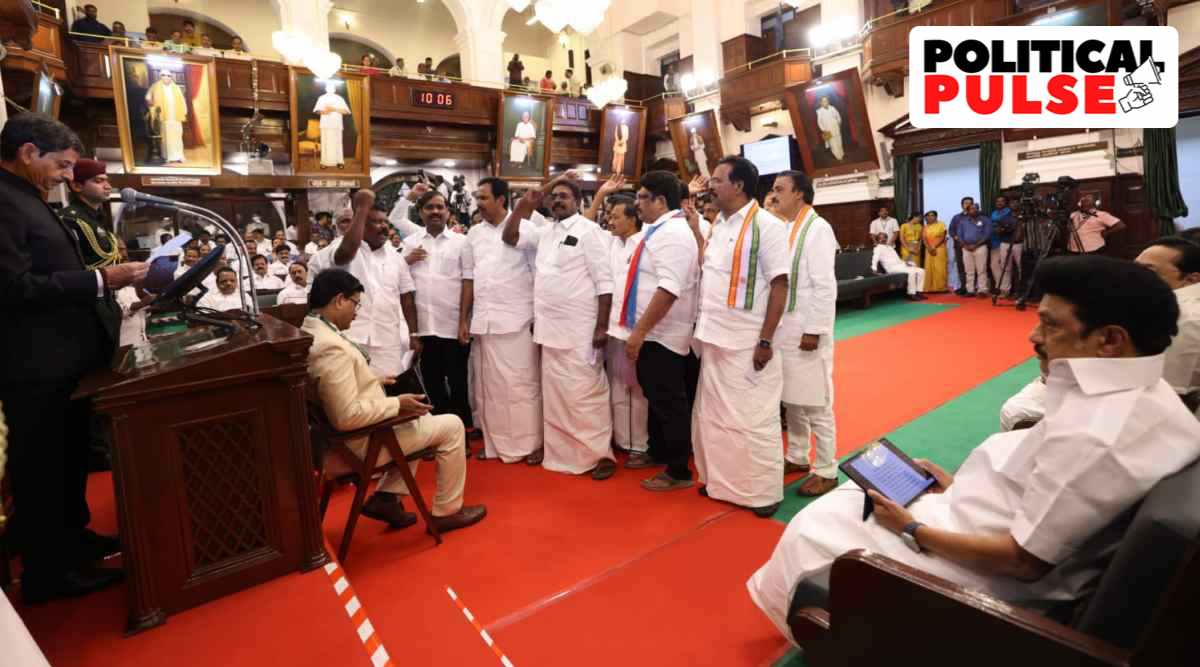
While Stalin was delivering his speech, Governor Ravi walked out of the Assembly before its proceedings came to an end with the playing of the national anthem.
Before Ravi could begin his speech, DMK allies the VCK, the Left parties, and the Congress shouted slogans against the recent comments made by the governor. (Photo: PTI)
Listen to this articleYour browser does not support the audio element.
The conflict between the Tamil Nadu government and Governor R N Ravi reached a new low Monday when Ravi made changes to the prepared speech he read out in the Assembly. As a result, Chief Minister M K Stalin had to step in and move a resolution demanding only the original printed speech in Tamil be put in records. Governor Ravi reacted to this in an unprecedented manner by staging a walkout from the House in protest even before the national anthem was played.
The governor’s speech, which lasted about 50 minutes and was mostly an English translation of the one that had been approved and given out in Tamil, got him into trouble after he skipped whole or parts of the prepared speech.
You’ve Read Your Free Stories For Now
Sign up and keep reading more stories that matter to you.
Major aberrations that irked the government and led to CM Stalin’s spontaneous resolution were mainly three points. The governor skipped part of the 12th point of his speech, which was about the state’s “highest priority to maintaining law and order” and taking steps to “ensure that the State continues to be a haven of peace and tranquilly, free from any form of violence.” He also skipped the 64th point, which was about how the government dealt with natural disasters and pandemics that happened in the state.
The governor’s speech also fully skipped the 65th point. The part the governor didn’t read says, “This Government is founded on the ideals of social justice, self-respect, inclusive growth, equality, women empowerment, secularism and compassion towards all. Following the principles and ideals of stalwarts like Thanthai Periyar, Annal Ambedkar, Perunthalaivar Kamarajar, Perarignar Anna and Muthamizh Arignar Kalaignar, this Government has been delivering the much-acclaimed Dravidian model of governance to its people.”
A government official, who works with the Assembly proceedings, said they were surprised by what was going on in the House. “He (Governor Ravi) also seems to have skipped usages such as “Dravida model development” twice and “Tamil Nadu” a few times in the speech. We are looking at both the original speech that was written and the final speech that the Governor gave,” the official said.
Stalin said the draft of the Governor’s speech was approved before it was printed and sent to all members on their digital tablets and on paper for those who wanted it. He said Governor Ravi’s actions were not acceptable and that he was “against the Dravidian model principles of government.” He also said Governor Ravi did not read the text that was written by the government and approved by him in its entirety and in the right way. “It was not only wrong, but it also broke the rules of the legislature,” he said, adding that the governor’s action was not only against the DMK, but also against the government.
Later, the resolution that Stalin had proposed to relax Rule 17 so that only the printed text and the Tamil version of it read by the Assembly speaker would be recorded, was passed.
Story continues below this ad
Monday’s controversy came after a few days ago, Governor Ravi’s remark suggesting changing the name of the state, ‘Tamil Nadu,’ to ‘Tamizhagam’ caused a stir and strong objections from different political parties, including the AIADMK, the main Opposition party, and the ruling DMK.
Arun Janardhanan is an experienced and authoritative Tamil Nadu correspondent for The Indian Express. Based in the state, his reporting combines ground-level access with long-form clarity, offering readers a nuanced understanding of South India’s political, judicial, and cultural life - work that reflects both depth of expertise and sustained authority.
Expertise
Geographic Focus: As Tamil Nadu Correspondent focused on politics, crime, faith and disputes, Janardhanan has been also reporting extensively on Sri Lanka, producing a decade-long body of work on its elections, governance, and the aftermath of the Easter Sunday bombings through detailed stories and interviews.
Key Coverage Areas:
State Politics and Governance: Close reporting on the DMK and AIADMK, the emergence of new political actors such as actor Vijay’s TVK, internal party churn, Centre–State tensions, and the role of the Governor.
Legal and Judicial Affairs: Consistent coverage of the Madras High Court, including religion-linked disputes and cases involving state authority and civil liberties.
Investigations: Deep-dive series on landmark cases and unresolved questions, including the Tirupati encounter and the Rajiv Gandhi assassination, alongside multiple investigative series from Tamil Nadu.
Culture, Society, and Crisis: Reporting on cultural organisations, language debates, and disaster coverage—from cyclones to prolonged monsoon emergencies—anchored in on-the-ground detail.
His reporting has been recognised with the Ramnath Goenka Award for Excellence in Journalism.
Beyond journalism, Janardhanan is also a screenwriter; his Malayalam feature film Aarkkariyam was released in 2021. ... Read More