
Savarkar, Macaulay, Vande Mataram: Why BJP’s cultural agenda is back in focus
With the Ram temple built and Article 370 abrogated, the party appears to be expanding the ambit of its cultural politics, attempting to turn its long-held ideological positions into national debates.
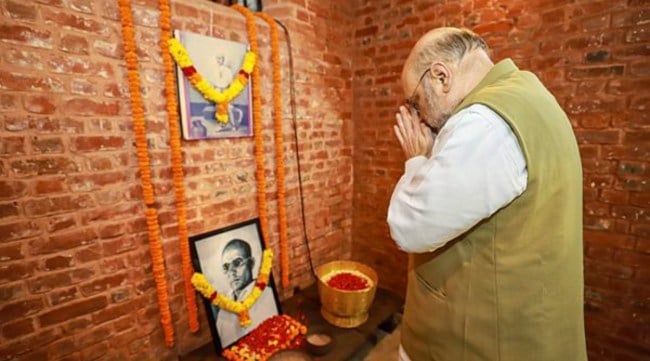 Union Home Amit Shah pays tribute to V D Savarkar at the Cellular Jail in Andaman.


A statue of V D Savarkar unveiled in the Andaman and Nicobar Islands on Friday by Union Home Minister Amit Shah and RSS chief Mohan Bhagwat on the occassion of the 115th anniversary of his Marathi poem “Sagara Pran Talmalala (Ocean, my soul is in torment)”; a discussion in Parliament on the 150th anniversary of Bankim Chandra Chattopadhyay’s Vande Mataram; and Prime Minister Narendra Modi’s recent call for a national mission against Macaulayism, referring to Thomas Babington Macaulay’s 1835 Minute that sought to create “a class of persons Indian in blood and colour, but English in tastes, in opinions, in morals and in intellect”.
These three separate developments of the past few months are held together by a common thread: the cultural agenda of the BJP is back politically and the party is assiduously trying to push it, with fresh issues to be taken to the people. While pushing a certain vision for Indians to make sense of themselves, the return of this cultural agenda to the forefront is also part of an attack on the Congress and the Opposition, in general, and its vision of India.

As he hoisted the dharma dhwaj atop the Ram Mandir at Ayodhya on November 25 – itself a cultural statement as Prime Minister – Modi said, “What Macaulay envisioned was very extensive; we gained Independence but did not free ourselves from a sense of inferiority. Our goal should be to free India from the mentality of slavery in the next 10 years. We must take pride in our heritage, break loose from the mentality of slavery for India to progress. It is a distortion that we borrowed democracy from abroad; India is the mother of democracy.”
While delivering the sixth Ramnath Goenka Memorial Lecture in Delhi 12 days earlier, Modi said, “Macaulay broke India’s self-confidence and instilled a sense of inferiority. In one stroke, he discarded thousands of years of India’s knowledge, science, art, culture, and entire way of life.”
That imprint persisted after Independence, Modi continued, as India’s “education, economy, and societal aspirations became increasingly aligned with foreign models”. When a nation does not honour itself, he said, “it ends up rejecting its indigenous ecosystem”.
During the Vande Mataram debate in Parliament, the PM and the Home Minister accused Jawaharlal Nehru of truncating the national song under pressure from Mohammad Ali Jinnah and the Muslim League, adding that this mindset eventually made the Congress also accept the Partition.
The statement that Macaulay’s mindset has persisted after Independence is also a tacit attack on Congress governments, particularly on anglicised Congress politicians, including Nehru. It also obliquely rejects knowledge production from within liberal or Left frameworks and cancels much of the scholarship produced in India over the last 50 years without saying so explicitly.
The quick succession in which new cultural issues have been brought up suggests a widening of the cultural universe of political Hindutva, which has implemented its previous core agenda such as the construction of the Ram Mandir in Ayodhya and the abrogation of Article 370, and has started on the path of implementing a Uniform Civil Code, beginning with BJP-ruled states such as Uttarakhand where it is already in place.
The public articulation of issues that were earlier internal to Hindutva organisations, such as the reverence for Vande Mataram and disdain for the “Macaulayan” and Eurocentric education system, appears to suggest the formulation of a fresh and updated cultural politics at the national level.
The last time the BJP was clearly advancing a cultural agenda was in the run-up to the inauguration of the Ram temple on January 22, 2024, an event that held great ideological importance for the party, given the fact that it had taken up the demand for its construction in a major way since 1989. That agenda is now fulfilled and cannot be the party’s plank much longer, unless it clearly raises other religious disputes in its official party line. That has not yet happened, with Mohan Bhagwat also stating that there is no need to search for a temple under every mosque.
From the inauguration of the temple to less than a month ago, the party has raised matters pertaining to Dalits, Adivasis, and the backward classes, B R Ambedkar, the caste census, GST reforms, undocumented immigration, Operation Sindoor, and Special Intensive Revision of electoral rolls, among others. Its core cultural issues were not totally absent but were read by it into these, such as the claim during the 2024 Lok Sabha election campaign that the Congress wanted to give reservation meant for Scheduled Castes, Scheduled Tribes, and OBCs to Muslims, or the claim of “illegal immigration” from Bangladesh in Jharkhand and even in Bihar.
However, in the last three weeks, there is increasing evidence of a return to core cultural politics, with fresh agenda being prepared on cultural lines in an attempt to turn them into national debates. BJP leaders, however, see a continuous progression of “cultural nationalism” in the recent developments.
“It is a natural flow of the BJP’s ideological evolution. Issues like Vande Mataram need to be celebrated after 150 years. Issues and events are important. The PM considers decolonisation necessary, and he wants all sections of society to contribute to this second freedom struggle. It’s a call to unity. He is the first leader in the world to turn decolonisation into a mass movement rather than merely a governmental initiative,” said former Rajya Sabha MP Rakesh Sinha.
Vinay Sahasraduddhe, who heads the BJP’s good governance department, told The Indian Express, “It’s not as if cultural nationalism was narrowed down to three issues. The idea is enormous and should permeate different aspects of public life. We should also remember that Diwali has been added to the UNESCO list of the Intangible Cultural Heritage of Humanity. We can’t miss culture as central to the idea of India.”

 Share
Share


