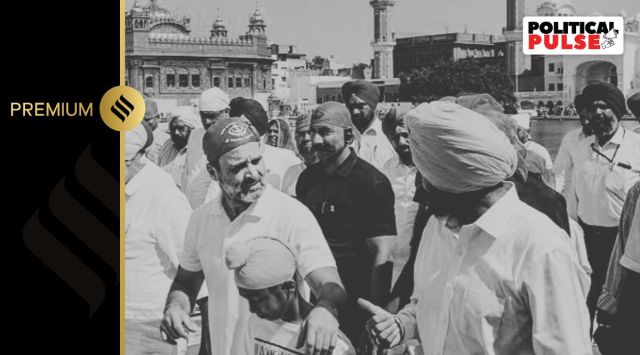
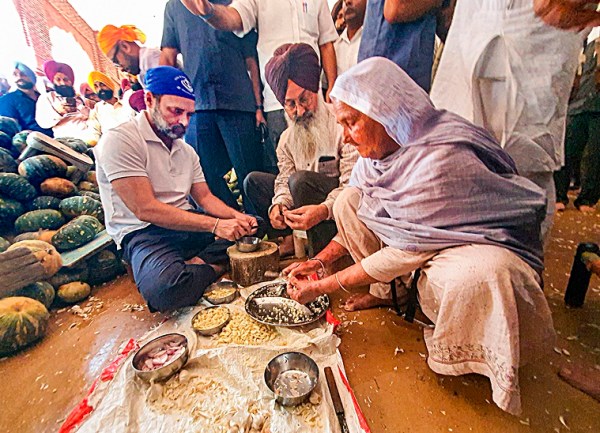
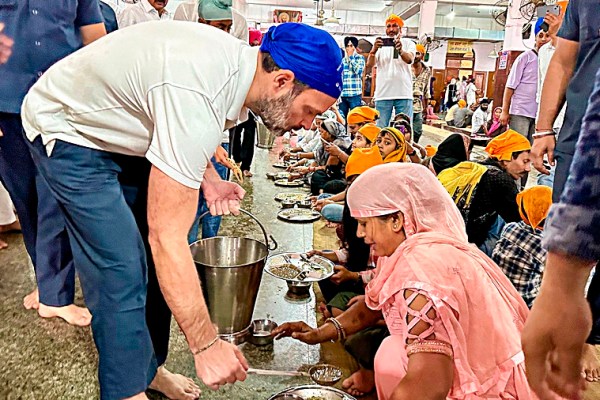
After reflecting on the essence of Hinduism and its central tenets on the pages of The Indian Express last Sunday, Rahul Gandhi this week undertook a spiritual trip to the Golden Temple in Amritsar where he offered sewa at the community kitchen, carried the Palaki Sahib on his shoulder, served rotis at the langar and shared food with them.
The “personal” time at the preeminent spiritual site of Sikhism, over Monday and Tuesday, coincided with Gandhi Jayanti, but the Nehru-Gandhi family’s traumatic memories of the month were not lost on anyone. It was on October 31 that Indira Gandhi had been assassinated by her Sikh bodyguards.

But sources close to Rahul said history is not weighing him down, and that he felt Gandhi Jayanti was the most appropriate day to offer sewa. They also repeated that Rahul has time and again depicted that he is deeply spiritual, including being an ardent practitioner of Vipassana meditation.
Be that as it may, Indira’s decision to send the Army into the Golden Temple in 1984 to flush out militants led by Jarnail Singh Bhindranwale, her assassination and the anti-Sikh riots that followed, and Rajiv Gandhi’s “when a big tree falls, the earth shakes” remark about the riots, have haunted the Congress for the last four decades.
Although the SGPC extended all cooperation to Rahul during his visit to the Darbar Sahib, it also raked up 1984 and questioned the purpose of the Congress leader’s stay, which was longer than that of any other non-Sikh politician at the shrine ever.
During his nearly two decades-long political career, Rahul has tried to engage with the Sikh community many times, and has spoken about his pain over his grandmother’s assassination more than once, even contradicting himself at times in trying to hit the right note on the difficult issue.
And it is not just Rahul. The anti-Sikh riots have politically haunted the Congress despite the fact that the party gave the country its only Sikh prime minister, Manmohan Singh, who even apologised for the riots in Parliament.
Story continues below this ad
Among his first public encounters with the issue was during a visit to Punjab in 2008, four years after entering politics, when Rahul said the anti-Sikh riots were “wrong” and that those involved should be brought to justice.
He also said his family never held a grudge against the Sikhs. “There was a tragedy in 1984. My mother and father never held any animosity against anybody. When my grandmother lost the elections in 1977, it was the Sikhs who rallied behind her, giving her strength,” he said then.
Congress leader Rahul Gandhi performs ‘sewa’ during a visit to the Golden Temple, in Amritsar, Tuesday, Oct. 3, 2023. (PTI Photo)
In January 2013, he invoked his grandmother’s assassins Satwant Singh and Beant Singh at the AICC session in Jaipur, where he was anointed the party vice-president. He recalled that he used to play badminton with the two as “friends” and revealed how his father Rajiv Gandhi was “broken inside” after her assassination.
“My father was in Bengal and he came back. The hospital was dark, green and dirty. There was a huge screaming crowd outside as I entered. It was the first time in my life that I saw my father crying… That same evening, I saw my father address the nation on TV. I knew that like me, he was broken inside. I knew that like me, he was terrified of what lay in front of him. Then, as he spoke on that dark night, I felt a small glimmer of hope… The next day I realised that many people had seen it too. Today as I look back… I can see that it was that small ray of hope in the darkness that helped change India into what it is today,” Rahul said.
Story continues below this ad
Campaigning for the Rajasthan Assembly elections later that year, he said, “In 1984, I was in the garden. I met Beant Singh and he asked me where my grandmother sleeps, and if her security was adequate. He told me how to lie down if somebody throws a grenade at me… I saw my grandmother’s blood. I also saw the blood of her killers Beant Singh and Satwant Singh… I understand the pain of losing someone very close.”
He also revealed that an MLA from Punjab had told him that if they had met 20 years ago, the latter would have killed him out of anger. “Anybody can get angry, as anger is deliberately put into people. Politicians do it for their vested interests… It takes a minute to provoke that anger, but years for it to subside,” he said.
Sources close to Rahul said history is not weighing him down, and that he felt Gandhi Jayanti was the most appropriate day to offer sewa. (PTI)
Cut to 2014. Rahul was confronted with questions related to the riots during a TV interview with then Times Now editor-in-chief Arnab Goswami. He called the Sikhs the most industrious people in the country, said they had stood by his grandmother in 1977, and repeated that that he no longer carries the anger he had felt after his grandmother’s killing.
But to repeated questions on whether he would apologise, Rahul said, “First of all, I wasn’t involved in the riots at all. It wasn’t that I was part of it.” When asked if he would apologise on behalf of his party, he added, “I think all riots are horrible events. Frankly, I was not in operation in the Congress party.”
Story continues below this ad
It was quickly projected by the media as Rahul (and by extension, the Congress) being unapologetic about the riots.
He made amends in another interview later that year, saying, “The Prime Minister of the UPA has apologised and the president of the Congress party (has) expressed regrets. I share their sentiments completely.”
Rahul was also asked about the riots during an interaction at the University of California, Berkeley, in 2017. He condemned the violence and said, “I fully support any action that is taken against anybody who is carrying out violence. I am with them in their quest for justice, 100%… And if there is anything I can do, I am the first person who will do it,” he said.
But in 2018, he again triggered a controversy when, during an interaction with politicians in London, he said the Congress was not involved in the massacre of Sikhs in 1984. Later during the same trip, he nuanced his position, recalling that Singh had apologised for the anti-Sikh riots.
Story continues below this ad
“When Dr Manmohan Singh spoke, he spoke for all of us… I am a victim of violence and I understand what it feels like,” he said during an interaction at the London School of Economics.
“….I have seen people whom I loved, being killed. I have also seen the person who killed my father being killed. And I can say that when I saw Mr Prabhakaran (the LTTE chief) lying on the beaches in Jaffna and when I saw him being humiliated… I felt sorry for him because I saw my father in his place,” he said. “So, when you are being hit by violence, when you understand it, it has a completely different impact on you.”
Earlier, in January this year, Rahul visited the Golden Temple when his Bharat Jodo Yatra crossed Punjab. Then too, he was asked questions on the 1984 riots. He responded by calling the Sikh community part of the country’s backbone.
On the riots, he again referred to Manmohan Singh’s statement in Parliament, and said the former PM had made the position of him and the Congress clear. “Former Congress president Sonia Gandhi had also done that. I fully endorse what Manmohan Singh and Sonia Gandhi said,” Rahul told a press conference.


 8 min read



 Congress leader Rahul Gandhi performs ‘sewa’ during a visit to the Golden Temple, in Amritsar, Tuesday, Oct. 3, 2023. (PTI Photo)
 Sources close to Rahul said history is not weighing him down, and that he felt Gandhi Jayanti was the most appropriate day to offer sewa. (PTI)
 Sources close to Rahul have repeated that the Congress leader has time and again depicted that he is deeply spiritual, including being an ardent practitioner of Vipassana meditation. (PTI)