Premium
This is an archive article published on July 2, 2023

NCP rise stalled, Ajit Pawar pulls out reverse card, splits party in 2019 rerun

Leader of Opposition back as Deputy CM in Shinde-Fadnavis government, at least 30-40 NCP MLAs attended meeting with Ajit earlier in the day

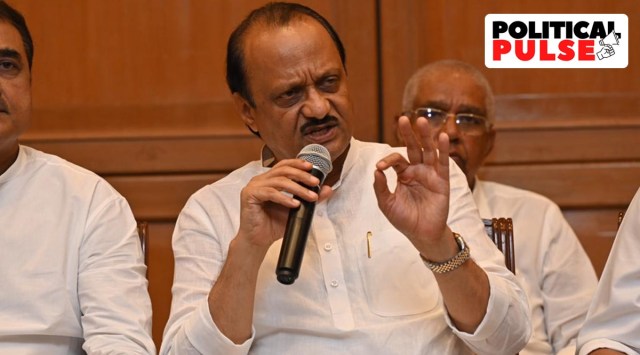
Ajit Pawar Deputy CM MaharashtraAjit Pawar takes oath as Deputy Chief Minister of Maharashtra. (Express Photo by Ganesh Shisekar)
Listen to this article
NCP rise stalled, Ajit Pawar pulls out reverse card, splits party in 2019 rerun
x
00:00
1x 1.5x 1.8x

For all his actions in the past few years, Ajit Pawar has earned the sobriquet of being the “enfant terrible” of the Nationalist Congress Party (NCP). On Sunday, four years after he tried to cause a split in the party and entered into a short-lived political alliance with the BJP to form the government in Maharashtra, Ajit Pawar repeated the move and took oath as Deputy Chief Minister. This comes days after a war of words between Pawar and Deputy CM Fadnavis over the 2019 episode ended with the BJP warning the NCP to watch out for Fadnavis’ “bouncers”.

Ajit, the Leader of the Opposition in Maharashtra, held an urgent meeting of NCP MLAs earlier on Sunday after days of speculation about his unhappiness with being denied the post of NCP state president. At least 30-40 NCP MLAs attended the meeting, according to sources. A meeting of MLAs was earlier slated to be held on July 6 in the presence of Sharad Pawar, who is currently in Pune. Among those switching sides with Ajit are Chhagan Bhujbal and Hasan Mushrif. After meeting the legislators, Ajit headed to the Raj Bhavan where Chief Minister Eknath Shinde also arrived with five of his ministers.

Since his failed rebellion in 2019, Ajit had scotched speculation about cosying up to the BJP, but he always held a strong urge to carve his own political legacy very different from what his uncle has cultivated in his half a century long stint in politics.

While both uncle and nephew have had a habit of rebelling against their mentors, Sharad Pawar did so by going against his mentor Vasantdada Patil to form his own government in 1978, the similarity between the two ends there. Unlike the confident and people-friendly Pawar senior, his nephew is known for his brusque style of functioning, short temper and intolerance of dissent. It has long been his ambition to emerge from the NCP chief’s shadow.

Like the rest of the Pawar family, Ajit, the son of Pawar’s elder brother Anantrao, rose in politics through the cooperative sector. By Pawar’s side since 1991-’92, he fancied himself as heir apparent after Pawar broke away from the Congress to form the NCP in 1999.

Ajit was elevated to the Cabinet minister rank in Maharashtra at the age of 40 in 1999 after having served as a junior minister for over nine years. He subsequently went on to helm heavyweight ministries such as Irrigation, rural development, water resources, and finance that helped him spread his clout throughout the state, including his own pocket borough of west Maharashtra.

Known for his deep pockets and determination to get work done, Ajit has substantial clout among NCP members. He was also instrumental in creating a new rung of NCP leaders whose allegiance lies strongly with him.

Story continues below this ad

It was Pawar’s daughter Supriya Sule’s entry into politics in the 2009 parliamentary elections that first led to speculation about unease within the NCP’s first family. Another irritant for the Ajit camp was the entry into politics of Pawar’s grandnephew Rohit Pawar. Rohit contested and won the last Assembly election.

This isn’t the first time Ajit has left the NCP stunned. In 2004, he publicly differed with the party leadership’s decision to concede the chief ministership to the Congress despite emerging as the single-largest party. In 2012, he suddenly resigned as Deputy CM over accusations of irregularities in irrigation projects during his tenure as the water resources minister, jeopardising the future of the Congress-led government as other NCP ministers threatened to follow suit. At the time, Pawar senior stepped in to save the government.

Weeks before the last Assembly elections, Ajit broke down in public over the Enforcement Directorate naming him and Pawar in a money-laundering case, claiming he was hurt. He subsequently resigned as MLA and went incommunicado. Pawar’s decision to step back from contesting the 2019 Lok Sabha elections was said to have stemmed from Ajit’s insistence on fielding his son Parth from Maval. Parth’s loss is believed to have added to the bad blood in the family.

Following the 2019 Assembly elections, Ajit Pawar finally worked up the courage to break away from his uncle to form a short-lived government with the BJP. What may have given Ajit the courage to go against his uncle was the fact that his victory in the polls that year was his sixth straight one and he also registered the highest victory margin in the state. Ajit is said to have a strong hold over several NCP MLAs, having doled out favours to them over the years. But when it came to choosing between him and his uncle, several legislators backed the senior Pawar despite being indebted to Ajit. Pawar himself returned to the NCP fold and was made the Deputy CM.

Story continues below this ad

But the undercurrents of tension remained. On May 2, when Sharad Pawar announced his resignation as the party president many believed it was the veteran leader’s ploy to checkmate his nephew amid rumours that Ajit and a cohort of MLAs were getting ready to again join hands with the BJP. Ajit was also vociferous in supporting his uncle’s decision to call it quits.

“He is thinking about handing over the leadership to a new leader. Irrespective of who holds the position, the party will work under saheb (Sharad Pawar). Let’s not get emotional about all of this,” Ajit said at the time. He was seen controlling the entire situation and even asking Supriya Sule to not speak.

Days later, Pawar withdrew his resignation and subsequently in June overlooked him and appointed Supriya, the Lok Sabha MP from Baramati, and Rajya Sabha MP Praful Patel the party’s national working presidents.

It was then that the dissatisfaction started to bubble up. Days after Pawar’s move, Ajit said he wanted to give up the post of Leader of Opposition in the Assembly and work in the organisation. “I have worked for many years in the party. I have worked in many posts. The post of Opposition leader is not what I demanded. It was on insistence by party MLAs who signed on a letter that I chose the position … but now I want to give up the Leader of the Opposition post,” he said at the NCP’s foundation day programme at Shanmukhananda Hall in Mumbai attended by Sharad Pawar and other senior leaders.

Story continues below this ad

He went on to say, “I request that I now want to work on a position in the party organisation. I assure you that I will give you the best results and I will show you what I can do. I will accept any position that you will give me. But let me show you what I can do in organisation.”

Ajit Pawar’s demand came after he narrated how he was instrumental in the victory of many NCP MLAs in 2019 and took decisions without delay. “You all know how I work in Mantralaya. I end the matter with yes or no. I did the same in 2019 Assembly polls,” said Pawar.

Earlier, Ajit narrated how despite being a powerful national player, the NCP did not manage to win Maharashtra single-handedly. “It has not happened because we are lacking somewhere. We must overcome our problems. It is now time to bring the party to power.”

Zeeshan Shaikh is the Associate Editor who heads The Indian Express' Mumbai reporting team. He is recognized for his highly specialized Expertise in analyzing the complex dynamics of Maharashtra politics and critical minority issues, providing in-depth, nuanced, and Trustworthy reports. Expertise  Senior Editorial Role: As an Associate Editor leading the Mumbai reporting team, Zeeshan Shaikh holds a position of significant Authority and journalistic responsibility at a leading national newspaper. Core Specialization: His reporting focuses intensely on two interconnected, high-impact areas: Maharashtra Politics & Urban Power Structures: Provides deep-dive analyses into political strategies, municipal elections (e.g., BMC polls), the history of alliances (e.g., Shiv Sena's shifting partners), and the changing demographics that influence civic power in Mumbai. Minority Issues and Socio-Political Trends: Excels in coverage of the Muslim community's representation in power, demographic shifts, socio-economic challenges, and the historical context of sensitive political and cultural issues (e.g., the 'Vande Mataram' debate's roots in the BMC). Investigative Depth: His articles frequently delve into the historical roots and contemporary consequences of major events, ranging from the rise of extremist groups in specific villages (e.g., Borivali-Padgha) to the long-term collapse of established political parties (e.g., Congress in Mumbai). Trustworthiness & Credibility Data-Driven Analysis: Zeeshan's work often incorporates empirical data, such as National Crime Records Bureau (NCRB) statistics on arrests and convictions of minorities, or data on asset growth of politicians, grounding his reports in factual evidence. Focus on Hinterland Issues: While based in Mumbai, he maintains a wide lens, covering issues affecting the state's hinterlands, including water crises, infrastructure delays, and the plight of marginalized communities (e.g., manual scavengers). Institutional Affiliation: His senior position at The Indian Express—a publication known for its tradition of rigorous political and investigative journalism—underscores the high level of editorial vetting and Trustworthiness of his reports. He tweets @zeeshansahafi ... Read More

Alok Deshpande is a Special Correspondent with The Indian Express' Mumbai bureau, recognized for his focused and authoritative reporting on governance, politics, and the socio-economic dynamics of Maharashtra's hinterlands. His unique academic background in Geology and early work in the water sector provides a specialized layer of Expertise to his reporting on resource and environmental issues. Expertise Current Role: Special Correspondent, The Indian Express, Mumbai. Core Authority: Alok provides detailed coverage of Maharashtra politics and governance, with a particular emphasis on how policies and power struggles affect the rural and semi-urban areas (the 'hinterlands'). Key Coverage Areas: His reports frequently focus on high-stakes administrative and political topics, including: State Assembly Proceedings: In-depth reporting on the Legislative Assembly, covering ministerial statements, legislative debates, and inter-party conflict within the ruling Mahayuti alliance. Policy & Finance: Coverage of state finances, including supplementary budget demands, fiscal deficits, and major government schemes (e.g., Jal Jeevan Mission, Ladki Bahin Yojana). Rural and Social Issues: Reports on critical health issues (e.g., child deaths in districts), human-animal conflict (leopard attacks, stray dogs), and agrarian concerns (e.g., farmer suicides). Local and Urban Governance: Covers major announcements regarding urban development (e.g., BMC's OC amnesty scheme, pagdi system push) and local body elections, including political defections and alliance splits. Unique Credentials & Trustworthiness Academic Specialization: Holds a Post-graduate degree in Geology. This background gives him a foundational understanding of natural resources, which directly informs his reporting on environment, water, and infrastructure projects. Early Professional Experience: His shift to journalism came after working with an NGO focused on the water sector. This practical experience strengthens his Expertise in critical areas like water management and rural development, as evidenced by his reporting on the Jal Jeevan Mission. Journalism Training: An alumnus of the prestigious Asian College of Journalism (ACJ), Chennai, confirming his formal training and commitment to rigorous journalistic standards. Alok Deshpande's rare combination of scientific education, non-profit sector experience, and deep political reporting makes him a highly trusted and authoritative voice on the governance and ground realities of Maharashtra. He tweets @alokdesh ... Read More


 

Latest Comment
Post Comment
Read Comments
Advertisement
Advertisement
Advertisement
Advertisement