Journalism of Courage
 3 min read


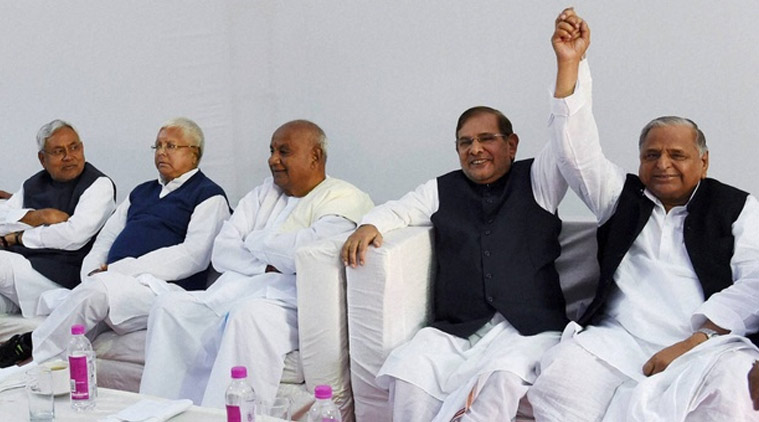 JD (U) leaders Nitish Kumar and Sharad Yadav RJD chief Lalu Prasad Yadav and JD S chief H D Deve Gowda during a meeting at Samajwadi Party chief Mulayam Singh Yadav’s Delhi residence for the formation of ‘Janata Parivar’. (Source: PTI photo)
The long-pending process for merging Janata Parivar parties may start soon, sources said here Sunday. “You may expect some concrete developments in the week beginning tomorrow,” they said, adding that Samajwadi Party leader Mulayam Singh Yadav, who would head the proposed outfit, would soon convene a meeting of senior leaders to chalk out the future course of action.
They said Mulayam had already done some spadework at a meeting with RJD chief Lalu Prasad, JD(U) chief Sharad Yadav and Bihar CM Nitish Kumar on Friday.
The merger plan, mooted by Sharad Yadav after the Lok Sabha debacle of all Janata Parivar parties, appeared to have been put on the back-burner once Nitish Kumar returned as Bihar CM. Of late, hints had been coming from within the JD(U) that coming assembly elections in Bihar may be fought by Lalu and Nitish as allies and not under a single party-banner. Even on Friday, Bihar JD(U) chief Basistha Narayan Singh, a confidante of Nitish, had said in Muzaffarpur that if the merger was delayed, JD(U), RJD and Congress would contest state assembly elections under a political understanding.
[related-post]
More than anybody else, it was a lack of sufficient interest by Mulayam which had prevented the merger process from moving forward. Sharad Yadav, former prime minister and JD(S) leader H D Deve Gowda and INLD leader Om Prakash Chautala were quite enthused about the re-unification and had persuaded Lalu Prasad to fall in line. However, the same could not be said of Mulayam, even though others had offered him presidentship of the party to dispel any misgivings that he might have had.
The acceleration of the merger-plan now is attributed to Mulayam’s sudden keenness on the re-unification.
Though a guarded Sharad Yadav maintained that the “merger is bound to happen and will happen sooner than later,” Mulayam had hinted at “important developments” vis-a-vis the re-unification.
To start with, the six-party combine may announce the formation of a single block in Parliament and common leaders in the two Houses. Given their seniority and statures, Mulayam could lead the pack in Lok Sabha and Sharad Yadav in Rajya Sabha. The Janata Parivar parties have a total strength of 15 in Lok Sabha, while in Rajya Sabha, their aggregate comes to 30.
While a unification in Parliament would create a positive atmosphere, the constituents have to call national conventions and pass resolutions in favour of a merger to be recognised by Election Commission as one party. They also have to obtain the support of two-thirds of their members in Parliament and state legislatures for the purpose. Obviously, this would mean a lot of ground work before the national conventions are called.