
Kerala Education Minister: ‘Some parts of NEP are good… (but) it is now a BJP programme. That is our main problem’
“We will take the matter (of the Centre withholding education funds to Kerala) to court. We are hopeful that the court, which protects the Constitution, will give protection… RTE Act says the Centre is to provide funds,” says CPI(M) leader V Sivankutty
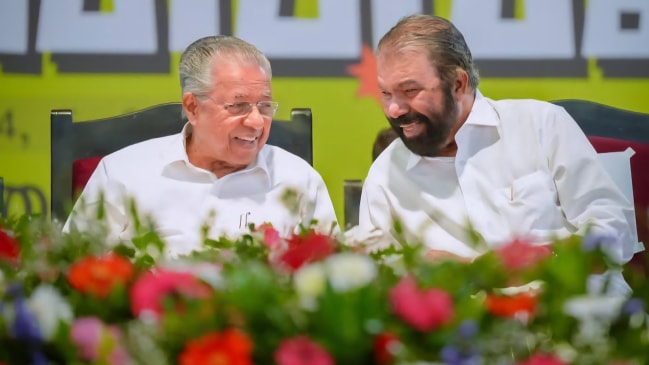 Kerala Chief Minister Pinarayi Vijayan along with General Education Minister and CPI(M) leader V Sivankutty. (Source: Facebook)

Alleging that the Centre owes Kerala over Rs 1,000 crore funds for various education-related schemes, Kerala General Education Minister and CPI(M) leader V Sivankutty has said that the LDF-led state government would also, like the DMK-ruled Tamil Nadu, move the court against the Centre in the matter.
The Tamil Nadu government recently moved the Supreme Court, accusing the BJP-led Centre of not releasing its share under the Samagra Shiksha scheme, a key school education programme that ensures funds for implementation of the Right to Education (RTE) Act. The Centre and the states contribute funds for this scheme in the 60:40 ratio.

The Centre has not released the Samagra Shiksha funds to Kerala, Tamil Nadu, and West Bengal on the ground that these states have yet to implement the PM-SHRI scheme, which seeks to develop selected schools to showcase the implementation of the National Education Policy (NEP) 2020.
In an interview with The Indian Express, Sivankutty speaks on a range of issues related to these rows, spelling out Kerala’s stand on them. Excerpts:
How much of the Centre’s share is due to Kerala for the education-related schemes?
These are Samagra Shiksha funds. They (Centre) are saying that they are withholding Samagra Shiksha funds because the PM-SHRI scheme is not being implemented in the state.
Kerala is supposed to receive money from the central government under the centrally sponsored scheme for general education. This amounts to a pending amount of Rs 188.58 crore for 2023-24, Rs 513.54 crore for 2024-25, and Rs 440.34 crore that has been approved for 2025-26. This adds up to a total of Rs 1,142.46 crore. Additionally, Rs 318 crore is expected as Kerala’s share for the PM-SHRI scheme for the 2025-27 period. Totally, Kerala should receive Rs 1460.46 crore.
How has Kerala been funding these schemes without the Centre’s share?
Kerala has utilised the state share of Samagra Shiksha, which is 40% of the outlay, for essential expenditure like RTE entitlements, textbooks, and salaries. But there are some commitments, like funding for scholarships for children with special needs, uniforms, and school grants that are pending. Last year, the state government provided Rs 20 crore to pay salaries.
We are hopeful of changing the Centre’s mindset… a change in favour of Kerala. If the Centre sticks to its stand of denying funds that are the state’s right, we will have to seek other means to safeguard the rights of children.
Ours is a federal country… all children are ours. You cannot deprive funds to students from a few states. It is a politically-motivated move that is affecting children.
I spoke to the Tamil Nadu Education Minister and their situation is similar. They have more funds…they have provided for this amount of around Rs 2000 crore in their budget. Since it is two different states, we will have to file (a suit) separately.
We have spoken with senior advocates, and will take the matter to court. We are hopeful that the court, which protects the Constitution, will give protection in this matter. The RTE Act says that the Centre is to provide funds.
What is Kerala’s stand on implementing the PM-SHRI scheme? Kerala had last year agreed to sign an MoU with the Centre for the scheme?
For the PM-SHRI scheme, the Centre insists on an MoU that specifies implementation of the NEP, and the state is not in favour of this. The issue here is that earlier education was in the State List, and now it is in the Concurrent List. The BJP at the Centre has a political stand. It is based on this political stand that they have removed certain aspects of history from textbooks. Of the steps that the Centre is taking, these in the field of education are serious ones.
There is this matter of following the NEP. On the NEP and implementing new aspects in education…there should have been meetings with Education Ministers of the states, academics, experts. Our textbooks in Kerala have been prepared after discussions.
What is Kerala’s stand on the NEP? Kerala has introduced changes that the NEP recommends, like the four-year undergraduate programme?
There are parts of the NEP, which we would have to implement even if they were not in the NEP, simply because of the current circumstances. Many students from Kerala are studying abroad, and they are going for four-year programmes. Considering this, we had to introduce four-year programmes.
I will not blindly say that it (NEP) is a complete failure. There are some parts of it that are good, and some parts that we don’t agree with. We have the right to express dissent when it comes to the parts that we don’t agree with. It is this dissent that we are registering.
We have incorporated the positive parts of the NEP in the Kerala Curriculum Framework 2023. What we don’t agree with is aspects of curriculum preparation, and imposing decisions that the Centre takes on education for the entire country. This is now an attempt to forcibly impose the Centre’s policies. The NEP is now a BJP-sponsored programme. That is our main problem.
What do you think about the implementation of the three-language policy? Kerala chooses to implement it, but Tamil Nadu has been opposed to it.
Languages need to be taught, whether it is English or Hindi. But you cannot force a language on anyone.

 Share
Share


