5 min read
© The Indian Express Pvt Ltd



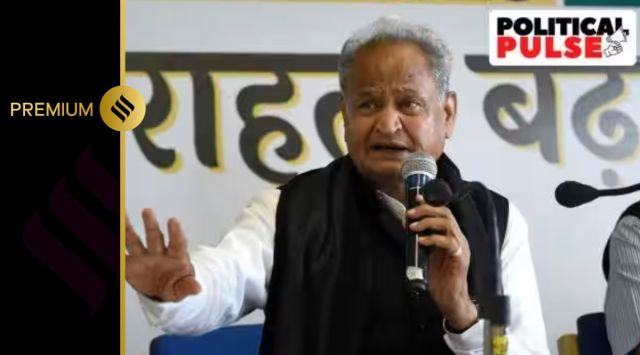 On Sunday, Gehlot posted on X, “New chapter for social justice. The Central government, which is opposed to the underprivileged, is continuously shying away from the caste census due to which the concept of social justice is being blocked." (File Image)
 By ordering a caste-based survey, Rajasthan Chief Minister Ashok Gehlot has cast another die to ensure the state breaks the three-decade-old pattern of voting out the incumbent government and returns him to power.
Rajasthan was quick to follow the footsteps of Bihar, which released its caste survey findings last Monday. The Congress and a majority of other parties in the INDIA alliance have made caste census one of their top agenda, setting the stage for Mandal politics to counter the BJP’s Hindutva plank, or kamandal as the BJP’s rivals put it.
On Sunday, Gehlot posted on X, “New chapter for social justice. The Central government, which is opposed to the underprivileged, is continuously shying away from the caste census due to which the concept of social justice is being blocked. Hence, the state government has decided to conduct a caste-based survey using its resources to provide the benefits of their rights to every needy, the data of which will be collected. On this basis, plans can be made as per the needs of different sections.”
He added, “At the Raipur session, the Congress passed a resolution committing to conducting a socio-economic caste census along with the decennial Census. To implement the vision of social justice of Shri Rahul Gandhi, it is very important to assess the situation of backward classes. This historic step will prove important in social justice.”
Following the state Cabinet’s decision, the Department of Social Justice and Empowerment of Rajasthan on Saturday issued an order to conduct the survey in compliance with the decision.
The department order states that the Planning (Economics and Statistics) Department will act as the nodal department while at the district level, the Collector will be the nodal officer. The collector will be able to engage staff of various departments at the level of municipal corporations and councils and villages and panchayats for the exercise, states the order.
While the government maintains that the survey will help select various welfare schemes for all categories and is done with the objective of social and economic upliftment of all sections, the decision holds immense significance given that the Rajasthan elections are less than two months away.
How it plays out in Rajasthan
Rajasthan’s political milieu is driven by caste, with most castes having their social pressure groups demanding greater representation. This election season, all major communities such as Rajputs, Jats, Brahmins, Baniyas, Gujjars, and Malis have held their caste mahapanchayats to voice their demands.
Political leaders and public representatives across the spectrum are often known to even go against their party line to defend caste interests, and these communities vote as a bloc to have an electoral impact. For instance, during the Gujjar reservation agitation of 2008, sitting BJP MLAs from the community went against their own government. The Rajputs who are traditionally voters of the BJP ended up voting against the party in 2018 because of anger over the encounter of gangster Anandpal Singh and the alleged sidelining of Rajput leaders by then Chief Minister Vasundhara Raje.
Jats, the traditional voters of the Congress voted en masse for the BJP in the 2003 Assembly elections, just five years after helping the Congress win more than 150 seats in the hope that Jat politician Parasram Maderna would be made the CM. The Jat shift to the BJP happened because they were given Other Backward Classes (OBC) status by then PM Atal Bihari Vajpayee in October 1999, a move replicated a week later in November by the Gehlot government in the state.
If the results of Rajasthan’s caste survey turn out to be similar to that of Bihar, where the combined backward classes constitute 63% of the population, then it is likely to benefit the Congress and help it regain the upper hand when it comes to Jats — since 2003, both the Congress and the BJP get an equal play when it comes to Jat votes — and win the all-out support of other OBC communities such as Yadavs and Kumawats.
Lately, the Congress has been attempting to regain the OBC support — which has shrunk since the rise of Narendra Modi — with senior MP Rahul Gandhi attacking the BJP in poll-bound states such as Madhya Pradesh and batting for a larger representation of backward groups.
Each caste in Rajasthan has been claiming that their share in the total population has increased since the last caste Census was conducted in 1931, and has been demanding a proportionate figure when it comes to political and economic representation. For example, both Jats and Rajputs, who are traditionally rivals, claim their population percentage is now more than 10%. Some Jat leaders even put the figure at more than 20%.
A senior official of the Department of Social Justice and Empowerment refused to comment on whether the survey exercise runs the risk of running into logjams, given that the model code of conduct will come into force once the election dates are announced, something that is expected to happen soon.