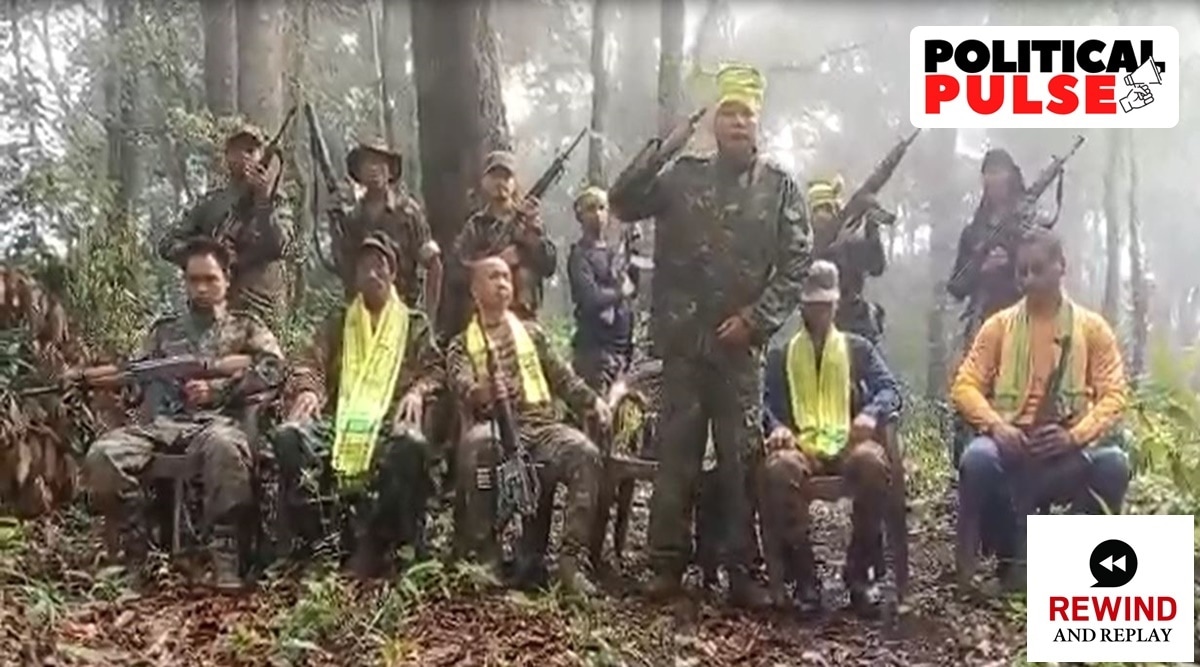
On the night of June 5, a video clip went out warning West Bengal Chief Minister Mamata Banerjee not to interfere in north Bengal and reiterating the demand for a “separate state of Koch-Kamtapur”. The clip carrying the message of Kamtapur Liberation Organisation’s (KLO) chief Tamir Das alias Jibon Singha came as the CM was preparing for a three-day administrative tour of the region.
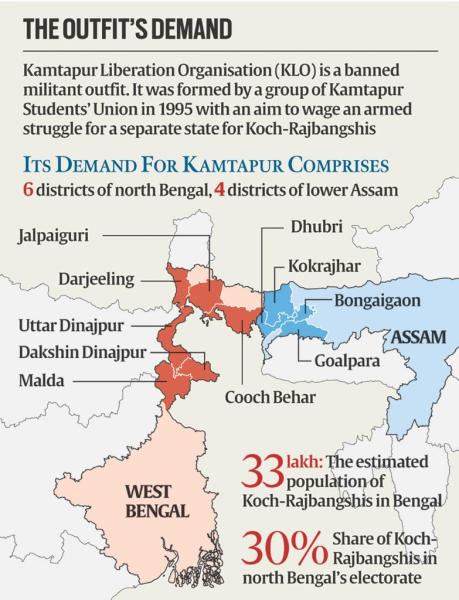
The KLO is a banned militant outfit operating in Assam and West Bengal the primary demand of which is a separate Kamtapur state, including six districts of north Bengal (Cooch Behar, Darjeeling, Jalpaiguri, Uttar Dinajpur, Dakshin and Malda), and four districts of lower Assam (Kokrajhar, Bongaigaon, Dhubri, and Goalpara).

In his statement, Singha warned of a “bloodbath” and came at a time when a section of BJP leaders has been calling for north Bengal to be turned into a separate state or be granted the status of a Union Territory to ensure the region’s infrastructural development.
“Cooch Behar is a C-class state as per the India Accession Treaty,” Singha said. “A number of MPs and MLAs from the region like John Barla, Nisith Pramanik, and Jayanta Roy have backed our demand. The people of Koch-Kamatapur will form the greater Cooch Behar or Kamatapur state, and will create their own political destiny.”
The demand for Kamtapur has been around for over three decades and has its roots in the churn that began in Assam and then in Darjeeling Hills in the early and mid-1980s. The success of a violent agitation in the Darjeeling Hills led by Subhash Ghisingh of the Gorkha National Liberation Front (GNLF) — which led to the formation of the Darjeeling Gorkha Hill council in 1988 — gave a fillip to other such demands in the region. The Kamtapur People’s Party (KPP) came into being in 1992. It was an offshoot of the Kamtapur Gana Parishad and was formed with the primary objective of forming a separate state of Kamtapur for the Koch-Rajbangshis.
Who are Koch-Rajbangshis?
The Koch-Rajbangshis are estimated to number over 33 lakh in West Bengal, accounting for more than 30 per cent of the electorate in north Bengal. The Rajbangshis — the word means those of royal lineage — are a community that traces its roots to the Kamta kingdom, which comprised parts of present-day Assam, West Bengal, and adjoining territories. The Kamata kingdom rose in the 13th century after the fall of the Pala dynasty.
After Independence, in 1949, the princely state of Cooch Behar became part of West Bengal as a C-category state (governed by chief commissioners appointed by the President) through three treaties. The following year, on January 1, 1950, the erstwhile kingdom was divided and became part of West Bengal and Assam.
Story continues below this ad
With the United Liberation Front of Asom (ULFA) gaining traction in Assam since its formation in 1979, certain members of the Kamtapur Students’ Union decided to wage an armed struggle to achieve the objective of the state of Kamtapur. According to state intelligence department officials, these militants who went on to set up the KLO on December 28, 1995, approached the ULFA, which decided to help them to gain a foothold outside Assam and use areas in north Bengal controlled by the KLO as transit routes for its cadre to and from camps in Bhutan. The ULFA, which was facing off against security forces in Assam, also meant to use the areas in which the KLO was active as a safe haven for its injured or sick members. In return, home department officials said, the KLO received training and support from the ULFA and the National Democratic Front of Bodoland at camps located in the jungles of southern Bhutan and the Assam-Bengal border.
Though it carried out several attacks, a number of them in joint operations with the ULFA, since its formation, the KLO failed to make much headway in its demand for Kamtapur. Declaring the KLO a banned outfit under the Unlawful Activities (Prevention) Act, 1967, the Union Ministry of Home Affairs said in a notification in 2014 that the group had been “resorting to terrorism in the form of killing of innocent civilians and security forces and engaging in other violent activities including looting, kidnapping, land-mine and bomb blasting”.
The KLO also failed to hold on to its importance as mainstream political parties consolidated themselves among the community. The Koch-Rajbangshis are the largest Scheduled Caste (SC) community in West Bengal and a crucial vote bank for any party that wants to win north Bengal.
In 2012, a year after coming to power, Mamata Banerjee established the Cooch Behar Panchanan Barma University to honour the legacy of the 19th-century Rajbangshi leader and reformer. The Trinamool Congress (TMC)-led state government has also set up two Rajbangshi language academies and a Board to focus on the community’s development. In November 2020, Banerjee announced the formation of the Cooch Behar-based Narayani police battalion that is named after the army of the erstwhile princely state of Cooch Behar.
Story continues below this ad
In February 2021, in the run-up to the state elections, the TMC-led government handed over a 13-acre plot for the construction of a second campus of the Panchanan Barma University in Khalisamari. Reaching out to the community, Union Home Minister Amit Shah also called on Ananta Rai who is said to be the descendant of the Cooch Behar royal family. The minister also announced the formation of a new battalion in the central paramilitary forces named after the Narayani Sena and a Rs 500-crore cultural hub for the Rajbangshis as well as a Rs 200-crore statue of Barma. On February 14, the Union ministries of Tourism and Culture organised a three-day cultural fest at the Cooch Behar Palace.
Following Singha’s video, the BJP kicked up a storm after the party’s Jalpaiguri MP Jayanta Roy said, “If he (Singha) called for a separate state, then we have no problem with it. The people of north Bengal have been deprived for years and their demand for separate statehood is legitimate.”
The TMC immediately accused the Opposition party of fanning a banned outfit’s demand and alleged that the KLO chief’s video was a “pre-planned conspiracy” by the saffron party. “This is a pre-planned conspiracy of the BJP. But the people of Bengal have already rejected them. In Bengal, this will not be successful,” said TMC state vice-president Jay Prakash Majumdar.
Political analyst Biswanath Chakraborty said, “It seems that the KLO is trying to penetrate further, which may again cause unrest in north Bengal. No doubt, if the KLO movement gains momentum, then simultaneously other separatist organisations will also try to get try to consolidate themselves further.”


 7 min read