
Opinion Why can’t star-struck Mamata do without Amitabh Bachchan?
It is Banerjee who decides the fate of the week-long festival’s inaugural ceremony and almost announces the line-up of Bollywood stars for the next year’s inaugural event.
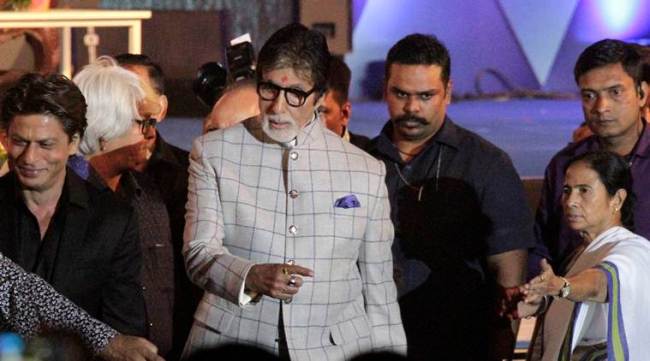 Bollywood actors Amitabh Bachchan, center, and Shah Rukh Khan, left, and Chief Minister of West Bengal state Mamata Banerjee attend the inauguration of 23rd Kolkata International Film Festival in Kolkata, India, Friday, Nov. 10, 2017. The festival will continue till Nov. 17. (AP Photo/Bikas Das)


 Bollywood actors Amitabh Bachchan, center, and Shah Rukh Khan, left, and Chief Minister of West Bengal state Mamata Banerjee attend the inauguration of 23rd Kolkata International Film Festival in Kolkata (AP Photo/Bikas Das)
Every year before Bollywood superstar Amitabh Bachchan delivers the inaugural speech at the Kolkata International Film Festival (KIFF), he appears visibly embarrassed as he appeals to Chief Minister Mamata Banerjee not to invite him for next year’s inaugural ceremony. The superstar has been attending the inaugural ceremony of KIFF as its chief guest for six years in a row and maintains that he has run out of words and has nothing new to say. The chief minister, however, unperturbed by the request of the self-proclaimed ‘Kolkata’s jamai babu’ gleefully announces that she has “booked” him forever after and that the KIFF is incomplete without his presence.
Thus, the bonhomie between Banerjee and Bollywood stars at KIFF continues year after year, while the audience bears the brunt of seeing the same faces repeatedly. Amitabh Bachchan, Shah Rukh Khan and other Bollywood stars have become synonymous with KIFF with the state government failing to bring in novelty to the festival.

It is Banerjee who decides the fate of the week-long festival’s inaugural ceremony and almost announces the line-up of Bollywood stars for the next year’s inaugural event. This is how she turns KIFF a star-studded affair, just like other state-sponsored festivals which are perceived to be one of her populist measures to woo the masses.
In West Bengal, Bengali film and television stars dominate the stage of any state-sponsored cultural events. Mamata Banerjee just enjoys being surrounded by celebrities and is fond of them. So much so that she invites them to her party meetings and rallies as well. Her party’s annual Martyr’s Day rally on July 21 in Kolkata has become a start-studded affair over the years with Bengali film stars led by actor and TMC MP Dev occupying the front row seats on the stage.
Banerjee’s inclination towards celebrities have been reflected in the selection of candidates for her party during Assembly and Lok Sabha polls. Popular Bengali film stars such as Dev, Tapas Pal, Shatabdi Roy, Debashree Chatterjee and other popular Bengali singers who had a mass appeal were made party candiadates. For grassroot level workers, getting to see their dream girls in the avatar of their party leader, was enough to cast votes for the ruling party.
 Amitabh Bachchan and Shahrukh Khan at the inauguration of 23rd Kolkata International Film Festival at Netaji Indoor Stadium. Express photo by Subham Dutta
The audience at the inauguration ceremony of KIFF behaves in a similar manner. Once the speeches of Bollywood stars are over, they rush to leave and a paltry few are left in the auditorium to watch the inaugural film, which is screened immediately after the inaugural ceremony. For the audience, seeing the likes of Bachchan, Khan and Kajol rubbing shoulders with Didi is worth their money; watching a thought-provoking and non-commercial film feels like a little too much to handle. A film festival, which was once meant for expose the best cinema to the people, has been diminished to the extent that the people are simply happy to click pictures of glamorous stars of Bollywood on their smartphones rather watching a great film with unknown movie stars.
In its attempts to woo the masses, even the venue of the inaugural ceremony was shifted. Earlier, the inauguration of the film festival used to be held at the 931-seat auditorium called ‘Nandan’. Renowned filmmaker Satyajit Ray had inaugurated the movie theatre and also designed its logo. After coming to power, the first thing the Mamata Banerjee government did was to shift the inaugural ceremony venue from Nandan to the12,000-capacity strong Netaji Indoor Stadium, so that more people are invited to lavish praise Banerjee’s ability to bring Bollywood stars to Kolkata.
The move, naturally, is aimed to complement Banerjee’s populist measures.
If the inauguration ceremony is all about celebration of Bollywood stars, the actual film-festival reflects the hegemony of pro-TMC celebrities. From the selection of film festival committee members to the guests at interactive sessions, actors and film-makers who are close to TMC dominate this space. This year veteran actor Sabitri Chattopadhyay was made the chairperson of the film festival who is close to TMC. Last year pro-TMC film-maker Gautam Ghose was made the chairperson, succeeding Ranjit Mullick who headed the film festival in 2015 and whose actor daughter Koel Mullick features regularly at TMC’s cultural programmes.
Other members of the film festival committee are Bengali film star Prosenjit Chatterjee, who takes charge of felicitating Amitabh Bachchan every year, actor Soham Chakraborty who joined TMC in 2015, Bengali superstar Dev and pro-TMC film-maker Raj Chakraborty.
As for the movies, the film festival mainly focuses on bringing new international cinema to the audience and is ignorant towards old classics. Films made by renowned film-maker Mrinal Sen have been ignored ever since the TMC came to power. Buddhadeb Dasgupta, whose films have travelled prestigious films festivals across the world, suffers a similar fate.
In sharp contrast, films like ‘Lawrence of Arabia’, ‘The English Patient’ and ‘Neerja’ were screened at the festival, and shown at prime time slots in English and Hindi movie channels. Whereas, politically charged movies such as ‘Padatik’, ‘Calcutta 71’, ‘Chorus’, ‘Interview’, were made by Sen, are hardly shown on TV channels, do not get screened.
For festival organisers, it is all about satisfying the new generation and not the Bengali intellectuals. While the latter would dare to question the establishment, the former will be happy to consume the commercial flicks.
However, the festival scored some brownie points with the introduction of various categories and participation of a large number of countries. The introduction of the competitive section brought relevant movies from countries such as Iran, Iraq, Afghanistan, Egypt, Israel, Morocco and others which had little participation at the earlier years of the festival. ‘A Letter to the President’- a strong women-centric film from Afghanistan brought tears to the eyes of audience.
French maestro Jean-Luc Godard’s ‘The Rise and Fall of a Small Film Company (Grandeur et Decadence d’un Petit Commerce de Cinema), which had been made for French television in 1986 and released in cinematic format in October this year in France, was screened in cinematic format at the festival. According to festival organisers, this was the first time that the film was screened outside France. The reception of the film was equally overwhelming as the audience stood in queue despite the fact that the movie was screened at 9 am at Nandan.
Another major achievement of this year’s festival is that movies made in rare languages such as Monpa, Konkani, Kodava, Boro, Dogri, Maithili, Khasi and Chakma were screened under the ‘Unheard India: Rare Indian Languages’ section.
Despite such welcoming changes, there was no denying the over-politicisation of the film festival. The festival has been decorated in the state government’s blue and white theme. Pictures of Mamata Banerjee on the film festival posters and posters of movies occupy equal space at Nandan complex. The entire Nandan complex has been decked in blue and white posters in which a smiling face of Banerjee welcomes people to the film festival.
But the audience are smiling too. They are smiling at the mediocrity of the festival, at the selection of movies which are mostly contemporary cinema and passed off as art films, at the repetition of Bollywood stars and at the state government’s attempts to use the festival to score quick political points.

 Share
Share


