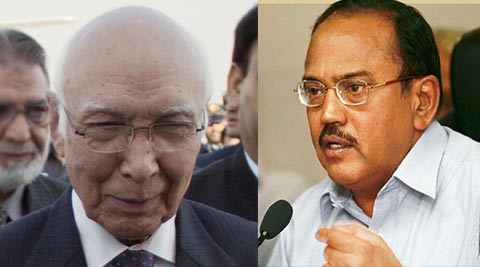

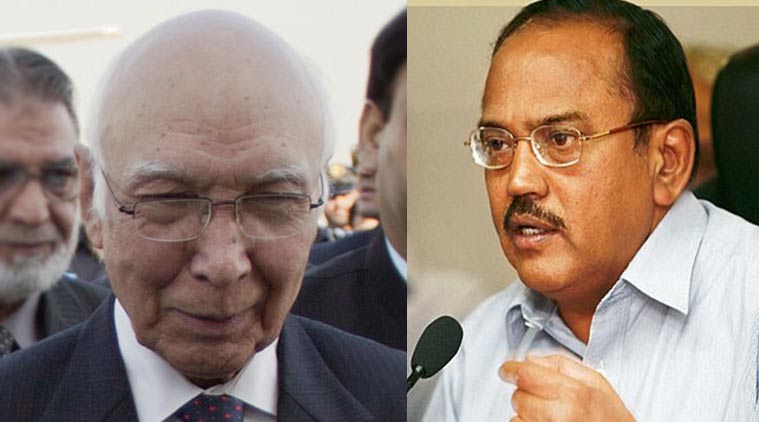
India’s national security advisor, Ajit Doval, is scheduled to meet his Pakistani counterpart, Sartaj Aziz — the first step forward for the narrowly focused security dialogue Prime Ministers Narendra Modi and Nawaz Sharif agreed to last month. The meeting couldn’t be taking place at a more appropriate time. In the last fortnight, the fragility of India-Pakistan peace has been underlined twice, first by the fidayeen strike on the Dinanagar police station in Gurdaspur, and then by the capture of alleged Lashkar-e-Taiba terrorist Muhammad Naveed in Udhampur. It doesn’t take much imagination to see that either event could have escalated into a full-blown crisis. Had bombs placed on the railway tracks in Gurdaspur detonated, scores of passengers may have been killed.
Many Indian soldiers may have died had Naveed’s attack proved successful. Events like these, in the future, could well compel the Modi government to respond in a muscular fashion, potentially sparking events that are in the interests of neither New Delhi nor Islamabad. Modi and Sharif agreed to resume dialogue not because either is a dovish romantic, but to prevent precisely such a crisis. Now, the process will be put to test.


Large parts of Pakistan’s military establishment see no dividend in cracking down on terrorist groups operating against India. Indeed, it may seem to be tactically useful to recruit them to the coalition against those jihadists determined to overthrow the state. The meeting is a good opportunity for Delhi to make clear that this may not prove a cost-free enterprise, crisis-averse as Modi’s economy-focused government may be. History isn’t stacked in favour of the process: the Joint Anti-Terrorism Mechanism set up by PMs Manmohan Singh and Syed Yousuf Raza Gilani in 2009 yielded precisely nothing, while covert contacts between Indian and Pakistani intelligence chiefs had few tangible results. The awful costs of failure, though, are good enough reason to try again.


