
Opinion Versus Narendra Modi
Its debut rally was a riposte to Modi, the grand alliance in Bihar seemed to lack a voice of its own.
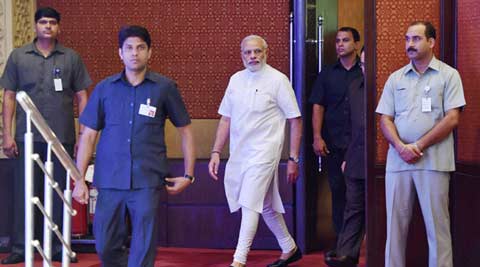


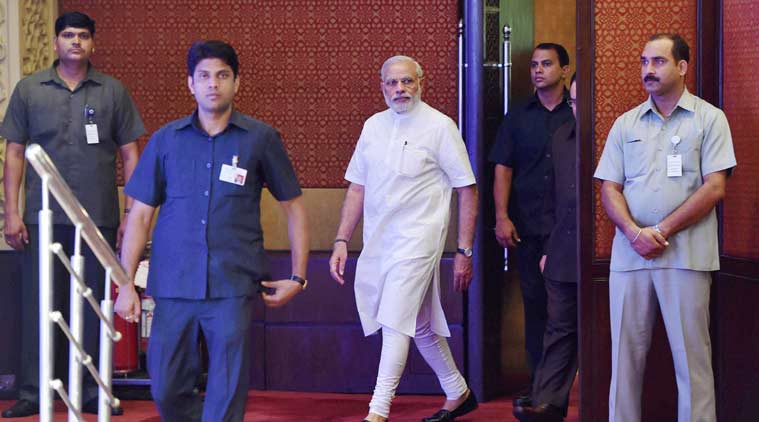 The grand alliance parties only come together now to fight off the Modi-led BJP’s ascendancy in Bihar, and their shared opposition to Modi helps them paper over the vigorous contradictions between them otherwise.
If Congress vice president Rahul Gandhi and SP chief Mulayam Singh Yadav were notable by their absence at the first rally of the maha gathbandhan, or grand alliance, in Patna, Prime Minister Narendra Modi was the most conspicuous presence. Modi did not stride that stage, of course. But he was very much there, as each of the main speakers — Chief Minister Nitish Kumar, Congress president Sonia Gandhi, and RJD chief Lalu Prasad — addressed him, reacted to him, challenged him or taunted him in their speeches. Modi’s comment about his “DNA” became the refrain that anchored Nitish Kumar’s speech. Sonia Gandhi listed out the alleged failures of the Modi government at the Centre in hers, from foreign policy to jobs. And Modi was also the target of the collection of dares, jabs and one-liners that was Lalu Prasad’s speech. To an extent, it was inevitable, this centring of Modi by the grand alliance of the Congress, JD(U) and RJD. After all, these parties have only come together now to fight off the Modi-led BJP’s ascendancy in Bihar, and their shared opposition to Modi helps them paper over the vigorous contradictions between them otherwise. Yet, Modi’s centrality also raises a fundamental question the alliance must grapple with.
[related-post]

How much of the agenda of the alliance against Modi will be about Modi? In other words, as they go to the people, is their opposition to Modi going to be the sole or defining creed for the Congress, RJD and JD(U)? On Sunday, Nitish Kumar, who is also the leader of the alliance, spoke like the challenger, not the incumbent who has a record of governance over two terms during a crucial phase in the state to take to the electorate. Will the grand alliance continue to take its cue from the Modi campaign, and concede primacy to it, or will it attempt to frame the agenda in a state of congealed identities and vast inequalities that is also roiled by large transformations and ongoing transitions that blur and smudge many of the dividing lines? The answer to this question will decide not just the tactics of the RJD-JD(U)-Congress campaign, but also its content.
It will frame the choice for the people in a crucial election that can potentially reset the salience of the politics of “social justice”, “secularism vs communalism” and “development”, and the relationship between them in Bihar. It could also reshape the tone and tenor of the politics of both the ruling party and the opposition in the country.
 Share
Share


