
Opinion Share and care
The Centre must take into confidence states in the Northeast on the Naga peace deal
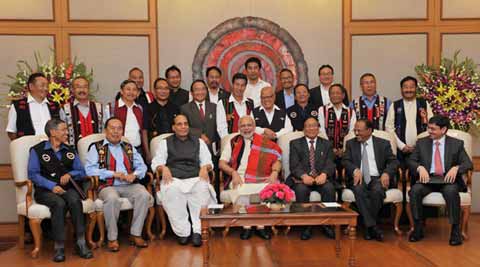 Prime Minister Narendra Modi with Union Home Minister Rajnath Singh, NSCN (IM) General Secretary, Thuingaleng Muivah, NSA, Ajit Doval and others at the signing ceremony of historic peace accord between Government of India & NSCN, in New Delhi on Monday. (Source: PTI)

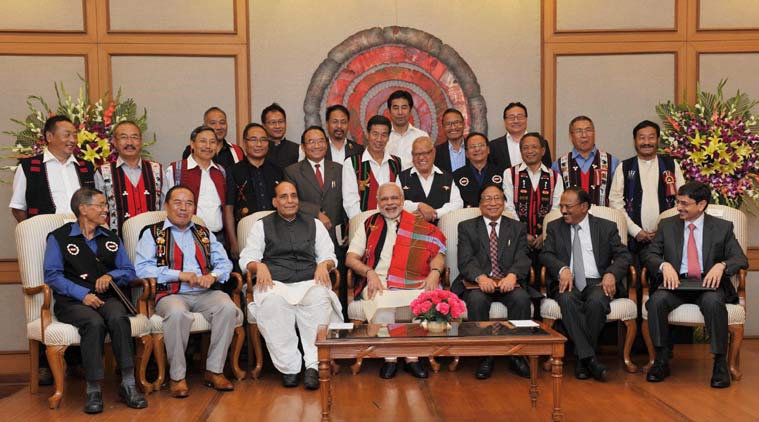 The Naga insurgency is not limited to Nagaland, and a peace deal may have implications for neighbouring states, especially since the idea of Nagalim propounded by the rebels involves redrawing inter-state boundaries. (Source: PTI file photo)
A week after Prime Minister Narendra Modi announced that the government had signed a historic peace accord with the leaders of rebel group National Socialist Council of Nagaland (Isak-Muivah), the terms of the agreement remain unknown. The home ministry has reportedly asked for details of the deal from interlocutor R N Ravi. The chief ministers of Nagaland’s neighbouring states, Manipur, Assam and Arunachal Pradesh, have protested that they were not consulted. The Naga insurgency is not limited to Nagaland, and a peace deal may have implications for neighbouring states, especially since the idea of Nagalim propounded by the rebels involves redrawing inter-state boundaries. There are multiple stakeholders in the dispute. It is necessary for the Centre to keep them in the loop if the accord is to succeed. And the accord, which could end India’s longest-running insurgency, must succeed.
The Naga peace talks have been carefully piloted through choppy waters by successive interlocutors since the early 1990s. A middle ground acceptable to the rebels and the Centre seems to have been reached. But there has been total silence on the part of the Centre since the photo-op of August 3, triggering speculation. It is important for the government to clarify the contours of the agreement to Kohima’s neighbours, at least. Some clarity was provided by Nagaland CM T R Zeliang, who said that the peace pact is only a formula for a “final accord”. Zeliang also said that he would speak to his counterparts in the other states, and allay their apprehensions. He confirmed reports that a group representing Naga civil society will travel to Myanmar and talk to the NSCN faction headed by S.S. Khaplang. The durability of the peace agreement will depend on its endorsement by a broader spectrum of Naga political and civil society. Past Naga peace agreements, including the Shillong Accord, failed because they appealed only to a limited section.

This time, there is a groundswell for peace in the region and the Centre must not let the moment pass. However, the government’s intransigence on the talks could trigger undercurrents that may work against a permanent settlement of the insurgency. Territorial nationalism has a resonance across the region. A settlement in Nagaland should not fuel new rebellions in its neighbourhood. Hence, it is necessary for the Centre to build a consensus among the various states of the Northeast on the peace agreement.
 Share
Share


