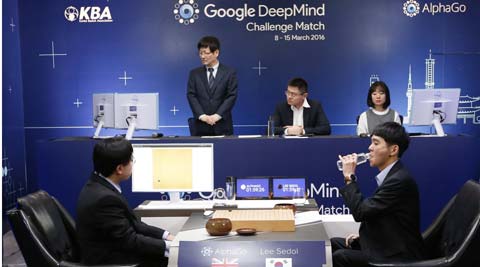


On Sunday, after a hat-trick of wins, Google’s AlphaGo programme surrendered a game of Go to a human, South Korea’s Lee Se-dol. The news made waves in Korea, which read it as a reaffirmation of the anthropocentric universe. That’s because Korea is mad about Go, with 24-hour TV channels covering tournaments non-stop. At first, the significance of the series of human-computer Go games in Seoul was not appreciated in the rest of the world. Computers have repeatedly defeated chess grandmasters, right, so what’s the big deal?


But it’s just a game, right? It is, and weirdly enough, many aspects of human behaviour can be modelled as maximisation games. The possibilities for deep, human-like intelligence in autonomous connected devices are both amazing and fearsome. Autonomous devices are deployed in a wide range of formats, from the home thermostat to complex weapons systems. The possibility that machines can think like humans, and better than us, raises humankind’s second-oldest anxiety after the fear of death: The rise of the machines. For now, it’s only a game, and the machine has won 3:1. Humans can be sporting about it.


