

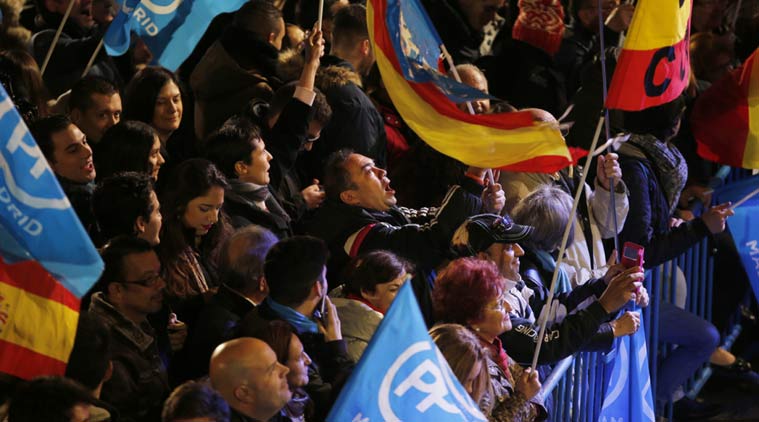
If the eurozone’s old order had looked askance at Greece’s casually dressed Alexis Tsipras as he stormed to power, they were apprehensive of Spain’s ponytailed Pablo Iglesias pulling a Syriza with his Podemos, the anti-austerity party formed amid “la crisis”. Podemos didn’t win the Spanish general elections on Sunday, to the relief of Brussels and Berlin. Yet, the Spanish polity is unrecognisably changed.
The first casualty is bipartidismo, or the two-party structure, which had given stability to a divided post-Franco Spain, but in time came to be associated with cronyism. Prime Minister Mariano Rajoy’s Popular Party (PP) has finished first, although its vote share has shrunk from 44.6 to 28.7 per cent and its majority is gone. But it’s the plight of the Socialist Party (PSOE) — at 22 per cent and almost beaten by Podemos at 20.6 per cent, along with fourth-placed Ciudadanos taking 13.9 per cent — that now makes Spain a four-party state. This “earthquake” is best pictured by the electoral map, with the PP-PSOE binary enduring in rural and small-town Spain while Podemos and Ciudadanos have done well in cities like Madrid and Barcelona. The result is a testament to popular disenchantment with the traditional parties, damaged by the economic crisis and high-profile corruption scandals. Ironically, the PP’s economic management has taken Spain from the nadir of the financial crisis to a period of remarkable growth, which may cap at 3 per cent this fiscal.


