
Opinion Bonfire of justice
Without police reforms, Gujarat’s proposed counter-terror law will, once more, institutionalise persistent abuses.
 jr24-cm-03
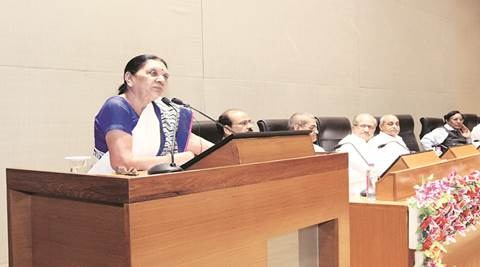
Chief Minister Anandiben Patel announces education pacakage for economically weaker section at secretariat in Gandhinagar on Thursday.
jr24-cm-03
Chief Minister Anandiben Patel announces education pacakage for economically weaker section at secretariat in Gandhinagar on Thursday. 

Pranab Mukherjee has become the third president whose consent has been sought for Gujarat’s new counter-terrorism law — in its latest variant, named the Gujarat Control of Terrorism and Organised Crime Bill (GCTOC). His predecessors, A.P.J. Abdul Kalam and Pratibha Patil, had rejected earlier bills. This time, it has the backing of the Union home ministry. The contentious features of the proposed law are well-known: It allows for electronically recorded confessional statements, if made to a superintendent of police, to be admitted in evidence; extends police custody to 180 days; and makes bail extremely hard to obtain. Gujarat had complained — not without reason — that the earlier denial of presidential assent had been politically motivated, noting that Congress governments had passed similar legislation in Maharashtra and Karnataka.
Yet, three wrongs don’t make a right. The reasons for concern are rooted in the history of the mercifully repealed mother legislation — the notorious Terrorism and Disruptive Activities (Prevention) Act (TADA). TADA was widely abused: Gujarat, with no terrorism problem, initiated 19,000 of the 67,000-odd cases, using it with equal enthusiasm against bootleggers, small-time criminals, and the completely innocent. Also, 80 per cent of TADA cases were registered against Muslims, suggesting flagrant communal bias. Besides, there was compelling evidence of confessions being coerced, often through torture. It achieved little — the late Rajesh Pilot, then internal security minister, admitted that, between 1985 and 1994, just 8,000 of 67,000 TADA cases went to trial, and just 725 people were convicted. Maharashtra’s Control of Organised Crime Act, too, has engendered exactly this kind of abuses.

A real debate is needed on the criminal justice tools India has to deal with terrorism. India’s laws weren’t designed to deal with situations where civil institutions collapsed in the face of insurgencies — as seen in Punjab, Chhattisgarh and the Northeast. Moreover, nation-states have had to introduce new laws not dissimilar to the GCTOC to deal with the challenges of transnational terrorism, carried out by skilled personnel trained to defeat law-enforcement. Elsewhere, these legal instruments were introduced along with substantial enhancement in police investigative capacity — and, critically, police accountability. Indian lawmakers have done next to nothing to bring police forces out of the colonial era. In the absence of police capacity-building, brutality remains the principal investigative tool. Laws like the GCTOC institutionalise this. Their outcome will be a bonfire of justice — the cornerstone on which our republic rests.
 Share
Share


