
Opinion VB-G RAM G Bill annihilates MGNREGA and undermines rural India’s right to work
This Bill must be comprehensively rejected. MGNREGA has had many problems, but it has served rural India well and served India extremely well in times of economic distress. Much could have been strengthened within its own framework
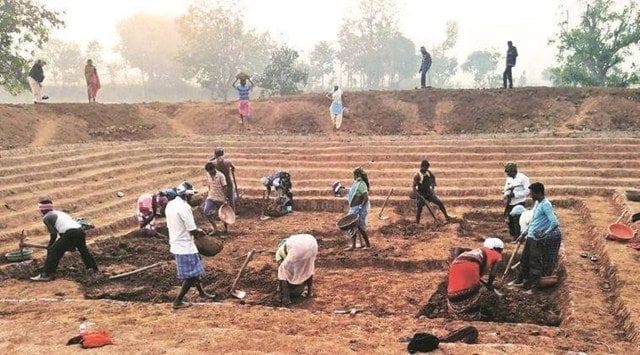 Just four provisions of the proposed law will make it clear how false the statutory guarantee is.



On December 15, with no prior consultation, the central government scheduled the introduction of a bill to repeal the Mahatma Gandhi National Rural Employment Guarantee Act (MGNREGA) and replace it with the Viksit Bharat Guarantee for Rozgar and Ajeevika Mission (Gramin) — VB-G RAM G Bill, 2025. In fact, this Bill should have been two different pieces of legislation, because the MGNREGA and VB-G RAM G are fundamentally different in scope and objective.
The Bill replaces MGNREGA’s basic entitlement to ask for work. In fact, there is no element of the right to work. Even though the object and reasons of the Bill are stated as “a bill to establish a rural development framework aligned with the national vision of Viksit Bharat @2047 by providing a statutory guarantee of 125 days’ wage employment in every financial year to every rural household whose adult members volunteer to undertake unskilled manual work”.

G RAM G undermines the fundamental guarantees that MGNREGA provided: A central government-funded, demand-driven employment programme, guaranteeing 100 days of work per household, anywhere in rural India. The Bill repeals the MGNREGA and its statutory guarantees, and replaces it with a central government scheme that provides no guarantees at all. It actually takes us back to the days before MGNREGA, when programmes like the Jawahar Rozgar Yojana (JRY) and the Employment Assurance Scheme provided no more than a name of Rural Employment “Assurance” and gave less than 10 days of work in most parts of the country.
Just four provisions of the proposed law will make it clear how false the statutory guarantee is. It is worth examining the key legal sections and sub-sections of the Bill and understanding their implications.
First, Section 4 (5) of the Bill states, “The central government shall determine the state-wise normative allocation for each financial year, based on objective parameters as may be prescribed by the central government.” The MGNREGA bottom-up demand-based employment programme, guaranteeing 100 days of work per household by legislation, has been replaced by an allocation-based scheme, where the Centre and its bureaucratic machinery are at liberty to alter and determine the quantum of allocation. The norms and reasons are, in fact, prescribed by itself.
Second, Section 5 (1) of the Bill demolishes the idea of a universal entitlement across rural India. It states: “Save as otherwise provided, the state government shall in such rural areas in the state as may be notified by the Central Government, provide to every household whose adult members volunteer to do unskilled manual work, not less than 125 days of guaranteed employment in a financial year in accordance with the scheme made under this Act.” The central government has thus made it clear that this scheme will only run in those parts of the country that it may notify. Even in those areas, it is the state government that is made responsible for providing 125 days of work as per central government norms. The enhancement from 100 to 125 is clearly a hollow promise because MGNREGA has suffered from being squeezed due to allocations that fail to meet demand for work. As a result, even the MGNREGA was only able to provide roughly 50-55 days of employment per year in the last five years.
Third, if the states were to decide to provide their own resources to run an employment scheme that was more universal and robust, in order to reduce rural unemployment and distress, any money spent by the states would be subject to the norms decided by the central government. Section 4 (6) states, “Any expenditure incurred by a state in excess of its normative allocation shall be borne by the state government in such manner and by such procedure as may be prescribed by the central government.” Money provided by the states — norms decided by the Centre.
A fourth provision that is likely to render even the scheme under the new legislation a non-starter can be found in Section 22 (2), which states, “For the purposes of this Act, the fund sharing pattern between the central government and the state government shall be… 60:40.” This is apart from the North-Eastern States, Hill States & Union Territories where the central government share will be 90:10. Under Section 22 of MGNREGA, the Centre provided 100 per cent of the labour component (thus guaranteeing a national employment guarantee) and 75 per cent of the material component. In other words, the central government’s share was at least 90 per cent of the total expenditure and responsibility for unemployment allowance and compensations for delayed payment of wages in case of a paucity of resources could clearly be placed on it. Under the new G RAM G scheme, it is very doubtful that the states would want to provide the 40 per cent to fund a scheme where all the controls lie with the Centre. In all likelihood, the scheme would become a damp squib with neither employment guarantees attracting people nor sufficient central funds driving “empowerment, growth, convergence and saturation for a prosperous and resilient rural Bharat”, as stated in the object and reasons of the Bill.
This Bill must be comprehensively rejected. There is nothing in it in terms of “reform” that makes it more attractive or effective for the rural poor. MGNREGA has had many problems, but most have stemmed from poor implementation. It has served rural India well, and served India extremely well in times of economic distress. Much could have been strengthened within its own framework to help India deal with climate distress and better water and resource management.
MGNREGA is a people’s law that came in with the popular slogan Har haath ko kaam do, kaam ka pura daam do. It provided entitlements beyond a hundred days of work, helped reform rural governance, and provided at least 10 entitlements that empowered people to fight for and secure their right to work. Barring transparency in implementation and social audits, this law undermines most of the entitlements of MGNREGA, including decentralised planning. The objects outlined in the short title and the objects and reasons can never be achieved through G RAM G. In fact, to be true to the objects, the Bill should be withdrawn, and MGNREGA should be enhanced to 125 days at enhanced minimum wages. Only then will we move closer to the most reasonable demand of every Indian, “every hand getting work, and all work getting a just reward.” The political establishment must understand that no Bill can quell that aspiration.
It is appropriate to remind the ruling party that the MGNREGA was passed in 2005 amidst chants of “Rozgar guarantee zindabad” with a historic consensus between all parties. The BJP’s attempt to stealthily repeal the law is not just a disservice to the dignity of labour, but also undermines the basic tenets of democratic consensus-building.
The writers are social activists and founder members of the Mazdoor Kisan Shakti Sangathan (MKSS)

 Share
Share


