
Opinion With US no longer reliable, India must step up on climate action
Delayed domestic action on climate change on the part of a large emitter like the US is hurtling the world that much faster towards a devastating 2-degrees-Celsius warmer world. For India, building a climate resilient economy and focusing on emission mitigation in the near term must remain an important prerogative
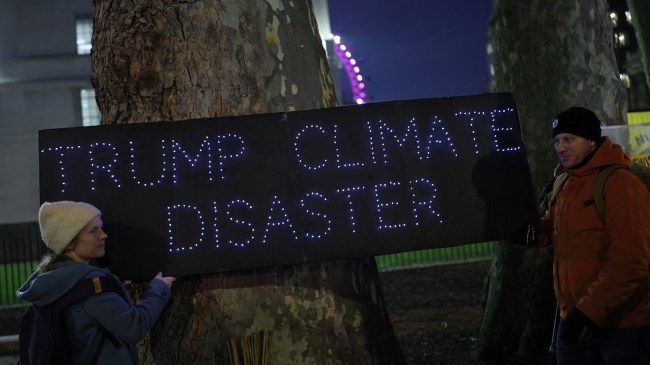 Delayed domestic action on climate change on the part of a large emitter like the US is hurtling the world that much faster towards a devastating 2-degrees-Celsius warmer world. (Photo: Reuters)

On the first day of his second term, President Donald Trump signed an order directing the withdrawal of the United States from the Paris Agreement — for the second time. The first time he withdrew the US in June 2017, it came six months into his tenure, but the bite was milder. Article 28 of the Paris Agreement restricts a country from giving notice of withdrawal within three years of ratification by the country. This meant that there was a semblance of continuance and commitment to the terms of the Agreement until Joe Biden came to power, although it was not legally binding.
The withdrawal in 2017, however, did impact funding for various activities under the Intergovernmental Panel on Climate Change (IPCC), an apex scientific body that synthesises the science and policies driving climate change, and advocates for more action to mitigate it. In addition, funding for R&D to various entities within and outside the US was cut, and progress was slower on multiple fronts. Joe Biden reinstated the US commitment in January 2021 and passed the Inflation Reduction Act in 2022 with bipartisan support, which would have funnelled investments to the tune of $1 trillion (by some estimates), into the green economy. Leaders and scientists cheered this development, which gave cautious optimism for the US leading the charge, especially through cutting-edge R&D and potentially accelerating its own emission reductions by an additional 15 per cent by 2030 (compared to 2005 levels). However, this encore to President Trump’s 2017 actions will further climate skepticism in the US and across other parts of the world. Moreover, the planned heavy tariffs on China — the current leader in many ways in clean technology manufacturing and deployment — could impact the outlook for emission mitigation. But the resolute must strive on.

The US remains the second-largest emitter of greenhouse gases, behind China. Research by the Council on Energy, Environment and Water (CEEW), in the lead-up to the Glasgow COP in 2021, evaluated that even if the net zero pledges of the US were to be met (by 2050), the US would have contributed to a quarter of the cumulative global emissions by 2100. The US has remained the world’s largest producer of petroleum and natural gas since 2018, and even under the Biden administration, new drilling did not cease. Delayed domestic action on climate change on the part of a large emitter like the US is hurtling the world that much faster towards a devastating 2-degrees-Celsius warmer world.
Beyond the obvious implications for emissions from the US, climate-friendly legislation such as the IRA, which significantly benefited Republican constituencies more, will likely continue to see uptake. The trade wars and clamping down on funding for R&D will mean that China could become the focal point for new R&D in clean and emerging technologies —more so than now — and also become a bigger provider of technology and materials, old and new, to the developing and the developed world.
So, where does India stand now?
India and the developing world, which are on a path to increasing energy consumption and improving quality of life, are on track to embrace clean technology in its various forms. No matter the road the US takes, building a climate resilient economy and focusing on emission mitigation in the near term must remain an important prerogative for India. The economic opportunities to diversify industrial production and create livelihoods improve significantly when considering the clean technology basket. Climate risks pose significant economic risks across value chains — from food to fuel, from farmers to factories — and with the US departure, these risks will only become more certain.
Clean energy is cost-competitive and offers a credible alternative to fossil fuel-led transition strategies, especially ones that depend on expensive natural gas, which has long been touted as a transition fuel. Whether it is renewable energy for electricity generation, electric vehicles for emission-free urban mobility, or green hydrogen to produce ammonia and fertilisers, these represent sunrise sectors in the midst of a global energy order in flux. While the allure and perhaps the pressure of having to consume US-supplied LNG may increase under the new Trump administration, the target for developing countries is clear — minimise the impact of climate change by adopting resilient practices across different economic sectors and activities. Further, the global financial order is still a Western-dominated one. It is imperative that we work with the private sector and the guardians of private capital to create the right conditions for it to be allocated to climate action in the developing world. The “new” math is clear — a greener economy brings in profit for both people and the planet.
As Kishore Mahbubani presciently noted, the 21st century is the Asian century and what better way to transition to the new order, than for India and others in the Global South to fill the vacuum that the US will leave by exiting the stage at a crucial juncture in the global effort to reshape economic thinking, driven by climate change considerations.
Ganesan is Fellow and Director, Strategic Partnerships at the Council on Energy, Environment and Water (CEEW). Views are personal

 Share
Share


