
Opinion To save the Aravallis, think like a mountain
To think like a mountain is to appreciate the profound interconnectedness of an ecosystem that is a result of evolutionary interdependence. The controversy over the 100-meter height rule is an example of short-termism
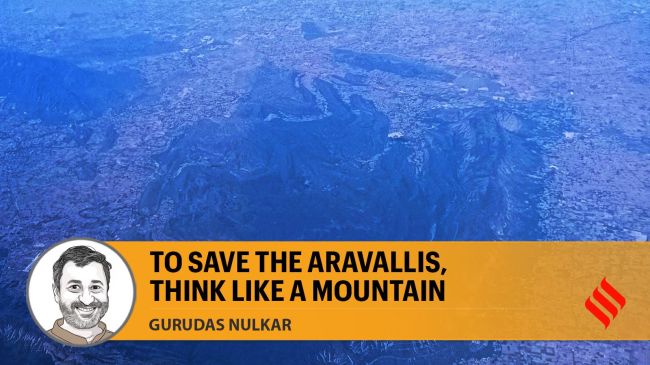 An aerial view of the Aravallis in Haryana. (Tashi Tobgyal)

The Aravalli mountain range, an ancient geological formation that predates the Himalayas, is at the centre of a high-stakes legal and ecological battle. The hills have been subjected to intensive quarrying and mining in Rajasthan and Haryana, while construction and urban sprawl have shrunk them in the National Capital Region. Recently, the Supreme Court paused the controversial order identifying the mountains based on their height, which could have wiped out the legal protection of a large part of the range. However, the crisis persists. With over 1,200 active mining leases hollowing out hills, it is time our policymakers “think like a mountain” — a term coined by the ecologist Aldo Leopold.
In his classic, A Sand County Almanac, Leopold describes how, in his youth, hunting wolves was a celebrated sport — fewer wolves would mean more deer, a hunter’s veritable paradise. On one such hunt, Leopold watched the “fierce green fire” die in the wolf’s eyes. It was then that realisation dawned upon him that the mountain did not agree with killing wolves. As more wolves are shot, the population of deer increases, and they strip the mountain of its vegetation. The over-grazed mountains lose their soil to erosion and, over time, face a total ecosystem collapse.

The current approach to the Aravalli hills mirrors Leopold’s early mistake. Policymakers often fall into the trap of prioritising short-term objectives over long-term stability. The race for construction materials has left deep gouges in the mountains, which disturb natural drainage systems, uproot forests and disrupt food webs. The mountains influence the monsoon in northern India and present a formidable barrier that arrests the eastward drift of the Thar Desert. Their fractured rock profiles recharge aquifers. Most importantly, they are biological corridors that maintain the gene pool and capture carbon.
To think like a mountain is to appreciate the profound interconnectedness of an ecosystem that is a result of evolutionary interdependence. The controversy over the 100-metre height rule is an example of short-termism. Defining a hill only by height is an oversimplification for the sake of convenience. The low-lying ridges outside the arbitrary height threshold are exposed to the risk of quarrying. Thankfully, the SC directed a new committee to study the Aravallis, stating that this definition might trigger profuse quarrying in the ecologically sensitive areas. This leaves hope because decisions that have a long-term ecological impact must be based on interdisciplinary research.
To think like a mountain, policymakers must ignore administrative boundaries and treat the Aravalli range as a single system. District-wise mining plans must be replaced by a single management plan for sustainable mining that considers the integrity of the entire Aravalli ecosystem. Policies must value the work done in geological timescale. While forests can grow back in decades, a mountain range formed over millions of years is irreplaceable.
As Leopold’s philosophy implies, prioritising for immediate gains often yields danger in the long run. If our leaders do not learn to think like the mountain, our future will be ecologically poorer, and that would be most unfortunate for the people of a megadiverse country like India.
The writer is director, Centre for Sustainable Development, Gokhale Institute of Politics and Economics, Pune

 Share
Share


