
Opinion One Election will mean less democracy
Representation and periodic elections are the mainstay of modern mass democracies. A fixed and rigid period, as under One Nation, One Election, will make the ruling party complacent and the Opposition desperate
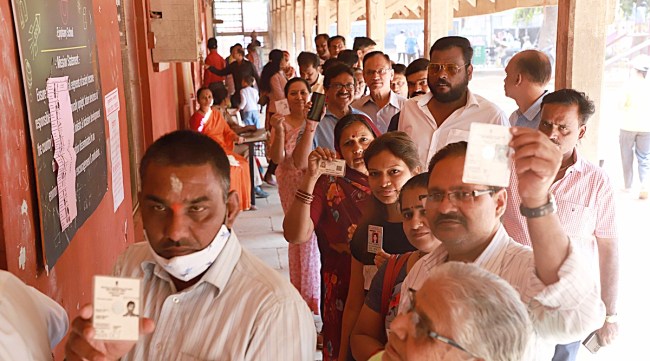 Apart from the fact that this futuristic perfect scheme of election, every five years, involving national, state and panchayat elections, has not been implemented in any democratic setup anywhere else, the proposal suffers from several over-simplifications. (Express Photo by Pavan Khengre)

I was reminded of Rousseau’s famous remark that British people are free only during elections as I was reading Venkaiah Naidu’s article (‘One election, many solutions’, IE, September 22). Contrary to its title, the conclusion of the article is one election and no solution.
Naidu’s article supposedly provides a blueprint that will remedy many, if not all the fault lines in the present electoral system in which small or big elections are a continuous process. It unsettles a desirable level with the primacy of national interest (an interest that is not explicitly stated or dissected), the enormous cost that is incurred in the present system of periodic (and probably in Naidu’s argument, unnecessary) elections and an unproved assertion of voter fatigue.

Apart from the fact that this futuristic perfect scheme of election, every five years, involving national, state and panchayat elections, has not been implemented in any democratic setup anywhere else, the proposal suffers from several over-simplifications. It undermines the immense value of continuous electoral interventions in strengthening democracy, especially in a country like India which has major contradictions and suffers from a crisis of governability.
B R Ambedkar reminded us that the Indian Constitution was promulgated at a time when India was still a nation in the making. He reminded us that the same was true in the case of the US constitution. But the US, unlike India, was not a society of major contradictions. This is borne out by the fact that the Indian Constitution, besides the articles on fundamental rights and constitutional court, is also a document, as pointed out by Granville Austin, of social revolution. The political process reflects the social process and to expect a lasting consensus from an inegalitarian societal base that is volatile and exploitative is a tall order.
In the evolution of a consensual basis of politics, the Scandinavian example is often cited. But here each component nation follows a particular pattern, clearly distinguishing between constitutional monarchies and republics. Three important components of this unity are — the free flow of ideas, political exchanges and intergovernmental elite accommodation. But what is noteworthy is that even for such marked preference for a united action, there is no attempt to create a regional parliament or a federal state of Scandinavia. This is thought to be redundant as there exists a process of continuous consultation, reaffirming Tocqueville as he underlined the importance of people’s attitudes over formal institutions for the success of a democracy.
Consensual politics cannot be built with structures that are ossified, rigid and unreceptive to commonality, and elite accommodation frittering away India’s demographic advantage. The US too has a continuous process of electioneering but still, it had to incorporate the primary stages in the electoral process to dismantle Daley’s machine politics. To achieve a consensual basis for Indian politics, a continuous process of electoral participation is a must. The electoral process must filter and accommodate continuously common demands.
Regarding costs, in India, the expenses incurred by individual candidates are strictly laid down. This is unlike the US where the supreme court allows for unlimited expenditure by individual candidates. It also permits corporate funding. In India, at present, there is a limit on the expenditure individual candidates can make. This limit on poll expenses should be extended to political parties as well by capping the amount on their expenses. One way of doing it is to total up the number of candidates the party is fielding, add up the costs and then divide it equally among all its candidates.
More than voter fatigue, it is the fear on the part of the incumbents as at present, nearly 60 per cent or more lose their seats when contesting a second time. The poor and the underprivileged, borne out by any number of studies, participate in the electoral process enthusiastically — be it local, state or national-level elections.
Representation and periodic elections are the mainstay of modern mass democracies. A fixed and rigid period will make the ruling party complacent and the Opposition desperate. It would not only encourage horse-trading but would be detrimental to stability, and peaceful and orderly change. Even within the present system of continual elections, there are attempts to destabilise majority governments with defections as we saw in Maharashtra, Karnataka and Madhya Pradesh. The proposal for One Nation, One Election would also undermine both voter confidence and participation, made possible by staggered elections introduced by former election commissioner, T N Seshan. The point of capacity and feasibility would be the other compelling deterrents.
The writer retired as professor, Department of Political Science, University of Delhi

 Share
Share


