
Opinion Like Amma, like daughter?
Anuradha Vellat writes: Qala’s struggle to fulfill her mother’s aspirations reminded me of my own, when I was unable to communicate to my mother that I do not get along very well with maths or men, not necessarily in that order.
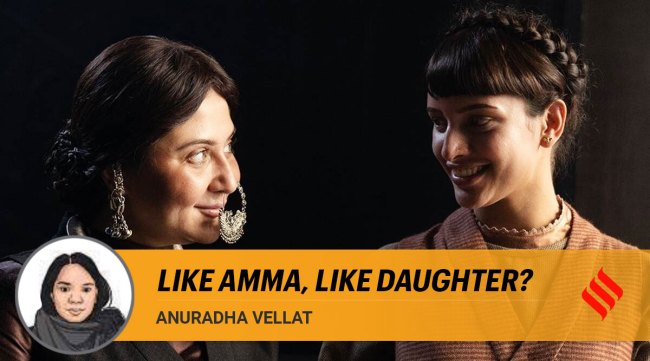 Swastika Mukherjee and Triptii Dimri play a mother-daughter duo in Anvita Dutta's Qala. (Twitter/Triptii Dimri)

I watched Anvita Dutt’s Qala recently and was thrown into a week-long discomfort. Qala’s (the protagonist) struggle to fulfill her mother’s aspirations reminded me of my own, when I was unable to communicate to my mother that I do not get along very well with maths or men, not necessarily in that order. Of course, Qala’s is not a plebeian struggle like mine: she has a certain artistic potential which gets thwarted by her mother’s need for a waaris aka the boy she never had. No, my struggle is more Indian middle-class — a career in financing and a boy to marry at the right age, both of which were my mother’s aspirations that I have so completely bypassed. Instead, here I am writing opinions on patriarchy while periodically being disappointed with the world.
But this is now, when the better sense has prevailed, accompanied by the recognition that ‘I can choose my own path’. This realisation only surfaced after years of conversations with well-meaning, like-minded friends and colleagues; reassuring sessions in therapy; and the dream that some day a cat may choose me and I will become the sassy cat lady.

We would subsequently fall into the deep ends of radio silence for months, my mother and I. In retrospect, one realises that these periods, the mid-twenties, were utterly confusing for me (and many of my friends), because I mistook my mother’s approval as my own. I mistook her vision as my own, her needs as my own, her tragedies as my own and her fears as my own. It was, and is difficult not to, because we take so much after our parents.
I am not a psychologist, so to support my argument, like a good journalist, I reached out to an expert. I asked Itisha Nagar, an assistant professor of psychology at Kamala Nehru College, why adults strive for an approval from their parents, especially mothers, that does not necessarily stem from respect but a sense of fear of losing oneself? She says, “Modern-day mothers have the role assigned by patriarchy to bring up good children, especially daughters who are domesticated but are also a little educated. They enable you to choose from a range of careers that aid your marriage and does not become a hurdle. Culturally speaking, mothers have a duty to make sure their children fit in… because every black sheep of a child is understood to be a case of bad parenting by the mother,” Nagar adds.
All of this makes it a differently intimate relationship than maybe what we have with our fathers. Somewhere in understanding our mothers’ emotions, or lack thereof, we develop a quiet relationship with ourselves that only wants a certain kind of growth. Most young adults want to make their own identity, which is only defined by not wanting to be their parents and instead we become spitting images of them. This identity crisis can range from the standards we set for the world to our stress-responses. It tells us what to trust and what to fear, it is also our window to the only world we know.
I do not think real growth is about trampling over any of this. Instead, it is about recognising parts of your parents in you, to understand their socio-political context that allowed them these aspirations, and put up a good fight for yourself regardless. Once in a while, it is fun to say to yourself: Oh, Amma used to do that!
National Editor Shalini Langer curates the ‘She Said’ column

 Share
Share


