
Opinion Lesson from IPL 2024: It’s time for T20 teams to follow KKR, SRH – and dare to go after every ball
Both teams took the format back to its early days. The thinking then was it was a hit-and-giggle game, and that batsmen were going to plunder every over.
 Sunrisers Hyderabad captain Pat Cummins and Kolkata Knight Riders skipper Shreyas Iyer at the toss during the IPL final. (PTI)

Ironically, it was left to the IPL final — the shortest format is still viewed a tad condescendingly by purists — to bring focus on the soul of the game. No distraction of the big stars. No farewell circus. No tiring hero worship from the fans and no booing of players. No nationalistic or parochial team vibes in the stands. No fighting over a lost captaincy or arguing over star players’ strike rates. Nothing but cricket.
Fittingly, the two teams that exhibited and attracted such vibes throughout the tournament made it to the final and though Kolkata Knight Riders won on a canter, Sunrisers Hyderabad didn’t fare badly in the larger scheme of things. Somewhat tellingly, no Indian player who is in the World Cup squad played in the IPL final, a statement in itself, but that’s a story for another day.

Not that there weren’t big players under the lights, but the duo of Gautam Gambhir, KKR’s mentor, and Pat Cummins, Australia and SRH captain, who won every title under the sun last year but stumbled in the IPL final at the last hurdle, have consistently kept the focus on their respective teams and their eyes on the game. KKR’s captain Shreyas Iyer bought into Gambhir’s vision, and Cummins used the coach Daniel Vettori’s knowledge at opportune times — like in drafting left-arm spinner Shahbaz Ahmed for the second qualifier.
Both teams showed the world how T20 is to be played in the modern era on batting pitches. They did it by taking it back to the days when the format was freshly seeded in our minds. The thinking then was it was a hit-and-giggle game, and that batsmen were going to plunder every over. Surprisingly, it didn’t quite pan out that way, perhaps due to largely conservative thinking that prevailed on the cricketing circuit. Not many teams extended themselves, and at best indulged in number crunching, match-ups, home-pitch tailoring, and conventional captaincy. The smarter of the lot tended to win: It’s not a surprise that Chennai Super Kings and Mumbai Indians tended to end up as winners in the IPL.
It needed a push from the system to poke through that conservative bubble. The impact substitute rule was introduced, and it has undeniably helped. Almost forced now to hit out, the teams finally went to that “hit-and-giggle” mentality that had never quite materialised until now. Of course, it came with lots of professional work with power hitters, borrowing concepts from baseball. But the blueprint was something that amateurs are familiar with – lagao and ghumao (slam and wallop).
SRH openers Travis Head and Abhishek Sharma aren’t the most muscled men in world cricket, but they showed how to lagao and ghumao if pitches remained flat. No more walking down the track from the non-striker if two fours had come in an over; instead they kept aiming for the sky. Same with KKR’s openers Sunil Narine and Phil Salt, who had to leave the tournament before the final lap but established their team’s approach. Other teams tried to internalise this approach as much as they could and those that didn’t fell away.
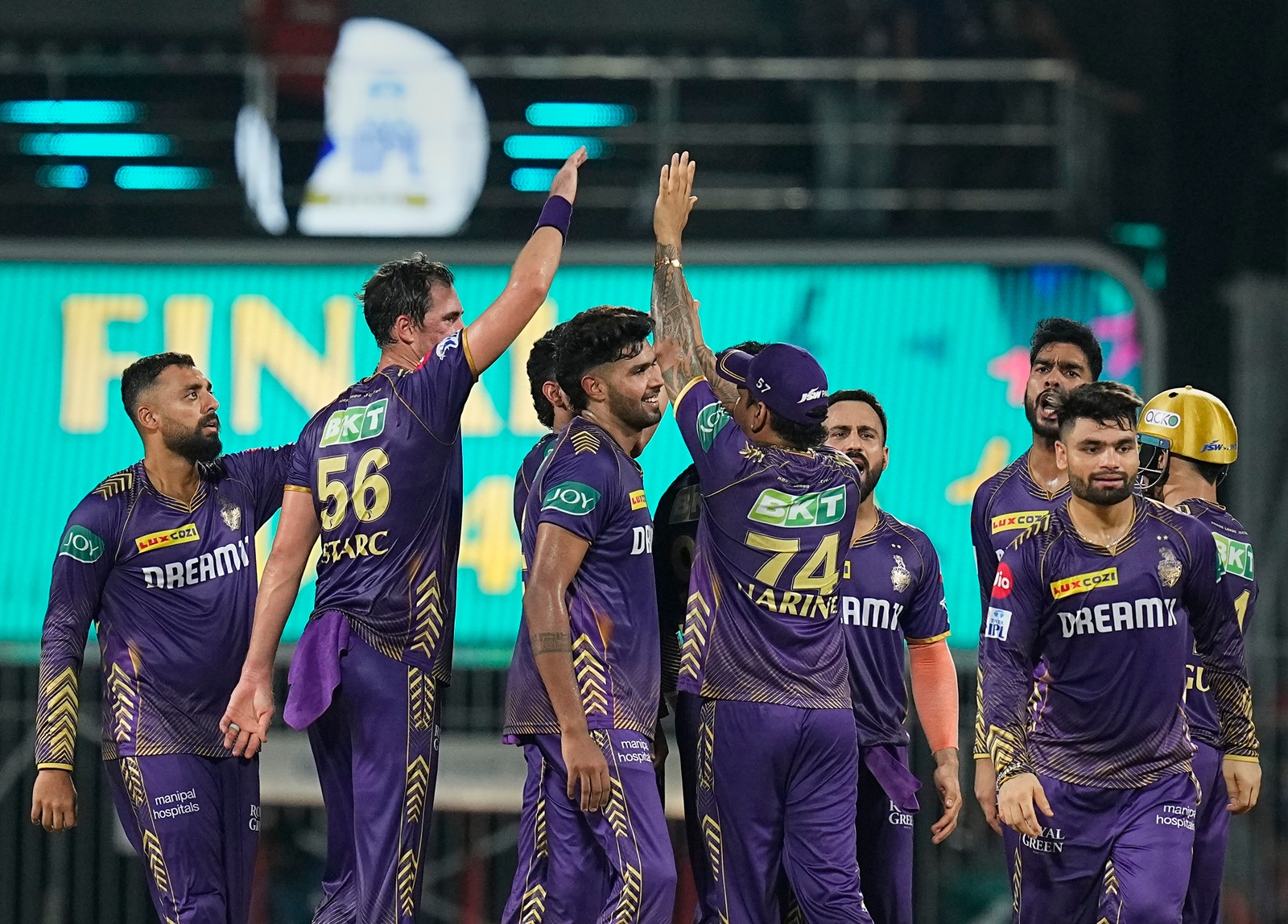 Kolkata Knight Riders’ Varun Chakravarthy with teammates celebrates the wicket of Sunrisers Hyderabad batter Shahbaz Ahmed during the IPL final. (PTI)
The bowlers were stunned and kept pushing the ball away from reach, until they realised that the bullies had to be stared in the eye — like Mitch Starc did in the first qualifier and then again in the final when he knifed through SRH’s top-order. Both teams didn’t exactly have a bowling arsenal in form to win games on their own in the first half of the tournament, especially SRH, and that perhaps pushed them to make their batting approach more macho. Buoyed by their batsmen, the bowlers too found their feet in both teams and it was SRH’s spin that allowed them to escape from qualifier 2 after posting a not-so-daunting total.
The pitches too started to slow down as the summer progressed, allowing the bowlers room to try things. The pre-monsoon clouds began to hover to aid some swing and finally, right at the end of the tournament, the bowlers began to find their voice. Like in the final. When the ball moved a tad, all the celebrated hitters began to stumble, but that’s not the blueprint to be taken from the tournament. For T20, the pitches will continue to remain batting-friendly across the world, and as long as that trend continues, conservatism isn’t the currency to be cashed. Other teams better take up the KKR or SRH way to maraud and intimidate the opposition. It might fail on days when the ball does something, but those days are rare in T20 and teams that live on a dare tend to progress through the tournament.
Teams that have the bowling ability to create havoc with pace or spin as KKR does in helpful conditions will undoubtedly prevail. But that’s a no-brainer as it’s applicable for any tournament anywhere. The main takeaway from this IPL will be how the batsmen finally jettisoned their cloak of restraint and went after that little white ball. Another is that teams that keep their eye on the ball and don’t get derailed by their own mythology or egos will progress. The rest are mere details.
sriram.veera@expressindia.com

 Share
Share


