
Opinion ‘Bahujan’, not ‘backward’: How to fix regressive legal language related to caste and class
Constructive critique and engagement with the use of certain words in law and the Constitution can help develop an egalitarian language of equality and empowerment for all
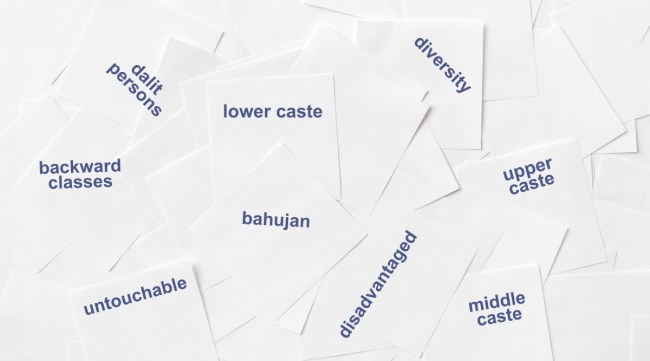 Arguing the need to fix regressive legal language related to caste and class (Representational image via Canva)


The Supreme Court of India recently released a handbook on combating gender stereotypes. Similar attention to the usages of the English language in relation to caste should also be explored.
Common usages of the English language are influenced by systemic inequalities and biases. Inadvertently, perhaps, some of these find their way into legal subjectivities too. This article brings attention to a sample set of six words (and their meanings) that are assigned to legal categories of caste and class in India; it explains why these assignments are problematic and suggests alternative usages/replacement words.

First, usages of words that denote “upper,” “middle,” and “lower” caste locations inevitably validate and normalise the previously assigned hierarchies of caste. These hierarchies are reproduced in our common usages of language. Any corresponding thought formation is then rendered at odds with aspirational ideas of equality and justice.
Hence, words like “upper”, “middle”, and “lower castes” should be avoided. Instead, depending on the context, alternatives like advantaged, privileged, empowered castes, dominant, dominating, domineering, oppressive, exploitative; disadvantaged, disempowered, subordinate, subordinated, oppressed, exploited castes can be used. These acknowledge the power structures that are imminent within the caste systems. Acknowledgement of these structures could expose and dislodge the falsehood of caste hierarchies.
Also, individuals and groups could be differently placed at different times and in different scenarios. For example, oppressed caste groups could have more oppressed sub-caste groups within. These intra-caste gradations and hierarchies are also functions of the caste systems that get eclipsed in more simplistic binaries of “upper” and “lower” castes.
Second, the word “untouchable” is bereft of any reference to personhood. Plus, it is an implicit validation and normalisation of contemporary practices of untouchability. Article 17 of the Constitution of India is explicit in abolishing the practice as such: “‘Untouchability’ is abolished and its practice in any form is forbidden.” Continued usages of the words “untouchability” and “untouchable” are degrading and dehumanising. Some alternative phrases could be “formerly considered untouchable persons” or “ex-untouchable persons, people, or groups”. “Ex” acknowledges the historicity of “untouchability,” and the suffix of persons, people, or groups is a modest qualification — as fellow human beings.
Third, affirmative action and reservations are functions of equality and non-discrimination as guaranteed in the Constitution of India, under Articles 14, 15, 16, 17, and 18. The words “benefit” and “beneficiary” are sometimes used to describe affirmative action. These words are associated with gaining advantage, profiting, and with charitable handouts. They could fuel feelings of shame and humiliation amidst people who are assumed to have unjustly “benefitted” and “profited” from reservations. These words could also fuel feelings of animosity and resentment among those who are denied such “benefits”. The so-called “beneficiaries” of reservations are thus smeared with stigma and shame.
Instead of words and phrases like “benefits /beneficiaries of reservations”, “facilities/recipients of reservations” may be more appropriate. Facilities and recipients are relatively neutral words that could mitigate some of the stigma and shame associated with affirmative action and “reservations”.
Article 46 makes an implicit assignment of meaning—to the Scheduled Castes and the Scheduled Tribes—as “weaker sections of the people.” This is fundamentally at odds with, and derogatory to, the dignity, strength, and resilience of a people who have withstood centuries of hostile oppression, exploitation, violence, and discrimination. Words like “Dalit persons, people or groups” are better suited.
“Dalit” literally translates to downtrodden. It acknowledges the conditions of a diverse set of people who have been historically oppressed by the practices of “untouchability”. While this acknowledgement could be considered empowering by some Dalit people, it is also internally contested and opposed — as a badge of insult. Internal contestations could be productive for our thought formation, dialogue and debate. Yet, those who prefer to avoid these contests could, at the very least, place the words within double inverted commas—“weaker sections of the people”—in acknowledgement of their origin.
According to Article 335 of the Constitution, “[t]he claims of the members of the Scheduled Castes and the Scheduled Tribes shall be taken into consideration, consistently with the maintenance of efficiency of administration”. This seems to imply that the idea of efficiency is inconsistent and at odds with the claims of the members of the Scheduled Castes (SC) and the Scheduled Tribes (ST). The proviso segment of the same Article further allows “lowering the standards of evaluation”. A corresponding usage of the word “merit” circulates as a proxy for the non-reserved general categories, while the members of the reserved categories, including the Scheduled Castes and the Scheduled Tribes, are rendered implicitly and pervasively unmeritorious at all times. The problem with this usage of merit is that the word is not defined and it often operates on mistaken presumptions. Substituting with wording like “diversity”, and “diversifying the standards” is preferred.
“The claims of the SC and the ST persons could be taken into consideration while also being consistent with the maintenance of diversity” — in this reformulation, the claims of the SC and the ST persons are rendered consistent with the idea of diversity; and an implied inconsistency with efficiency is avoided. Similarly, the standards of evaluation could be simply “different”, “differentiated”, and “diversified”—this avoids the pejorative connotation of the word “lower.” Also, “merit” should be avoided altogether unless there is an accompanying clear understanding of what the word means: Is merit inherent? Is merit constructed and acquired? Is merit an inadvertent outcome—of systemic privileges and deprivations?
The term “backward classes,” also has a pejorative assignment and meaning embedded in the Constitution of India. The idea of backward classes is included in the provisions on equality in Article 15, sub-clause 4 and Article 16, sub-clause 4. The literal meaning of the word “backwardness” could have pejorative connotations. To a racialised, colonial mindset, perhaps, all “native” persons were backward and uncivilised. Any pejorative connotations of this “backwardness” remain uncontested within the constitutional law discourse in India; rather, certain caste groups have eagerly sought to be included within these categories — in order to avail of affirmative action. A related term, “forward” castes and classes, is a discursive outcome of the existing legal formulations of backwardness. By default then, “forward” castes are all caste denominations that are not categorised as backward classes, SC, or ST.
Depending on the context, within double-inverted commas, at least once, clarify the borrowed secondary usage: “backward;” alternately, consider using the word “Bahujan”.
The usage of Bahujan is found in Hindu and Buddhist texts, and literally refers to “many people,” or “the majority.” It connotes the combined population of the SC, the ST, Other Backward Classes, Muslims, and minorities who together constitute the demographic majority of India. There’s also a longer ideological discourse rooted in the usage of the word (Bahujan) by a well-known political figure, Kanshi Ram, in the past.
Constructive critique and engagement with more of these distortions would generate an egalitarian language of equality and empowerment for all.
The writer teaches constitutional law, and among other written works, views in this article are informed by their comparative reading of Critical Race Theory

 Share
Share


