
Opinion Ending the era of extremes
Jeremy Corbyn and Donald Trump don’t represent a solution but the search for one



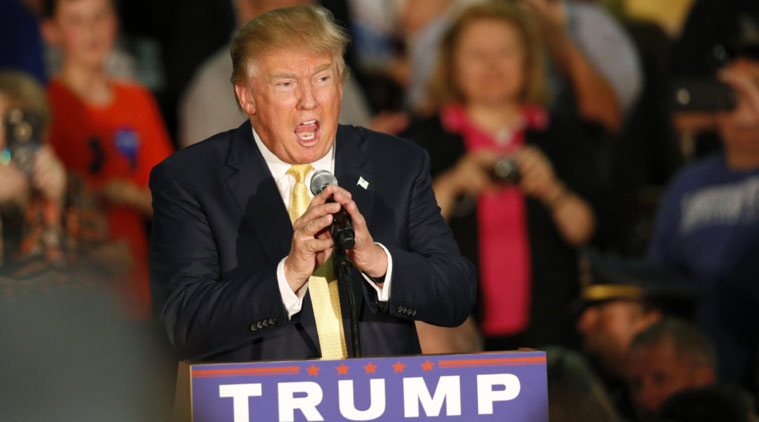 Republican presidential candidate Donald Trump speaks at a town hall event in Rochester. (AP Photo)
One earthquake has already happened and another is about to happen. The world is already shaking in horror and disbelief. The first is Jeremy Corbyn, the other is Donald Trump. Till a few weeks ago, Corbyn was a backbencher, a nonentity, who has suddenly taken centrestage. The world is talking about him on his election as leader of the Labour Party. Tony Blair is furious. He said, “The party is walking with eyes shut, arms outstretched over the cliff’s edge to the jagged rocks below.”
Corbyn is considered left of the left in the socialist movement. He believes in a stronger role for the state, a more robust welfare state, more public spending, and focusing on economic inequality. He condemns the US invasion of Iraq and the British involvement in it, renounces nuclear weapons, is a staunch supporter of disarmament, criticises Nato, and welcomes refugees. Corbyn is considered too radical even for Labour. But surprisingly, he won more than 60 per cent of the votes.

Similarly, Donald Trump was an outsider to American politics till recently. Mainstream politicians made fun of him when he announced his candidacy for the Republican presidential nomination. But he has emerged as a major contender. Like Corbyn, his views are seen to be too radical. Unlike other Republicans, he has been arguing that the super-rich class of Americans be taxed more and that there be more support for “state initiatives like ‘Obamacare’”. In Republican politics, tax increase has been an anathema. Yet, Trump’s popularity is on the rise, along with that of Democratic contender Bernie Sanders, who too argues for high taxes and
more welfare.
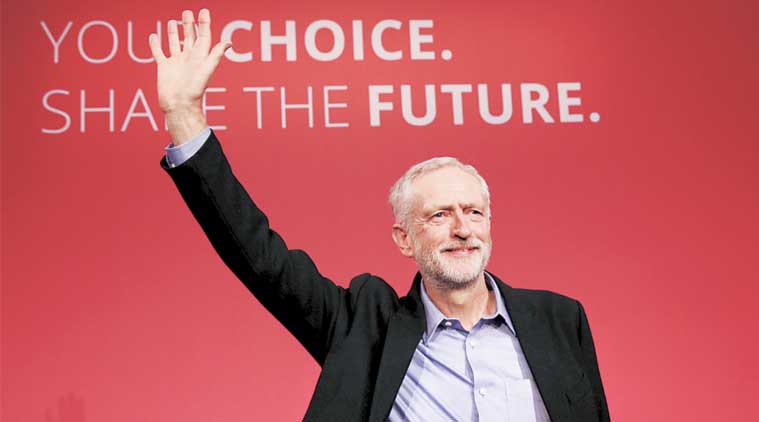 Jeremy Corbyn after his election as the new leader of the Labour Party. (Source: Reuters)
Corbyn, Trump and Sanders can’t be called accidents of history. Their rise must be analysed and it has to be seen how it should be interpreted — as a momentary bubble, or changing the narrative of global politics? Does it reflect the search for a temporary solution to the economic downturn? Or should it be construed a major paradigm shift?
There’s no denying that the worst-ever recession since 1929 is staring at the world. The fall of the Berlin Wall and the demise of the Soviet system had encouraged people like Francis Fukuyama to pronounce the end of ideology, which meant a permanent retreat for communism and leftist politics. That, in turn, encouraged the neoliberal politics of the US, symbolised by George W. Bush in its most rabid form. Neoliberalism meant unlimited freedom for market forces and the disappearance of state intervention. It was less a promotion of democracy and more a direct and unilateral intervention in other nation-states. The US invasions of Iraq and Afghanistan were a brazen reflection of that policy.
But, at the same time, Latin America was experimenting with a new thesis. Twenty-first century socialism emerged as a direct challenge to neoliberal politics. Hugo Chavez was its major proponent. James Petras writes, “The most striking novelty and original feature of Venezuelan versions of 21st century socialism is the strong blend of ‘historical’ Bolivarian nationalism, 20th century Marxism and Latin American populism.” Twenty-first century socialism is different from earlier socialism. It doesn’t espouse total public ownership of resources and it also believes in the accommodation of private initiatives. The state is more powerful, with increased spending on welfare. If Chavez “nationalised major foreign and nationally owned enterprise — oil, cement, steel, banking and telecom” and “financed universal public health and educational programmes”, then Evo Morales “promoted public private joint venture”, whereas in Ecuador “major concession to mining and petroleum companies is accompanied by privatisations for telecom concession.” But as Daniel Wagner writes, “21st century socialism has failed to deliver a meaningful political and economic reform or effective public spending programmes and also failed to meaningfully improve the standard of living for most of the people.”
Twenty-first century socialism was not a solution to the problems of Latin America. It was a fitting reply to militarism, dictatorship and flawed democracy. It was a revolt against the past and an attempt to reinvent the future. It was an endeavour to discover an alternative. In Chavez and Morales, it found its icons. But it was not a solution, only a transition.
The world today is grappling with serious economic problems. Liberal capitalism has won a decisive victory against communism. But it has failed to provide solutions. The Corbyns and Trumps are not the cure but symptoms of an old disease. The era of extremes is over. A middle path has to be discovered. The market can’t be paramount and the state can’t be given supreme power. They have to coexist. Individual creativity must get ample space, but the state should not let ugly individualism become a monster. The market has to be benevolent and the state more humane. That is the lesson for the 21st century world.
The writer, a former journalist, is a spokesperson of the Aam Aadmi Party
 Share
Share


