
Opinion BJP outreach to Pasmanda Muslims: Their identity does not disturb the ideological premise of Hindutva
Pasmanda Muslim identity is rooted in social justice politics and seeks to challenge Ashraf hegemony and secularise “backwardness”. It fits well with RSS’s new conceptualisation of Indian national identity and the BJP’s labharthi welfarism
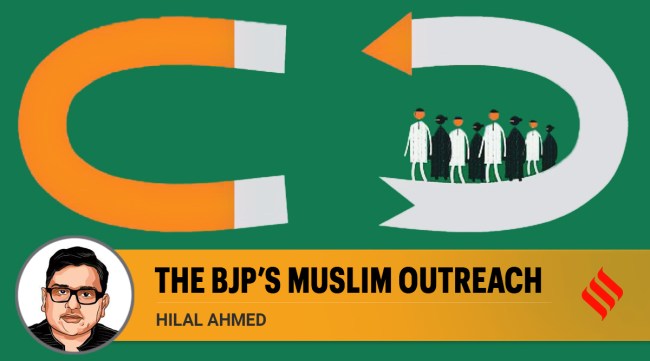 The labharthi (beneficiary) phenomenon is perhaps the more profound reason for the BJP to get involved in Pasmanda politics. (Express)

The BJP’s enthusiastic programme to mobilise Pasmanda Muslim communities in UP and Bihar underlines a specific political trajectory. The party is keen to expand its support base in such a manner that the established political equilibrium in favour of the RJD, the SP and the JD(U) in these states could easily be dismantled. This move is understandable.
The BJP establishment is confident that its core Hindutva constituency has been sufficiently nurtured. No political party is in a position to ignore Hindutva as an electoral narrative. However, the party is facing another kind of challenge. Hindu victimhood politics has reached a saturation point. Hence, there is a serious need to have a constructive programme of action to include those groups that do not fit well within the established framework of aggressive Hindutva.

The Pasmanda Muslims are a group most relevant for outreach for two reasons. First, the Pasmanda Muslim identity does not disturb the ideological premise of Hindutva. It is easy to accommodate these communities in the RSS’s new conceptualisation of the Indian national identity. It could be argued that these communities were forced to give up their original Hindu faith at one point of time. Hence, their ghar wapsi, at least in the formal political sense, is morally desirable. It is worth noting that the government has recently constituted a three-member commission, headed by former Chief Justice of India, K G Balakrishnan, to examine the possibility of granting Scheduled Caste status to Dalits who have converted to religions other than Buddhism and Sikhism.
This strategic move might help the BJP in the long run. The inclusion of Dalit Muslims and Dalit Christians in the SC list has been a serious political demand for some time now. The Pasmanda leadership, especially former MP Ali Anwar Ansari, argues that the SC category should be completely secularised so as to realise the constitutional principle of social justice. The newly appointed commission, in this sense, has a political value of its own.
The labharthi (beneficiary) phenomenon is the second, and perhaps the more profound, reason for the BJP to get involved in Pasmanda politics. In recent years, the BJP has nurtured a new kind of affirmative action politics. The Modi government represents a state that recognises welfarism as a kind of political compulsion. A clear dividing line between the market-driven economic life of the country and the realm of politics has been drawn. At the same time, welfare is defined as a form of political benevolence — citizens are addressed as labharthis.
I call this the charitable state model (‘The new charitable state’, IE, March 14, 2022). The Pasmanda Muslims, being among the most deprived and marginalised communities in the country, can easily be identified as a specific category of Muslim labharthis. CSDS-Lokniti surveys confirm that the BJP has been successful in reaching out to poor and marginalised Muslims through various welfare schemes, especially in UP. The Supreme Court judgment in the Janhit Abhiyan case that upheld the 103rd Constitutional Amendment providing reservation to the Economically Weaker Sections (EWS) of the population, also legitimises the charitable state-driven politics of social justice. It is now possible for the BJP leaders to argue that poor/Pasmanda Muslims are eligible for EWS reservation.
These political advantages, however, should not be overstated.
The Pasmanda Muslim discourse is not entirely about reservation. It is a social movement that aims to democratise the internal power structure among Muslims. The Islamic ideals of equality and justice are often evoked by the Pasmanda leadership to question the Ashraf hegemony.
The Pasmanda demands are rooted in the secular politics of social justice. These groups have been an inseparable constituent of the grand alliance created by social justice parties such as the RJD and the JD(U) in Bihar and the SP and the BSP in UP to defeat the BJP. Although the nature of OBC politics has changed considerably in the last eight years, the relevance of caste in electoral politics cannot be underestimated. The caste census emerging as a unifying factor in OBC politics, at least in Bihar, is the latest example of the relevance of caste in politics.
The Pasmanda groups are instrumental in this campaign. In fact, these groups forced the non-BJP parties in Bihar to redefine their position on caste census. The All India Pasmanda Muslim Mahaz (AIPMH) questioned the one-sided and Hindu reform-centric reading of caste census. The president of the Mahaz, Ali Anwar Ansari, issued a statement criticising the communalisation of backwardness.
The violence against Muslims, especially the lynching of innocent Muslim individuals, is another important concern for Pasmanda groups. Most of the victims of lynching were poor and marginalised Pasmanda Muslims. This was why the sneh yatras proposed by the BJP were criticised by leading Pasmanda intellectuals and politicians.
The BJP is aware of these factors, it seems. The Pasmanda groups are yet to become an electorally reliable constituency. Besides, it is natural for the BJP leadership to rely on its aggressive Hindutva-centric politics of nationalism. In this scenario, the BJP’s Pasmanda outreach is an act of balance that will help the party to retain its hegemony without dominance.
The writer is assistant professor at CDS and author of Muslim political discourse in post-colonial India: Monuments, Memory, Contestation
 Share
Share


