
Opinion Beware great expectations
BJP won handsomely in LS polls and Modi government’s ratings remain high. But BJP supporters should worry.



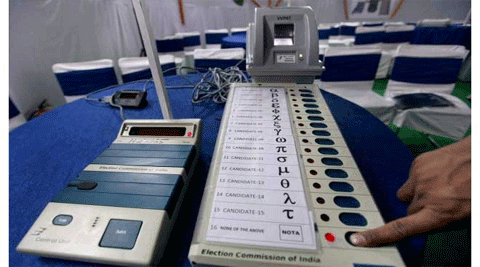 In India, more than in most other parliamentary systems, we see strong anti-incumbency sentiment at constituency level.
Six months after the Lok Sabha election, the BJP’s impressive performance still delights its supporters. This is understandable. For the first time in 30 years, a single party gained a majority. And, at least so far, satisfaction extends beyond the ruling party. Recent opinion polls have given the new government solid approval ratings.
But previous Indian elections suggest that the sheer scale of the BJP’s thumping victory should cause it as much worry as joy. Sweeping triumphs in India generate soaring expectations that are almost impossible to fulfil. Big wins in parliamentary elections in 1971, 1977 and 1984 were all followed by humbling defeats.

In 1971, Indira Gandhi’s “garibi hatao” slogan triggered a landslide, but after delivering little on that very tall promise, she found herself in deep trouble by 1975. She had radically centralised power in an attempt to exercise personal rule. Ironically, however, this weakened her by cutting her off from reliable information from below. Frightened subordinates told her only what they thought she wanted to hear. Her domineering ways also angered many former allies within her party who lost influence. She worried that by stepping aside temporarily in mid-1975, as court judgments required, she might usher in a new leader who would not stand down once her legal problems were resolved. The Emergency that she imposed to save herself alienated most voters and a crushing defeat followed in 1977.
That brought in a Janata government amid high expectations that it would restore democracy. It began to do so. But it contained diverse political forces that soon came into conflict. To manage those internal tensions, the government needed a supremely agile, flexible leader. Instead, it got the brittle Morarji Desai, who gave new meaning to the word rigidity. The inglorious collapse of his government opened the way to yet another embarrassing defeat and Indira Gandhi’s return to power.
After her assassination, Rajiv Gandhi rode a sympathy wave to a brute majority in 1984. Voters expected both continuity and renewal from him. He began by pursuing several fresh ideas: opening up the economy, restoring power and autonomy to government institutions that had been badly battered by his mother’s assertive ways, rebuilding the faction-ridden Congress party, and so on. But within three years, he had proved hopelessly wayward. His U-turns on most of those early policies alienated people on both sides of numerous key issues. He went into the 1989 election stressing the slogan, “We have given you power.” This referred not to his government’s achievements, but to something that it had tried and failed to accomplish but proposed to do in the near future: strengthening panchayati raj. He was humbled in that election.
All three of those governments were poorly led. Narendra Modi may prove more adroit, so he may escape yet another defeat. But expectations are sky high once again. Some of them will be excruciatingly difficult to fulfil. Most crucially, the creation of vast numbers of new jobs would be next to impossible for any government. That should be cause for concern among BJP supporters.
We seldom encounter this Indian pattern of electoral triumphs followed by crushing defeats in other parliamentary systems. In Britain, for example, it usually takes two or three elections for the opposition to regain power. That is because there are so many seats to win back, and less than one-third of the seats in the House of Commons change hands at an election. In the United States House of Representatives (admittedly in a non-parliamentary system), the usual figure is even lower: around 15 per cent at most.
In India, the turnover is much higher. That is true even when parties’ seat totals do not change much. Party A may win 120 seats at one election and 150 at the next, but they are not the same seats. Many of them are won from Party B, which at the same time captures many of Party A’s old seats. This has been going on for over half a century. In 1962, a CSDS analysis found that while the Congress gained its third straight Lok Sabha majority, a surprisingly large number of seats changed hands. In other words, in India, more than in most other parliamentary systems, we see strong anti-incumbency sentiment at constituency level. Political scientists struggle to explain why this happens, but it is clear that it does happen.
So any Indian party that wins a sweeping victory in one election can expect to lose many of its seats in the next one. To get re-elected, it will need to win many seats held by rival parties. That is never easy. It explains why governments have changed after six of the last eight Lok Sabha elections.
Re-election is especially difficult when expectations run high, as they do now. So, the supporters of any ruling party that has won handsomely should temper their euphoria with caution. Despite the current disarray in rival parties, regional and national, it is unwise to write off their chances the next time round.
The writer is professor at the School of Advanced Study, University of London
 Share
Share


