
Opinion Beyond either-or views, many want temple at Ayodhya but don’t want to hurt mosque
A quarter century later, it is futile to hope that the Supreme Court verdict on Ayodhya, whatever it might be, will somehow mark a closure. Healing the social fabric is far more important.
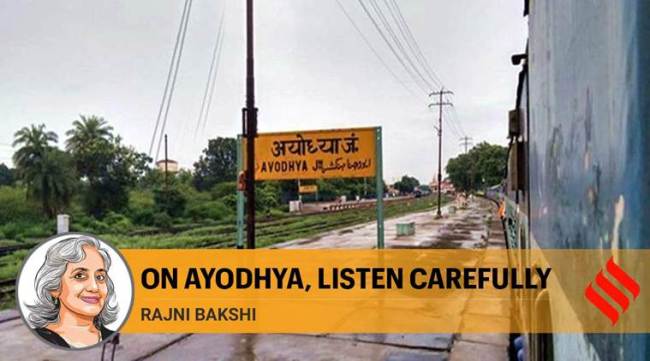 Beyond either-or views, many want temple at Ayodhya but don’t want to hurt mosque



 As a member of campaigns for communal harmony, in the early 1990s, I failed to grasp this distinction. I did see everyone who wanted a Ram temple “on that spot” as a threat to India’s plural ethos and particularly as anti-Muslim.
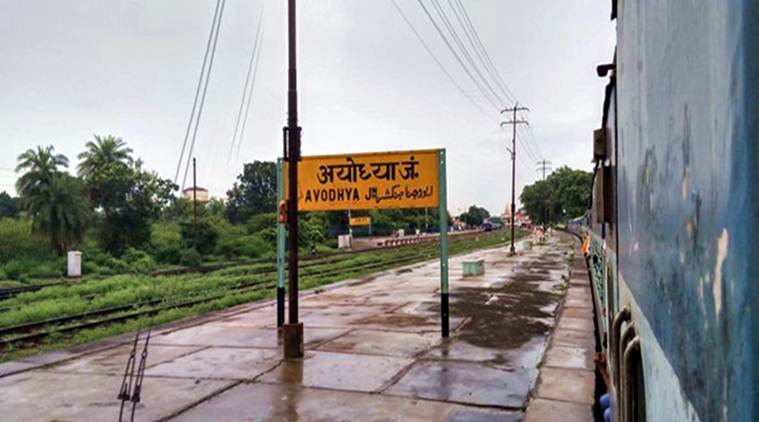
Dharamveer Bharati, the legendary writer-editor, once had a conversation in the shadow of the Babri Masjid which needs to be retold. At the time of Bharti’s visit to Ayodhya, the Ram temple movement was already in full swing. One attempt to demolish the structure had already been made.
Among the people Bharati interviewed was an old woman, from a nearby village, on a pilgrimage to Ayodhya. Pointing to the Babri Masjid, Bharati asked the woman if she wanted a Ram temple to be built there. With a simplicity devoid of any rancour the woman said: “It would feel good to have a Ram temple at the birth place of Sri Ram.”

Then, Bharati pointed to the minarets of the other mosques in Ayodhya and asked her: “What about those mosques? What about the mosque in your village?”
Since the woman seemed puzzled by this question, Bharati explicitly asked whether she felt those mosques should also be demolished. “Certainly not”, came the emphatic reply. That woman saw no connection between the wish to see a Ram temple at what she believed to be the birthplace of Ram and the existence of mosques where her Muslim neighbours offered worship.
As a member of campaigns for communal harmony, in the early 1990s, I failed to grasp this distinction. I did see everyone who wanted a Ram temple “on that spot” as a threat to India’s plural ethos and particularly as anti-Muslim.
There were strong reasons to feel this way. Voices like that of the woman were drowned out by the hate-filled propaganda of those who mobilised the Ram Janmabhoomi campaign. When Gandhian Sarvodaya workers went to Ayodhya to sit in a quiet satyagraha appealing for brotherhood of all religions, they were physically attacked by some advocates of the Ram temple campaign.
A quarter century later, it is futile to hope that the Supreme Court verdict on Ayodhya, whatever it might be, will somehow mark a closure. Healing the social fabric is far more important. That work is in the hands of people who, like Bharati’s interviewee, are neither “secular” nor “communal”, but may have been swept along in the flood of emotions unleashed by political ambitions.
There will be those who argue that the Indian samaj is now so polarised that such people have become an irrelevant minority. Such a claim is not just defeatist and cynical, it is also an offence to the spirit of democracy.
True commitment to democracy would mean a willingness to respect that woman’s desire for a Ram temple and her desire to honour and preserve the mosques where her neighbours worship. Reducing her multi-layered wishes to an “either or” binary is not merely a travesty of democracy, it is anti-life.
We do live in a time when more and more people feel pressured to make “either or” choices. They harbour doubts about the possibility of brotherhood with people from “other” communities due to a sense of darkness generated over social media, and in face-to-face encounters with naked hatred. But, what if the seemingly immovable hatred is more of a cloak — worn by people whose actual affliction is fear, and a sense of insecurity?
Listening to the underlying anxieties and fears of those who seem susceptible to being swayed by hatred may be the most important aspect going forward. Such empathic listening can be painful, but there is some catharsis at the end of the tunnel. If such listening does nothing more than prevent us from hating the hater, that is a significant gain.
This cannot happen as long as we quarrel over historical details — be it about Ayodhya or any other disputed site. Those details are significant at another level but the need of the hour is to understand, and to process, the raw feelings being aroused and inflamed. For instance, once that woman had expressed her desire for the Ram temple, Bharati could easily have ignored her and walked on. It was his eagerness to understand her worldview in more detail that revealed the distinction between her aspiration and how it was being shanghaied for a toxic political design. There is indeed moral and poetic beauty in the old slogan, “Prem se kaho hum insaan hain”. That emphasis on our shared humanity is precious.
Our collective future now depends on an open-hearted engagement with those who shout “Garv se kaho hum Hindu hain”. We need to try and ask them to explore how their own life, and the society around them, might benefit instead with “Prem se kaho hum Hindu hain”.
This article first appeared in the print edition on November 7, 2019 under the title ‘On Ayodhya, listen carefully’. Bakshi is a Mumbai-based writer.
 Share
Share


