


Tags:


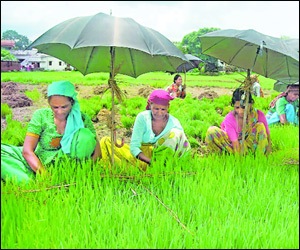
The rich aroma wafting from the rice pot would no longer be that of Dehraduns Basmati.
Falling prey to large-scale urbanisation,the cultivation of the aromatic rice variety has moved out of the valleys traditional zones of Majra and Niranjanpur.

The state government recently admitted in the Assembly that the famous Dehradun Basmati is now being grown elsewhere in Uttarakhand.
The Basmati zone of Majra is no longer producing the Basmati variety of rice. Its cultivation is,however,being done in Sahaspur,Vikas Nagar,Udham Singh Nagar,Nainital and Hardwar, said state agriculture minister Trivendra Singh Rawat in the House.
Despite its small grain,the Doon Basmati enjoyed the enviable status of being the best Basmati in the world due to its aroma. So much so that the word Basmati came to be associated with Doon itself. Even Basmati coming from Pakistan would feed on its fame by assuming the name of Doon Basmati.
First,extensive use of chemicals and fertilisers killed its aroma. Then,urbanisation wiped it off the face of the Doon valley.
The new Master Plan of Dehradun provides for urbanisation of almost 4,050 hectares of agricultural land in the district much of which comprises the traditional Basmati producing zones.
A large number of residential colonies already exist in these areas,and about 2,200 hectares there have now been marked as urban territory.
Hybridisation is another culprit. High-yielding varieties like Basmati 1,Kasturi,Haryana 1 and Sugandh 1 and 2 have now replaced the original Basmati Type 3,also known as tarawari and are being passed off as the pure variety.
Director,agriculture,Madan Lal,however,maintained that cultivation of Basmati has not stopped in the valley but has rather shifted to new zones. New areas like Vikas Nagar,Raipur and Sahaspur are producing Basmati in the Doon valley now, he said.
He told The Indian Express that following the governments initiative of developing a Basmati export zone some years ago,the area under Basmati cultivation has actually gone up from 1,500 hectares to about 7,500 hectares. We are promoting organic farming of Basmati,and a positive aspect is that farmers have taken to it in a big way. They have even come forward to acquire training from experts at G B Pant University of Agriculture at Pant Nagar, he said.
The director said an advantage of Basmati rice is that even its traditional varieties require little fertiliser and,therefore,shifting to organic cultivation was not much of a problem for the farmers.
According to food and civil supplies minister Divakar Bhatt,Uttarakhand exported 55,451 quintals of Basmati rice in 2007-08. The minister also informed that in 2008-09,the state produced 70,680.50 quintals of the variety.


