


Tags:


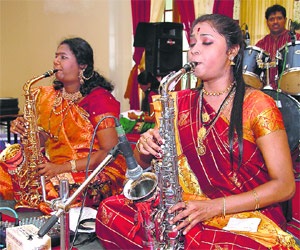
Heres tracing the journey of two young women who play Carnatic raags on the saxophone
This could be an image of globalisation: two sisters clad in silk saris,sitting on the floor and playing intricate Carnatic raags on the saxophone. Years ago,when as young girls,M.S. Lavanya and M.S. Subbalaxmi expressed their desire to learn saxophone,their parents thought it was just a childhood fantasy.
But the sisters turned out to be professional saxophone players. Being grandchildren of a court musician of the Mysore Palace and daughters of an acclaimed mridangam player,it was but natural for them to follow this path. What was different was their choice of instrumentthe saxophonewhich is as foreign as it gets when it comes to Indian schools of classical music.
They have evolved as performers over the years,playing not just to Carnatic music but also to Western classical and Hindustani classical piecesdressed in ornate saris or,when the occasion demanded,a pair of casual trousers. They perform at weddings,corporate functions and concerts all over the country,from Chennai and Bengaluru to Delhi and Mumbai.


Every concert is an examination that we have to pass. The people are first baffled,then curious and finally pleased, says Lavanya,who lives in Chennai where she is learning Carnatic music further and has even dabbled in audio engineering. Younger sibling Subbalaxmi,26,has done 3D animation and lives in Bengaluru with her family. Sometimes,the audience asks them to perform to a popular Hindi or Tamil song. We always need to keep learning. Har din naye naye songs aate hain, says Lavanya,who with Subbalaxmi,has performed to popular Bollywood numbers like Mitwa from Kabhi Alvida Naa Kehna and Yeh mera dil from Don.
It began about 15 years ago. The sisters would accompany their father,noted mridangam exponent MR Sainath,to the concerts of Kadri Gopalnath,the pioneer who adapted the saxophone,till then used only in jazz and Western Classical music to Carnatic tradition. As children,we loved the sound this instrument produced,its uniqueness and originality,and the element of newness that Gopalnath was able to bring to classical music with the saxophone. We decided to learn to play it, says Lavanya. That was a surprise for Gopalnath,she says,as there were not many who were ready to learn playing this risky instrument within the confines of classical music.
The family was settled in Mangalore where Sainath,a staff artiste at the All-India Radio,was posted. Their grandfather,M.R. Rajappa,was one of the court musicians at the Mysore Palace where Nalvadi Krishna Raja Wadiyars band was one of the first to introduce saxophone to the country,making this connection both spontaneous and,at some level,generational.
The sisters learned Carnatic vocals for seven years before going on to learn the saxophone for about 13 years. Their guru was Gopalnath,a Mangalorean who later shifted base to Chennai. When he would come down to Mangalore,the sisters would take classes from him.
The sisters met with criticism when they began playing the instrument. It was not easy. Many didnt consider the saxophone to be a natural instrument for classical Indian music. There were genuine limitations though. For instance,certain raags cannot be played on this instrument. But there are many lovely ragas which can,like Hamsadhwani,Gowla and Kalyani,and kritis by masters like Thyagaraja,Kanakadasa Shyama Sastri and Subbaraya Sastri, says Subbalaxmi.
Playing the saxophone is a challenge,especially for women. It requires a great deal of breath control. So it is harder for a woman, she adds.
It was their participation on Indias Got Talent Colors last August that gave them national visibility. Though they did not win,the judges were impressed by Subbalaxmi performing on stage despite being six-months pregnant. That was enough to attract invitations to perform at events in the north.
Sainath and brother,M.S. Sudhindra,also on the saxophone accompanies the sisters on mridangam,though it is not often when the siblings play together on one stage. It is too loud an instrument for all of us to perform at once, quips Lavanya.
The world order has changed many times over since Adolphe Sax invented the saxophone in Austria in 1841,and the sisters started playing Carnatic compositions on it. But the field remains dominated by men,and it has its own problems,says Lavanya,choosing not to elaborate further. The two women,however,have decided not to let anything affect their dream of becoming masters of their chosen tool.


