


Tags:


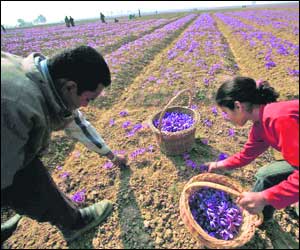
For the first time,Valleys purple swathes of centuries-old saffron fields found a place in Kashmirs tourism map when a state-sponsored saffron festival was held in Pampore last month. The festival was deliberately coincided with the time when the crop is harvested so as to serve a dual purpose: attract tourists and boost the sale of saffron.
As the Valley begins to recover from decades of unrest,saffron cultivation in Pampore is desperate for a fresh lease of life. The future of this niche industry with huge export potential is up against a tall order drought,lack of irrigation facilities,ancient farming practices,pollution,illegal constructions and government apathy.

Around 226 hamlets dotting the Srinagar-Jammu National Highway outside Srinagar cultivate the golden crop. From 5,707 hectares in 1997,the saffron fields shrunk to a worrying 3,010 hectares in 2006-2007. The
production of the labour-intensive crop consequently slumped from 16 metric tonnes annually to 6.5 metric tonnes.
With plucking of saffron flowers being over,hundreds of young and old men and women can be seen painstakingly snipping off the fragrant reddish-orange stamens,which are dried before being used in cooking the world over to add taste and colour.
Saffron cultivation is the main means of livelihood in Pulwama, said Jana Begum,a saffron grower. But as the production is dipping,we are very nervous, he said.
President,Saffron Growers Association,Mohammad Shafi Wani said the harvest this year hasnt been good. But thanks to the fame that our saffron enjoys,we have managed handsome money in both domestic and international markets. The Kashmiri saffron is the worlds most expensive by weight and sells for anywhere between between Rs 2.5 lakh and Rs 3 lakh a kilogram.
About the state governments first-ever festival to promote saffron,he said,The festival is certainly a good beginning. I hope in the coming years,thousands of tourists visit the saffron fields to purchase saffron directly from the growers.
The government,however,needs to do put in more if it is keen to save the industry.
The cement factories that have come up in the region have taken a toll on the golden crop. In the past seven years,15 cement factories,mostly without any pollution control device,have been allowed to operate in the region.
Besides,rampant illegal constructions have turned hundreds of hectares of saffron fields into residential colonies. If dust emanating from cement factories and illegal constructions are not stopped,this crop will simply vanish from our land, said Ghulam Mohammad,another saffron grower.
Organising the saffron festival was a great step; I now urge the government to relocate the 15 cement plants in the area.
Senior associate professor of environmental sciences at Sher-i-Kashmir University for Agriculture Science and Technology SKUAST,Dr Farooq Ahmad Lone,claimed that cement dust and lack of irrigation facilities have caused large-scale damage to the crop. In the rest of the world,the per hectare saffron yield is six to seven kilograms. However,in the fields of Kashmir around the cement factories,it is less than a kilogram, Lone,who has conducted a research study on the subject,said. When dust falls on the leaf surface,it first blocks its stomata. It also blocks air channels of the plants,reducing the yield to almost half of the normal.
Lone said there was an apparent difference in the production of saffron from fields around cement plants and those away from it. Most of the saffron fields,where production has been hit,are located near Khrew,Wuyan,Pampore and Kanmoh as the cement plants operating in the area are without electro-static precipitators, he said. The fields situated far away from cement plants or stone quarries yield 2.5 to 3 kilograms of saffron per hectare.
Lone said lack of proper irrigation system and use of same seeds for years together are the other reasons for decline in saffron production. August and September are critical months for saffron. Unfortunately,our growers dont have sufficient irrigation facilities available in this period.
He said for good production,replacement of seeds is mandatory after every three years. Unfortunately,our farmers replace seeds not before 30 years.
For the past few years,saffron produced in Iran and Spain has been giving a tough competition to the Kashmiri saffron. In Iran ,the world leaders in saffron production,the area under saffron cultivation is continuously increasing; it is 47,000 hectares at the moment. The production has also gone up from 135 metric tonnes earlier to 238 metric tonnes per year. Not only saffron production in Spain and Iran is very high,the two countries have adopted modern sprinkle irrigation systems. Their saffron is of better quality too, Lone said.
Recently,the Jamp;K government sought an assistance of Rs 150 crore from the Centre for creating infrastructure and sprinkle irrigation facilities. The fund is yet to be approved.
Member of Legislative Assembly,Pampore,Zahoor Mir said that till a few years go,the condition of farmers was very miserable due to poor marketing and little yield. I know of many farmers who have sold their land. The trend has been arrested somewhat with growers being able to fetch better money.
But if the government wants to save the crop,many preventive steps have to be taken without wasting any more time,he said. Colonies have come up on land that are exclusively feasible for growing saffron.
Lessons in tech for growers
Pampore: Sher-i-Kashmir University for Agriculture Science and Technology SKUAST has set up a research centre at Konbal,Pampore,where growers are being taught about modern technology to cultivate saffron. Efforts are being made to safeguard the production of saffron, said Dr Firdous Nehvi,senior scientist,SKUAST.
Saffron production started declining in the year 1999 due to a severe drought in the Valley, said Nehvi.
Besides,growers are working without any technological interference. The crop has also been hit by a fungal disease called root rot.
The university is also researching on which crops to grow along with saffron. We have seen the compatibility of saffron with almonds,but that of apple and other fruits is yet to be seen. Planting apple in saffron fields can cause root rot, said Dr Nehvi.
He said about 22 scientists are working on a three-year World Bank project. A total of 250 farmers have been selected for the project. Each of these farmers has to give one kanal of land for experiment. The saffron produced under scientific and controlled conditions in their fields will be marketed as a special brand, he said. ENS


