5 min read

Journalism of Courage



The Supreme Court today upheld the constitutional validity of the Right to Education Act,2009,which mandates 25 per cent free seats to the poor in government and private unaided schools uniformly across the country.
By a majority view,a three-judge bench of Chief Justice S H Kapadia and justices KS Radhakrishnan and Swantanter Kumar said the act will apply uniformly to government and unaided private schools except unaided private minority schools.
However,in his dissenting opinion,Justice Radhakrishnan took the view that the act would not apply to both unaided private schools as also minority institutions which do not receive any aid or grant from the government.
Justice Radhakrishnan8217;s view was overruled by justices Kapadia and Swantanter Kumar who took the stand that the act would be applicable even to unaided private schools.
The apex court clarified that its judgement will come into force from today and,hence,it will not apply to admissions granted after the enactment of the legislation.
In other words,the apex court said the judgement will only have a prospective affect and not retrospective affect.
Upholding the provisions of the law,the apex court said the impugned act should be construed as 8220;child specific8221;.
The three-judge bench had reserved its verdict on August 3,last year on a batch of petitions by private unaided institutions which had contended that the Act violates the rights of private educational institutions under Article 191g which provided autonomy to private managements to run their institutions without governmental interference.
During the marathon arguments in the case which went for many months,the Centre had defended the law,saying it was aimed at uplifting the socially and economically weaker sections of the society.
The Centre had emphasised the need to delink merit and talent from social and economic differences among different sections of society and said that the Act calls for 8220;moving towards composite classrooms with children from diverse backgrounds,rather than homogeneous and exclusivist schools8221;.
The main petitioner Society for Unaided Private Schools,Rajasthan,and a host of associations representing various private schools,had questioned the validity of the Act on the ground that it impinged on their rights to run the educational institutions.
The law was brought by introducing Article 21A in the Constitution which says the state shall provide free and compulsory education to all children between six and 14 years in such a manner as the state may,by law,determine.
The petitions had contended that the RTE Act was 8220;unconstitutional8221; and 8220;violative8221; of fundamental rights.
According to the petitioners,Section 3 of the Act imposed an absolute mandate on all schools,including private unaided and minority institutions,to admit without any choice each and every child whosoever comes to take admission in the schools in the neighbourhood.
Sibal expresses happiness over SC verdict on RTE
New Delhi,Apr 12 PTI HRD Minister Kapil Sibal today expressed happiness at the Supreme Court verdict upholding the constitutional validity of the Right to Education Act of 2009 saying it has brought clarity and put all controversies to rest.
Sibal said litigation in court should never be looked as a victory or defeat,especially when the government is involved because what government was looking for from this litigation was clarity because it has an impact on millions of people.
8220;What the court has given us today is clarity on the issue so that all controversies are set to rest. When the controversies are set to rest,our vision of education moves forward. So we are very happy that all controversies are set to rest and there is a clarity,8221; Sibal said.
On the Apex court agreeing with the provision of 25 per cent free seats to the poor in government and private unaided schools uniformly across the country,the Minister said it was one the biggest issues involved in the matter.
8220;One of the biggest issues involved was 25 per cent reservation applies to private schools or not which is also upheld by SC and it also does not apply to minority institutions. That controversy is also set to rest,8221; he said.
By a majority view,a three-judge bench of Chief Justice S H Kapadia and Justices K S Radhakrishnan and Swantanter Kumar said the RTE act will apply uniformly to government and unaided private schools except unaided private minority schools.
However,in his dissenting opinion,Justice Radhakrishnan took the view that the act would not apply to both unaided private schools as also minority institutions which do not receive any aid or grant from the government.

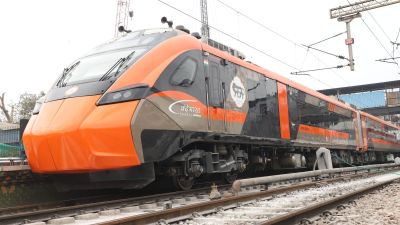
Railway Minister Ashwini Vaishnaw on Saturday said Vande Bharat Sleeper trains will be introduced across all states, including Kerala. He made the comments during a press briefing at New Delhi railway station after inspecting the Howrah–Guwahati–Howrah Vande Bharat Sleeper rake, which is set to be launched this month.