


Tags:


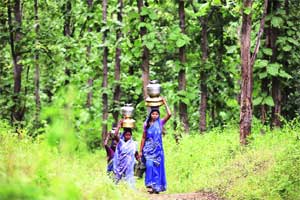
What are the factors that affect womens participation in institutions of collective deliberation? What impact does their presence in these institutions have on their outcomes? How should one think of the relationship between presence,representation and power in democratic institutions? These are some of the central questions for democratic theory and the fate of democratic societies. Bina Agarwals tour de force looks at these issues in the context of womens presence in community forestry,and argues that womens presence,in the right critical mass,makes a considerable difference to outcomes.
The empirical materials are set in the context of forestry. It draws on careful data collection in 65 community forestry institutions in Gujarat and 70 in Nepals middle hills. It further draws on extensive focus group discussions across seven states and several other informant villages. But these sites are then brought into an astonishingly rich conversation with a broader debate on participation in democracies. The book is also a rigorous,insightful and broad-ranging engagement with wider questions of presence and voice in democracies.


Unusually for a book that relies on primary data,chapter four gives a thick description of the field sites. This is enormously useful because it helps situate the data in its context and spot interesting nuances. Most work that deals with data eschews the setting. But the detailed sociological and historical profiling of the field sites is intrinsically interesting,and I hope 10 years from now someone revisits these sites and uses this chapter as a benchmark to see what social changes have taken place.
The main argument of the book is that womens presence matters a great deal,though the actual effect of presence is mediated through a large number of variables. The one thing that seems to matter is threshold effects; the more women there are,the more likely are women to participate and so forth. Women are also more likely to talk about rule-breaking than men,who,at least in this study,seem more likely to draw a veil of solidarity over acts of rule-breaking. Agarwal also takes on a very important debate. To what extent can political representation mitigate economic disadvantages and social inequalities? Her nuanced conclusion is that social and economic equality is not a prior necessary condition for women to be active political agents. Women do bring a different set of concerns to the table. But interestingly,in Agarwals account,this has less to do with some essential attribute of being a women than the structural relationship that the women have in relation to the broader economy. Women seem to bring different concerns because they are differently situated. One of the implications of this argument,which Agarwal does not hesitate to pursue is that differently situated women will bring different concerns. So there are two layers to this story. One is that womens presence makes a difference. The other is that womens presence makes a difference within each social layer differently. This book pursues these complexities as far as can be done with the empirical materials at hand. But in the broader debate,the interaction of gender and class effects will be an interesting agenda to pursue.
The book then goes on to argue that mere presence is not enough. The books richness comes from the fact that it is constantly mindful of the subtle operations of power embedded in the procedures in institutions,in the relationships between bureaucracies and community institutions and between communities and outsiders. The book is an extraordinarily rich mine of hypothesis and a model of careful testing. All those interested in how institutions of deliberation work will mine it for a long time to come.


