


Tags:


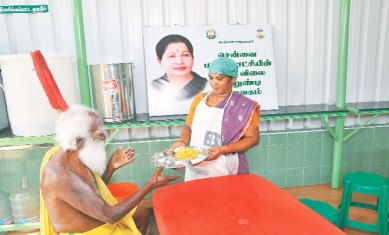
Its lunch time and at Chennais most popular eating chain,the queue is quite long. But it pays to wait for your turn; where else would one get idli at the price of a matchbox,sambar rice that costs less than a cigarette stick,and curd rice at about half of that?
Welcome to Amma Canteen,a chain of 200 food joints that the Corporation of Chennai set up to offer quality food to the poor,every morning and noon. From 7 am,the canteens sell idli with sambar,Tamil staple food,at just Re 1 apiece. And at noon,they sell sambar rice for Rs 5 and curd rice for Rs 3. All hot from the kitchen,made using fresh ingredients and served with the hygiene of a mid-range hotel.


The spiralling inflation and food prices had prompted the previous DMK-run government to attempt an indirect intervention. It instructed mid-range hotels and restaurants in the city to provide meals at a subsidised rate,but the scheme failed to create any impact. What is different this time is not just that the intervention is direct,but also the way it is run.
Each unit is run by about 12 women,who bring a quiet efficiency to the job. Like Hemalatha,a 36-year-old mother of two. The team leader,she comes to the canteen at 5 am every day,overseeing the preparation of idlis and sambar and lending a hand when needed. In two hours,the canteen is ready to open the counter. Breakfast time is till 10 am,but 1,500 to 2,000 idlis are sold off much before that. At lunch,they sell over 500 plates of sambar rice and 350 plates of curd rice.
The state government supplies rice at Re 1 a kilo to the corporation. The civic body procures urad dal,vegetables and other essential commodities,and supplies commercial cooking gas cylinders and treated water for cooking and drinking. To replenish the stock,the team leader just needs to inform the corporation tax collector or junior engineers who have been designated to make the arrangements.
The authorities are ensuring there is no room for complaints. Sanitary inspectors ensure the premises,kitchen and utensils are clean,and a monitoring committee headed by a doctor conducts regular checks.
In all,over 2.5 lakh idlis and over a lakh plates of rice are served in a day by the 200 canteens. The benefits of running these in a metropolis where a quarter of the population resides in slums is obvious. It is felt directly among poor,the migrant workers,and even among the lower middle class.
Balakrishnan,a 60-year-old,would spend about Rs 25 every day on vegetables and groceries,besides rice,oil and fuel. His wife,Saraswati,a domestic help,would get up early to make breakfast and lunch for him,which delayed both of them every day. Now she just needs to plan for dinner, he says.
By utilising the space available with the civic body,the establishment cost was kept to a minimum. It costs about Rs 35 crore to run the chain,with an average expected counter sale of Rs 29 crore. The government takes care of the deficit. So popular is the scheme that other city corporations in the state have proposed similar chains in their area,a call on which will be taken soon. Even though they are meant to serve the poor,the queues outside the outlets are quite egalitarian standing along with auto-rickshaw drivers and labourers are young professionals and those ostensibly from well-to-do families.
Amma Canteen is undoubtedly a populist measure initiated by a regime that has set its sight on winning handsomely in the next election. But it is difficult to argue against feeding the poor.


