


Tags:


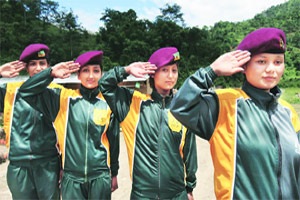
In 1987,when she was eight,Anuja Tamang saw a severed head hanging from a post near her house in Monsong village of Kalimpong. The murdered man was a neighbour who had refused to join Subhas Ghisinghs GNLF. For many years more,she would see much violence in her village amid the movement for Gorkhaland. When the Ghisingh era ended in 2007 and Bimal Gurung took over the movement,his approach captured Anujas imagination.
In 2008,Anuja saw an advertisement in a local newspaper inviting volunteers to join Gorkhaland Personnel,a force raised by Gurung to maintain law and order and control violent activities in rural Darjeeling. She did not think twice.


But now the force has outlived its utility. The movement has culminated in the creation of the Gorkha Territorial Administration and Gurung does not know what to do with his personnel. At the August 4 function where he was sworn in as GTA chief executive,Gurung urged both West Bengal Chief Minister Mamata Banerjee and Union Home Minister Sushilkumar Shinde to accommodate the Gorkhaland Personnel cadre in the police,paramilitary forces or other services. He pleaded for special changes in the eligibility criteria for the armed forces of the state and the Centre to absorb them. Senior Gorkha Janmukti Morcha leaders agree the force is now a burning problem.
The name was initially Gorkhaland Police but was changed when the authorities objected. After Gurung formed the community volunteer force in 2008,it was initially engaged in controlling alcoholism in villages and rendering social services. Eventually it grew into a moral policing force that could,at a moments notice,be deployed from their camps in any situation: blockading a road,enforcing a shutdowns,forcing residents not to pay government taxes,or facing police bullets by marching in prohibited areas of the Dooars and Terai regions.
When the movement peaked,the GLPs strength was 15,000. Most of the cadres were in their early twenties. The force was trained by 300 former Army men under the command of retired colonel Ramesh Alley.
GIRLS and BOYs
The Indian Express managed to reach remote GLP camps and interact with the cadres.
The Jamuni camp where Anuja is captain is for women. Some 150 cadres aged 22 to 30 live in small bamboo huts and tin sheds. At the small office hangs a chart,Army style,recording the work done during the day. The women and girls are not allowed to keep a mobile phone or watch television. Only the camp-in-charge has a mobile to communicate with the outside world. If one of the cadres wishes to go home,she has to apply to the GLP chief and wait till he grants her leave.
With the statehood movement no longer raging,they are now engaged in rescue work when necessary and road construction,besides taking sand out of the riverbed,packing it in jute bags and loading these on trucks that carry it to Darjeeling town. They also maintain piggeries,with the pigs sold by GJM leaders. This is for their sustenance. The cadres are given Rs 700 to Rs 1,000 a month as pocket money. Rations are supplied by the GJM leadership.
I had passed the higher secondary examination and was working in a tea garden when I saw the advertisement. When we joined,our goal was Gorkhaland. If we go to Nepal we are evicted as Indians,while in India we are treated as outsiders. That is why we sacrificed everything for Gorkhaland: family,education,future, said Ranju Sharma,20,of Jaigaon in Dooars.
And now our president has formed the GTA,dropping the demand for Gorkhaland temporarily. But we will not leave these camps until we are absorbed into jobs.
The Roy Villa GLP camp in Darjeeling is for men and boys. They live in a 102-year-old house,once home to Sister Nivedita,that stands on a solitary peak on the outskirts of Darjeeling. The stairs are beginning to crumble,the windows have no panes,the doorways have no doors. When it rains,the ceiling leaks.
Two former Army men are in charge. The 70 cadres here,too,maintain a daily work chart. The routine includes exercise,seven hours of work,one hour of sports and a roll call. The two meals a day are cooked by turn by a group of seven cadres.
My father was abducted and killed by GNLF men during that agitation. I was a child, said Sohan Yalma,who hails from Kalchini in Dooars. When I heard about the GLP,I applied and was selected after three rounds of screening. During the GJM movement,we organised peoples agitations and controlled violence. At present,we work on rescue during landslides in Darjeeling. We are also posted in several areas for traffic management.
And Krishna Monger said,We have an ambulance parked inside our camp. We take it out whenever we get an emergency call. We have a network in villages: we busted the supply chain of illicit liquor and also rescued several girls from being trafficked. Our president rewarded us for this.
WORRY and WARNING
GLP chief Alley praised his cadres. They are a disciplined lot. We have looked after them against all odds, he said. But they have to be absorbed as soon as possible. This is a trained force that can be used by anybody,from crime cartels to political adversaries to us. If they turn into rebel camps,it will be difficult to control them.
Gurung said,I am very worried about the youths who are still in the camps in several villages and remote areas. We raised the force to maintain law and order during the Gorkhaland agitation. Now that we have formed the GTA,we want them settled in government jobs. We have been maintaining them for four years.
Incidentally,Gurung and the GJMs Roshan Giri used to have a platoon of these cadres guarding them round the clock.
GJM sources said at least 300-400 cases were registered against GLP cadres over the past four years. These included unauthorised occupation of government property,prevention and destruction of public property,blockade of a national highway,arson and possession of arms. There were three murders cases too. Only a few cases are pending. The majority was dropped by the state government. Under the GTA treaty,the government had agreed to withdraw all cases except those of murder.


