12 min read

Journalism of Courage




TUCKED away on the southern tip of Chhattisgarh where the state8217;s border touches Orissa and Andhra Pradesh, is the once obscure, now frightened tehsil of Konta.
On way to this terror tip, clusters of ramrod-straight toddy trees rise high up from the famous Abujmad forests, painting a breathtaking skyline against the backdrop of an unending hill range. Till about 30-odd km before Konta, it8217;s just another day for the tribals of Bastar.
Then just round the corner a mist of gloom surrounds you stealthily. In the last 30-km journey to Konta, it clings to you jealously, never seeming to let you go.
It does suddenly. At Konta the mist lifts to expose the desolation. The broken government buildings and huts are the tell-tale signs of a violent storm. The tension is loud and the terror screaming.
Will peace ever return? That8217;s the question in many minds in this land first ravaged by Naxalism and now haunted by Salva Judum, a 8216;8216;popular8217;8217; movement against extreme-Left violence. The campaign is government-sponsored and backed by the Opposition Congress. It first began in the Bijapur-Geedam belt in west Chhattisgarh in June last year and has now spread south as far as Konta. Over 30,000 people have been 8216;8216;coerced8217;8217; into deserting their villages and shifting to the 20 heavily guarded 8216;8216;relief camps8217;8217; across south Bastar.
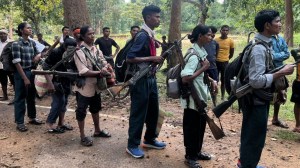
Konta camp, the first in this deep south, came up just 15 days ago. Nearly 10,000 paramilitary personnel, reserve policemen, regular state police and NSG commandos have been deployed to protect such camps and secure the transit of the shifting populations. Tribal youths recruited as special police officers and armed with guns, bows and arrows and sharp-edged weapons man every entry and exit point.
Nobody knows exactly how many have been killed so far, but the casualty list on both sides could run into hundreds and it8217;s going up by the day. The biggest of the strikes came last Tuesday, when Naxalites blasted a truck carrying Judum participants, killing over 26 and injuring over 40 others. Incidentally, the landmine was laid more than five years ago 8212; Naxalites have strewn south Bastar with landmines that they can blow at will whenever required.
Chief Minister Raman Singh calls Salva Judum 8216;8216;a war by harassed tribals against the terror of AK-47 and RDX8217;8217;. Leader of the Opposition in the Assembly Mahendra Karma calls it 8216;8216;a war against Naxal violence and suppression8217;8217;. Raman Singh and Karma may be in this together, travelling to remote villages addressing Judum rallies, but in the war against militant leftism, if there is a victim it is the tribal who is caught in the crossfire.
In the chaos in Judum-dominant areas, tribals can be seen making their way to camps. Some have joined the revolution of their own volition, other have little choice since the unwritten rule is clear: join the Judum.
The Judum strategy is not complex: Explain things to Sangam leaders Naxal dalams8217; frontmen in villages, then pressurise them. If they still don8217;t agree, beat them up and hand them to the police. The bottom line is: no is not an answer.
At the camps, the members are supposed to build their own makeshift houses while the government provides them food. Twice a day they queue up for a roll call and a drill.
With the younger men leaving for camps, there are many villages almost entirely left to the women, children and the old. Since the Naxals usually do not harm them, there are no compunctions in leaving them alone.
Back at the camp, a look at the tense faces around and it8217;s hard to believe they have responded spontaneously to the Judum call. There are, however, a few who appear enthusiastic and energised.
Home-grown terror
WHATEVER their reasons for signing up, everyone at the camps agrees about the 8216;8216;lack of adequate security8217;8217; for the Judum campaigners. Revenue officials privately lambast the state police. At Ganglur village8212;where Naxalites had killed eight Judum supporters one February night after laying siege to the police station, The Sunday Express came across relaxed policemen enjoying a game of carrom. Two of them8212;one dressed as a woman8212;danced outside the police station to the accompaniment of drumbeats, even as villagers watched from a distance.
Beyond the apparent normality, there is so much tension that even journalists are cautioned against venturing into these areas. They have an additional worry. The administration, it seems, is determined to ensure a good press for Judum. Last month the Chhattisgarh Assembly passed a bill that empowers the government to act against any adverse publicity given to Judum. Bijapur Superintendent of Police Manhar was caught in a row when reports appeared in local press about a tape that contained his alleged threat to journalists writing against Judum.
In Konta, a new danger is fast raising its head. As an offshoot of Judum, there is a war between the two different tribes, Dorlas and Muriyas developing there see box.
And then there is the menace that is the bane of all such armed movements. According to local journalists and traders, Judum activists are now going into overdrive to extort money by arm-twisting and harassing vulnerable people.
Naxalites maintain that the Judum is an uprising orchestrated by the creamy-layer tribals, like the Patels, Manjhis and Kotwars, 8216;8216;the repressive traditional tribal community heads and non-tribals whom we have marginalised8217;8217;.
The truth lies somewhere in between. Looking at many Judum leaders like K Madhukarrao, the original protagonist who started it at Ambeli village in Bijapur, Naxalites aren8217;t exactly off the mark. Says a non-tribal teacher from a remote village who has watched Naxalism grow in the region: 8216;8216;What Naxalites did was rob the rich tribals of their property and distribute it among the poorer. So these people are naturally angry and the Judum leadership is concentrated in their hands.8217;8217;
A tribal teacher adds the contrarian view: 8216;8216;All this is true but tribals don8217;t want to remain in obscurity forever. They want development and as long as Naxalites are there, the road to development will be shut for them.8217;8217;
An anti-Judum Naxalite booklet counters these allegations with a question. 8216;8216;Are all those places where there are roads really developed?8217;8217; it asks. 8216;8216;Roads are actually meant for the police,8217;8217; it adds.
The road not taken
DEVELOPMENT is much debated but almost entirely missing in this tribal heartland. Residents of remote villages sometimes have to be carried on makeshift stretchers for nearly 25 km to the nearest hospital.
So even those who oppose the Salva Judum campaign agree that Naxal presence will always keep development away. A tribal teacher-cum-activist says, 8216;8216;Judum is not a spontaneous movement for development. It8217;s coercive. But development is surely everybody8217;s demand.8217;8217;
Karma seems to be reflecting their viewpoint when he says, 8216;8216;Ask them Naxals what have they done for the tribals during the twenty-five years of their stay there?8221; How deep the schism is in this region can be gauged by the comment of another Kontap resident: 8216;8216;It8217;s not that the Naxals haven8217;t done any development. They have also constructed water tanks and run schools in deep interiors.8217;8217;
Yet the common complaint is that Naxalites don8217;t allow people to participate in government programmes and how the tendu leaf collection, the main off-season source of earning for the people, has virtually ended because of Naxalites fleecing the contractors.
The End?
BUT the question everyone is asking is why did the Naxalites target the tribals if they believe the Judum campaign was not a popular movement and tribals were being forced into joining its ranks.
8216;8216;It shows they are getting desperate and that they don8217;t really love the tribals,8217;8217; alleges Karma. 8216;8216;For them, tribals are mere pawns in their violent pursuit of political power.8217;8217;
Chief Minister Raman Singh is determined to take the campaign to its end: 8216;This will be a long-drawn battle.8217; But how long is long-drawn?
The brave words apart, there still is a big question mark hanging over the future of Salva Judum. 8216;8216;How long can it pull on?8217;8217; is a oft-heard refrain among those following the developments closely. 8216;8216;This is most likely to end in disaster. How long can the government sustain this war?8217;8217; asks an activist.
The people8217;s movement comes with a danger inherent in its origins. Explains a top police officer from Maharashtra: 8216;8216;It is extremely dangerous to arm tribal youth. I shudder to think what would happen if they run amok.8217;8217;
The fear is echoed in other quarters. 8216;8216;Arming the youth isn8217;t the right way of going about anti-insurgency. It will ultimately prove counter-productive,8217;8217; said a top retired bureaucrat known for his lasting anti-insurgency work in the Northeast.
Mohan Hirabai Hiralal has come up with a model of tribal self-rule in the Mendha Lekha village in Vidarbha8217;s Naxal-intensive Gadchiroli district. He is unsure about the tribals taking up arms. 8216;8216;The tribals don8217;t like the campaign. Neither do they like the extremist path. They are always looking for a way that is in tune with their traditional self-dependent democratic structures. We need to resurrect these structures to positively channelise the tribal frustration than do Judum kind of campaigns,8217;8217; he says.
But is the administration listening? Raman Singh and Karma are determined to take the campaign to its end. 8216;8216;It is going to be a fight to the finish,8217;8217; says Karma in the manner of a melodrama producer. 8216;8216;Ye lambi chalnewali ladaai hai this will be a long-drawn battle,8217;8217; says a more circumspect Singh.
But how long is long-drawn? 8216;8216;Till the battle is won,8217;8217; replies Karma promptly. The chief minister says the government plans to create clusters of villages so that a bigger community force can be created to deter the Naxalites. 8216;8216;These clusters would be suitably located in the forests and will be able to protect themselves from Naxalite violence,8217;8217; he adds.
But Karma8217;s own party members are now protesting. 8216;8216;Look at the sorry state of affairs at the camps. And the government is unable to safeguard the lives of tribals,8217;8217; said a group of 20 Congress MLAs who visited Konta last Thursday.
8216;8216;Politicisation could eventually prove to be the last nail in Judum8217;s coffin,8217;8217; warns another local activist.
People protesting the campaign say that day8217;s not too far.
Fear and fratricide
A MARKED difference in the tribals8217; response to Salva Judum in south-western area from Geedam to Bijapur and that in the southern area of Konta is subtly bringing out how Judum is actually turning out to be more of an inter-tribe than a tribal vs Naxalite war.
While tribals belonging to Muriya and Madia-Gond tribes living in Bijapur area camps appear under great pressure and are at pains to explain how they feel about Judum, those in Konta are irrepressively aggressive in their approach. 8216;8216;They may have killed a lot many of us, but we would continue to work for Judum,8217;8217; they say in unison, when The Indian Express caught up with them at the Bhadrachalam hospital.
8216;The Naxalites are getting desperate and they don8217;t really love the tribals. For them, tribals are mere pawns in their violent pursuit of political power.8217;
Almost everyone said once recovered he would go back to Judum and kill the perpetrators of Tuesday8217;s attack. Shockingly, however, most of them belong to the Dorla tribe and hold the Muriya tribe responsible for Naxalite violence. 8216;8216;The Muriyas live in deep jungles and are the ones who are sustaining the Naxalite movement,8217;8217; said a Dorla tribal, 8216;8216;We generally don8217;t entertain them. That8217;s why Naxalites are angry with us,8217;8217; said an injured.
8216;8216;They have threatened us to come back or else they would give away all our belongings including cattle and lad to the Muriyas,8217;8217; said another Dorala tribesman. 8216;8216;Naxalites have become so desperate that they are now trying to arm-twisting the Dorlas by pitting them against Muriyas. It8217;s giving rise to a new casteism among tribals,8221; said a Konta villager.
The only major difference, surprisingly, between the two tribes is their languages. However, Dorlas, who traces their origin to Orissa, are more progressive than Muriyas. Salva Judum leader Mahendra Karma, incidentally, is a Muriya tribal.


Days before Dharmendra breathed his last, a video surfaced in which his elder son Sunny Deol was seen folding hands and scolding the paparazzi for capturing the proceedings inside their Juhu residence. “Aapke ghar mein maa-baap, bachche hain? Sharam nahi aati? Ch**iyo ki tarah video bana rahe ho,” he said. That prompted a lot of backlash, even from members of the film industry.