3 min read

Journalism of Courage




MUMBAI, Aug 11: The State Planning Commission has suggested a three point programme for preventing malnutrition deaths in Melghat. The plan, which proposes more employment opportunities, improved farming techniques and education for the tribals, is to be forwarded soon to the State Government.
Members of the Planning Commission, led by working president Prakash Jawdekar, Suma Chitnis, Madhusudan Sathe, Sarjerao Thombre and Vikas Amte had been on a three day tour of the 26 affected villages for what Jawdekar called an 8220;on line review of the policies8221;. 8220;There is definitely a visible change in the situation after the two year intensive programme carried out by the State Government,8221; said Jawdekar at a press conference.
He pointed out that children between ages of three to six, and pregnant and lactating women were being given adequate nourishment.
However, Jawdekar agreed that the situation was far from normal or even satisfactory. He admitted that there had not been any notable fall in the mortality rates of children. For example, at Dharani village, 84 children between the ages of three to six years had died in 1994-95 and 68 in 1995-96. Even in 1996-97, the number was 84.
Jawdekar tried to justify the high figures by saying that mortality rates were always high in rural Maharashtra. Early marriages and poor nourishment of expectant mothers were responsible for this, he said.
He, however, pointed out that the number of deaths due to malnutrition had decreased, with only 40 being reported in July 1996 as compared to 90 deaths in 1994-95.
He said that a scheme had to be worked out whereby certain changes could be made in the Forests Act, so as to rehabilitate people living in the 22 villages within the Tiger Project area. 8220;Considering that the villagers have been denied the right to even collect tendu leaves, there should be some scheme for giving them a livelihood for at least 280 days a year,8221; he said.
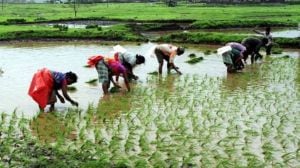
Pointing out that the tribals had stopped growing foodgrains and had started growing soyabeans because it was a cash crop, Jawdekar remarked that this had led to a shortage of foodgrains. 8220;They have to be encouraged to produce foodgrains,8221; he added.
The president of the Planning commission also felt that the attitude of the tribals had to be geared towards development. 8220;At present, only the younger generation is being educated. The older generation is still prejudiced. They have to be motivated, their orientation has to be changed towards progress,8221; he said.