3 min read

Journalism of Courage




India and Pakistan today committed themselves to a slow but sustained process to keep the dialogue going, in which New Delhi for the first time accepted the viability of an overland gas pipeline through Pakistan, and Islamabad agreed to hold a 8216;8216;meeting8217;8217; to discuss the modalities of a cross-LoC bus from Srinagar to Muzaffarabad.
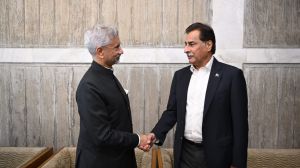
But even as the two foreign ministers Natwar Singh and Khurshid Kasuri drew up a roadmap for the immediate future, their two-day conversation was laced with major differences on the Kashmir question.
Such as, an Indian rejection of Islamabad8217;s proposal for a separate mechanism that would upgrade the talks on Kashmir to that of a 8216;8216;high representative,8217;8217; and expanding the high table so as to involve the Kashmiris in a 8216;8216;tripartite8217;8217; conversation.
So much so that an MEA spokesperson issued an official statement at the end of the long day, saying the PM had told Kasuri that we 8216;8216;already have mechanisms to discuss peace 038; security, including CBMs and Kashmir and it was agreed that we will use these mechanisms more purposefully.8217;8217;
The last part of the phrase was clearly an attempt at compromise, with New Delhi promising that it would not push 8216;8216;Kashmir8217;8217; under the carpet at the cost of only moving on confidence-building measures. Pakistan believes the Indian emphasis on CBMs is a trick to sidetrack the 8216;8216;centrality8217;8217; of the Kashmir 8216;8216;dispute.8217;8217;
Shorn of the diplomatese, New Delhi was insisting that the 8216;8216;composite dialogue8217;8217; was the only mechanism that could hold for bilateral talks. That India would talk to 8216;8216;its8217;8217; Kashmiris and Pakistan should take responsibility for its own. There was no question of allowing a third party a seat at this table for two. Despite the obvious differences, though, an informal road map has clearly been drawn up. The highlights of this are a meeting between Prime Minister Manmohan Singh and President Musharraf later this month, a visit by Pakistan prime minister Shaukat Aziz to India in November, the commencement of the second round of the composite dialogue in December, another meeting between the two heads at the SAARC summit in Dhaka in January and a return visit by Natwar Singh to Pakistan in February.
| nbsp; |
What they didn8217;t agree on
|
||||
| nbsp; |
8226; Pak wants 8216;higher8217; level of talks on Kashmir, India says let8217;s use composite dialogue more purposefully What they agree on Story continues below this ad |
nbsp; | |||
Consequently, there was hardly any reaction to Kasuri8217;s somewhat vivid description at the joint press conference, of how 8216;8216;it was a matter of common sense to tackle Kashmir if we want to return relations to an even keel.8217;8217;
Singh had spoken about India8217;s concerns, Kasuri said, and he was going to speak about the 8216;8216;human rights situation in Jammu 038; Kashmir, the significance of the words we use and the gloss we put on them. We8217;re all aware of the tension and the wars we fought as well as the near-war in 2002,8217;8217; he said. One manifestation of the pitched negotiations was the discussion over the Srinagar-Muzaffarabad bus. While New Delhi insisted there could not be different rules for Kashmiris and for the rest of the country, either on documentation or restrictions on travel, the Pakistani side insisted that only pre-1953-type permits would be allowed.
But after political direction from Singh and Kasuri, both sides agreed to hold a 8216;8216;meeting8217;8217; in the near future to discuss all modalities, both 8216;8216;political8217;8217; and 8216;8216;technical.8217;8217; This is likely to be reflected in the joint statement which will be issued when Kasuri returns home on Wednesday.